

The best way to track your habits is the system you will still be using in a month, and for most people that is the one that takes under two minutes a day. A paper habit tracker, an app, a calendar with X marks, a simple spreadsheet, and a bullet journal all work. They differ in cost, in how much they ask of you each day, and in how they handle a missed day. This guide compares all five side by side, then gives you a seven-day test so you can pick one with evidence instead of guessing.
One boundary before the systems: this article is about tracking itself, not about which habits to build. If you are still choosing which habits to build, start with the habits you want to track most, the ones that lift your mood and energy, then come back here and pick the tracker that fits them. Tracking a few habits well beats tracking twelve badly.

Why tracking helps, and where it starts to hurt
A written record does two useful things. It shows you what you actually did, which is often more than memory gives you credit for on a hard week. Research on implementation intentions shows that a written plan, deciding in advance when and where a habit happens, makes follow-through more likely than a vague intention alone. Tracking is the record of that plan: each mark is a small piece of evidence that habit formation is under way. And it turns a vague intention (“walk more”) into a visible pattern you can adjust. Many people find that the act of marking the day is itself a small reward, and that small reward helps the habit repeat.
Tracking turns against you when the record becomes a second job. The warning signs are plain: you track so many habits that the daily check-in takes ten minutes, a broken streak makes you want to quit altogether, or you spend more time decorating the tracker than doing the habit. If stress is already running high, a demanding tracker adds pressure instead of removing it. Our guide to dealing with stress and anxiety covers the wider picture; the short version here is that the tracker should serve the habit, never the other way round.
Habit building runs on the same three parts in every system. Tracking a behavior starts with a fixed set of habits, a fixed moment in the day when you record them, and a record you can see at a glance. Everything else, from streak flames to monthly charts, is decoration on those three parts. If a tracker you are considering cannot show you last week in five seconds, it is carrying more than the basics, and the extra weight will cost you on busy days.
Every habit you track is judged against the same standard: can you keep it going on your worst week, not your best one? That is the whole test.
The 5 habit tracking systems, side by side
| System | Cost | Time per day | Best for | Watch out for |
|---|---|---|---|---|
| Paper habit tracker | Free to the price of a notebook | About 1 minute | Beginners, screen-free evenings | Easy to misplace; no prompts |
| Habit app | Free tier usually enough; paid tiers vary | Under 1 minute | People who forget to check in | Streak pressure; notification overload |
| Calendar marks | Free (any wall or phone calendar) | Seconds | One single habit at a time | Only tracks one or two habits well |
| Spreadsheet | Free | 1–2 minutes | People who like totals and patterns | Setup time; feels like office work to some |
| Bullet journal | Pen and paper | 2–5 minutes | People who also journal or plan on paper | Layout envy; pages take time to draw |
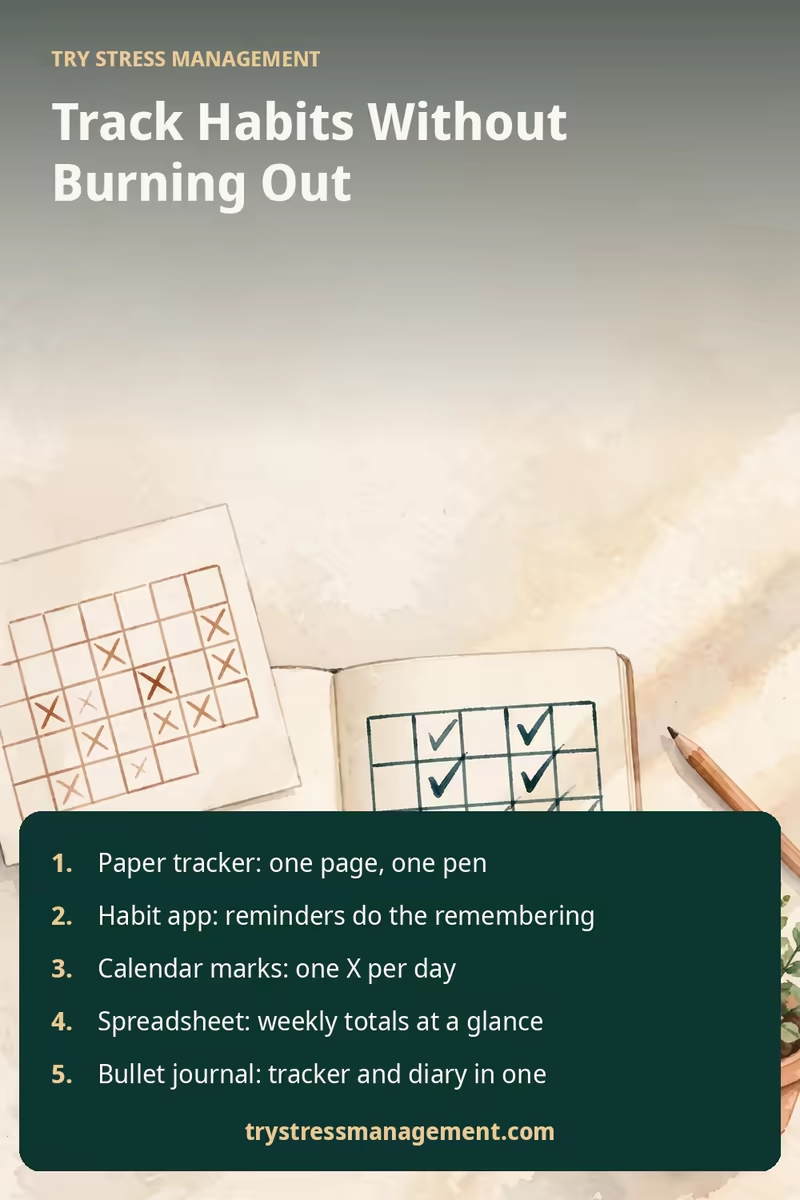
1. The paper tracker: one page, one pen
Draw a grid on one page: write your habits down the side, days of the month across the top. Mark each square when you do the habit, the same habit every day, even if the effort is small. That is the entire system, and its plainness is the point. Making the habit visible is the whole method; everything else is decoration. There is nothing to charge, sync, or update, and the page can live where the habit happens: on the fridge, by the kettle, next to the bed.
Paper suits beginners because the start-up cost is near zero and the record is visible all day without opening anything. Paper is also the simplest free habit tracker there is: no account, no app, no subscription. It also suits anyone trying to spend less time on their phone in the evening, since the check-in happens off-screen.
The weak spots are real. Paper sends no prompts, so pair the page with an existing cue, like marking it while the kettle boils. And a single page holds a month at most, so start a fresh page monthly and keep the old ones in a drawer. Looking back over three or four pages is a better progress check than any single week. Three or four months of pages is a better record of your monthly habits than any single week.
2. A habit app: reminders do the remembering
A habit tracker app holds your list, prompts you at the times you choose, and taps count as check-ins. Completing habits feels quick because the list is short. For people whose main problem is forgetting one particular habit, the reminder is the feature that matters; the charts are decoration. Most apps that offer a free tier cover a handful of habits, which is everything you need to track well. A good app should help you track without demanding attention: if it needs more than a minute a day, it is working against you. If you want a free habit tracker app, install one app only, the first plain-looking one, and try it for a week, and delete it if it nags you. Apps like these all promise the same thing, a streak, a chart, a nudge, but the best habit tracker app is the one you actually open, not the one with the most features. Opening the app should take two taps, not a hunt through folders. On an iPhone, a habit tracker app for iPhone can put the check-in on your wrist through the Apple Watch app, and some sync with Apple Health. Check the App Store listing for the free tier before you pay for anything. The habit tracker is the one that disappears into your day. If you notice the app more than the habit, switch.
Set the app up defensively. Keep reminders to one per habit, at a time tied to your routine, and silence everything else the app wants to send. If the app pushes streak warnings or shame-based messages, look for a setting to soften them, or pick a plainer app. A habit streak counter is information. The day it starts deciding whether you feel good about yourself, it has stopped being a tool.
A new app makes it easy to add habits on a motivated Sunday and drown by Thursday. Add one specific habit at a time, a week apart, and delete any habit you have stopped caring about instead of letting it sit there unmarked. Cut the list back to the habits you actually want. Whatever habits you want to keep, keep only those.
3. Calendar marks: one X per day
The oldest system on this list: put a calendar where you will see it, and draw an X on each day you do the habit. Some people write ‘track my habits’ at the top of the calendar. The words themselves are the cue to mark the day. After a few weeks the chain of X’s motivates you to continue, and a gap in the chain is honest feedback rather than a failure notice.
Calendar marks work best for a single habit, or two at most with different colored pens. The method’s limit is also its strength: there is no room for notes, totals, or nuance, so there is almost nothing to maintain. Make the check-in as easy as possible and it survives busy days. Seconds a day, done.
Choose this if you are rebuilding after a demanding tracker burned you out. A single habit, one calendar, one pen. Sometimes the right move is to use a habit tracker that asks almost nothing of you. When the chain feels steady after a month, you can graduate to a fuller system, or decide that simple was the answer all along.
4. A spreadsheet: weekly totals at a glance
A spreadsheet tracker is one row per day, one column per habit, and a 1 or 0 in each cell. A weekly sum at the end of each row group tells you how the week went without any judgment about individual days. People who think in numbers tend to trust this record more than a streak, because a 5-out-of-7 week reads as what it is: a good week.
Setup takes about fifteen minutes once: dates down the side, habits across the top, a sum formula for each week. After that, the daily cost is a minute of typing. Keep the file on your phone’s home screen, or use a mobile app that opens to the same grid, so opening it is never a project.
The risk is scope creep. A spreadsheet invites extra columns: mood scores, notes, ratings, minutes. It also tempts you to track daily tasks and recurring tasks in the same sheet. Keep those on a separate to-do list, or the tracker becomes a planner. Each one adds daily friction. Start with done-or-not columns only, and add a single extra column after a month only if you keep wishing it were there.
5. A bullet journal: tracker and diary in one
In a bullet journal, the monthly tracker sits inside the notebook you already use for plans and notes: one spread per month, habits listed down the side, days across the top, squares filled in as you go. If you already journal, this folds tracking into a ritual that exists, and the page next door gives you room to note why a day went sideways.
That context is the bullet journal’s real advantage. A paper grid tells you that you missed three walks; a journal page can tell you those were the three days your kid was sick, which changes what the misses mean and what you do next. It is also the natural home for journaling alongside tracking: a line about why the day went sideways turns the record into a short diary, and that diary is what makes the habit stick.
The cost is time and temptation. Drawing each month’s spread takes a few minutes, and social media is full of elaborate tracker art that has nothing to do with whether the habit happened. Linking a new habit to one you already do gives it a cue it can ride on. Rule for this site: the spread gets drawn in under five minutes, with a ruler if you like, and decoration is allowed only after the month’s marks are in.
How to choose: run a seven-day test
Reading about systems will not tell you which one fits your life. A week of using one will. If you want ways to stay with it past the first week, pick the system from the table that matches your situation, track a maximum of 3 habits for seven days, and then answer three questions honestly. The point is to learn how you track habits when life gets busy, not to build a perfect record.
- Did the daily check-in stay under two minutes?
- Did you remember to check in without effort by day five?
- When you missed a day, did the system make it easy to just continue?
Habit stacking makes the first week easier. James Clear’s Atomic Habits popularized the idea: link a new habit to one you already do, so the old habit becomes the cue. A glass of water with breakfast, or brush your teeth in the morning and then mark the square. It happens right after the old one, and that pairing is easier to keep than willpower alone. BJ Fogg’s work on tiny habits makes the same point from the other side: make the habit small enough that skipping it feels stranger than doing it. Forming new habits takes repetition, not intensity. The tracker just makes the repetition visible.
No tracker builds the habit for you. A tracker does not build habits; it records them. The best any system can do is help you build the routine around it: same time, same place, same mark. Then it stays out of the way. The goal is better habits, not a better record. Make habit tracking boring: the same mark, the same time, every day.
One more setup choice matters as much as the system itself: where the tracker lives. Put it where the last habit of the day happens, or where your morning starts, so the check-in attaches to a moment that already exists. Pick a tracker that lets you see your daily progress in one glance. If the record hides behind three screens, the tracker is hiding the very thing it exists to show. A paper page in a drawer and an app buried three folders deep both fail the same way, quietly, by being out of sight on the exact day you were tired. During the test week, treat placement as part of the experiment. If you forget twice, move the tracker before you blame your discipline.
If the day itself feels too crowded for even a two-minute check-in, the fix is usually a slot, not more willpower. Our quick time management tips to crush stress show how to protect one small window in the day and let the rest flex around it.
Three yeses mean you have your system; keep it for a full month before changing anything. A no points at the fix. Check-ins too slow means the system is too heavy, so drop a level: app to paper, spreadsheet to calendar. Forgotten check-ins mean you need a cue or a reminder, so move the tracker to where the habit happens or use an app with one daily prompt. A missed day that felt heavy means streak pressure is the problem, and a weekly-total view like the spreadsheet’s will treat you better. If you miss a day, mark it honestly and move on. One gap does not erase a month of marks. Get back on track the next morning and the record keeps working.
Habit tracking tips that keep the whole thing light
Track fewer habits than you want to. Three habits is a working maximum for most people. Each added habit raises the daily cost of the record, and the record is what has to survive your worst week. Five habits at once is how most trackers die in the second week. You can also track sleep or steps alongside them, but they do not count toward the three.
Cap the check-in at two minutes. If marking the day takes longer, the system is asking for data you will not use. The tracking method matters less than the check-in itself: cut fields, columns, and notes until two minutes is generous.
Decide your missed-day rule in advance. A workable rule: a missed day gets a dot instead of a mark, and the only job the next day is one mark. Never miss twice is a decent motto, but treat it as a nudge, not a verdict. Life will hand you a flu, a deadline, or a family emergency, and the tracker should bend around all three.
Review weekly, not constantly. Pick one five-minute slot, Sunday coffee or Friday lunch, and look at the week’s pattern then. Ask what got in the way (a late meeting, a sick kid, a day when daily activities simply ran long) and what made the easy days easy. Checking the record multiple times per day turns a tool into a scoreboard you live under. A weekly review is also when you check off habits you have finished building and retire them from the list. It works when the record stays honest and the check-in stays short; habit tracking works best when the system disappears into the day.
Let the cheapest option win ties. Every system in this guide has a free version that works. A free habit app costs nothing, and paper costs nothing either. Paid tiers add charts and themes, and neither one marks the square for you. Spend money only after a free month proves you will use the thing.
And a note on where tracking sits in a calmer day overall: the habits worth tracking are usually small, repeatable, and tied to a healthy lifestyle (small things that make the day feel steadier). The habits that steady mood and energy are a good starting set of three. Choose them first, then let the tracker stay boring.
Free printable: Sleep Better Tonight
A 10-minute evening wind-down on one page: dim lights, screens off, tomorrow’s worries onto paper, a gentle stretch, and slow breathing. An evening routine is one of the easiest habits to track, because it happens at the same time every day. Join the free email list and the PDF arrives in your inbox. Print it and keep it by the bed.
Frequently asked questions
What is the simplest way to track daily habits? Calendar marks. One calendar, one habit, one X per day takes seconds and asks nothing else of you. If you want to track up to three at once, a one-page paper grid is nearly as simple and holds more.
How many habits should I track at once? Start with one to three. More than that raises the daily cost of checking in, and a tracker that feels expensive gets dropped. Add another only after the current ones have run for a few weeks without much thought.
Are habit tracking apps worth paying for? For most people, no. Free tiers cover a small habit list, prompts, and a calendar view, which is everything the method needs. Pay only if a specific paid feature solves a problem you have actually hit during a free month of use.
What should I do when I break a streak? Mark the day honestly and do the habit the next day. A streak is a record, not a grade, and one gap in a month of marks still describes a month of practice. If broken streaks make you want to quit entirely, switch to a weekly-total system like the spreadsheet, where a 5-out-of-7 week reads as success.
How long before habit tracking feels automatic? It varies widely from person to person and habit to habit. A practical checkpoint is four weeks: by then the check-in itself should feel routine, even if the habit is still effortful. If the tracking still feels like work at four weeks, the system is too heavy, and dropping to a simpler one is the right move.
This article is general educational information about organizing daily routines. It is not medical or mental health advice. If stress or low mood is persistent or getting worse, a qualified professional can help you work out what support fits.

Hi, I’m Sophia! Welcome to my blog Try Stress Management (trystressmanagement.com), where I share simple, down-to-earth ways to handle stress and bring more calm into everyday life. Think of me as your friendly guide, offering practical tips, reflections, and little reminders that we’re all figuring this out together.
When I’m not blogging, you’ll usually find me with a good book, sipping tea, or exploring new walking trails. I believe small changes can make a big difference—and that a calmer, happier life is possible for everyone.