

This is Part 3 of Sleep Better Tonight, our five-part series on building an evening that actually leads to sleep. Each part stands on its own, and each one adds a piece of the routine. Part 2 covered light and screens, and Part 1 set out the 10-minute wind-down routine this series is built on.
A paper wind-down helps racing thoughts at bedtime because it moves unfinished business out of your head and onto a page you can close. Fifteen minutes, a pen, and three prompts, no app, no purchase, nothing to download: write down what is still open, name the next small step for each item, and park the rest until morning. Then close the notebook, set the alarm once, and let your body take over. It works best on the nights your mind will not switch off, and it costs nothing to try tonight.
Why can’t I stop thinking at bedtime?
The quiet of bedtime is when unfinished tasks get loud. During the day, work, conversation, and movement keep your attention busy. Once the lights go out, there is nothing left to compete with the list of things you did not finish: the email you never sent, the conversation you keep replaying, the appointment you still need to book. Psychologists call the pull of unfinished tasks the Zeigarnik effect: open loops hold attention more than closed ones. At night, with no new input arriving, those loops can run for hours. Racing thoughts at night follow a pattern: an open loop, a rehearsal, and a mind that stays on duty. Once you recognize the pattern, you can interrupt it on paper instead of arguing with it in the dark.
Overthinking at bedtime usually traces back to unfinished business. Anxious thoughts tend to arrive as a queue, not one at a time, and a cognitive model of insomnia described by researcher Allison Harvey points to worry and rumination as one of the drivers that keep arousal high at bedtime: the mind scans for threats, finds the unfinished list, and stays alert to deal with it. Harvey’s model, published in Behaviour Research and Therapy in 2002, treats that nighttime mental activity as a normal process that can get stuck, not as a personal failure. Telling your mind to stop racing rarely works; the loop is doing a job, badly. The paper wind-down works with that process instead of fighting it: it gives each open loop a place to sit until morning.
There is also direct evidence that writing helps. In a 2018 sleep-lab study, 57 healthy young adults wrote for five minutes before the overnight sleep recording. Those who wrote a specific to-do list for the next few days fell asleep faster than those who wrote about tasks they had already finished, and the more specific the to-do list, the faster sleep came, whereas the opposite trend was observed when participants wrote about completed activities. Scullin and colleagues reported the result in the Journal of Experimental Psychology: General. The study was small and used healthy young adults in a lab, so it does not prove the same result for everyone at home. But the direction fits what many people notice on their own: writing the list down can help you sleep, because the mind stops rehearsing what the page now holds. For anyone trying to sleep with a busy mind, the practical lesson is simple: write the list down, and write it specifically.
Two other things are worth checking before you blame the thoughts themselves: caffeine late in the day, and a glowing screen in the last hour. Both can affect your sleep, and both are easier to change than a busy mind.
Writing about stressful events has a longer research history, too. In a 1986 study, students who wrote about personal upheavals for fifteen minutes a night over four nights made fewer health-centre visits in the months that followed than students who wrote about trivial topics. Pennebaker and Beall published the finding in the Journal of Abnormal Psychology. That study was small, early, and about general health rather than sleep, so it is background rather than proof. It does suggest that putting difficult thoughts into words can loosen their grip, which is the same mechanism this wind-down relies on.
If your main problem is a racing mind rather than a to-do list, start with our wind-down routine for racing thoughts, which pairs slow breathing with the same idea: give the mind a job, then give it a stopping point. The paper wind-down below is the written version of that job, and it is the piece Part 3 adds to the series.
The 15-minute paper wind-down, minute by minute
Do this in the last fifteen minutes before bed, in a quiet place with the lights low and screens off, as part of your bedtime routine. The routine below can help you manage the nights your mind will not switch off. Use paper, not a phone: a notebook by the bed keeps the routine in one place and keeps the glow out of the last minutes of the day. Keep the same notebook every night so the routine becomes a habit rather than a decision.
Minutes 0–3: Dump the day onto the page
Write fast and do not edit. Put down everything that is still buzzing: tasks, worries, half-formed thoughts, the thing someone said at lunch that you keep replaying. Spelling and handwriting do not matter. Nobody reads this but you, and you do not need to read it again either. The point of the dump is to get the noise out of your head and into a place where it stays put. Three minutes is enough. Set a timer if you need a boundary, and stop when it rings.
Minutes 3–8: Three prompts that move worries off your mind
Now turn the dump into something you can close. Work through three prompts, one at a time, writing a line or two for each:
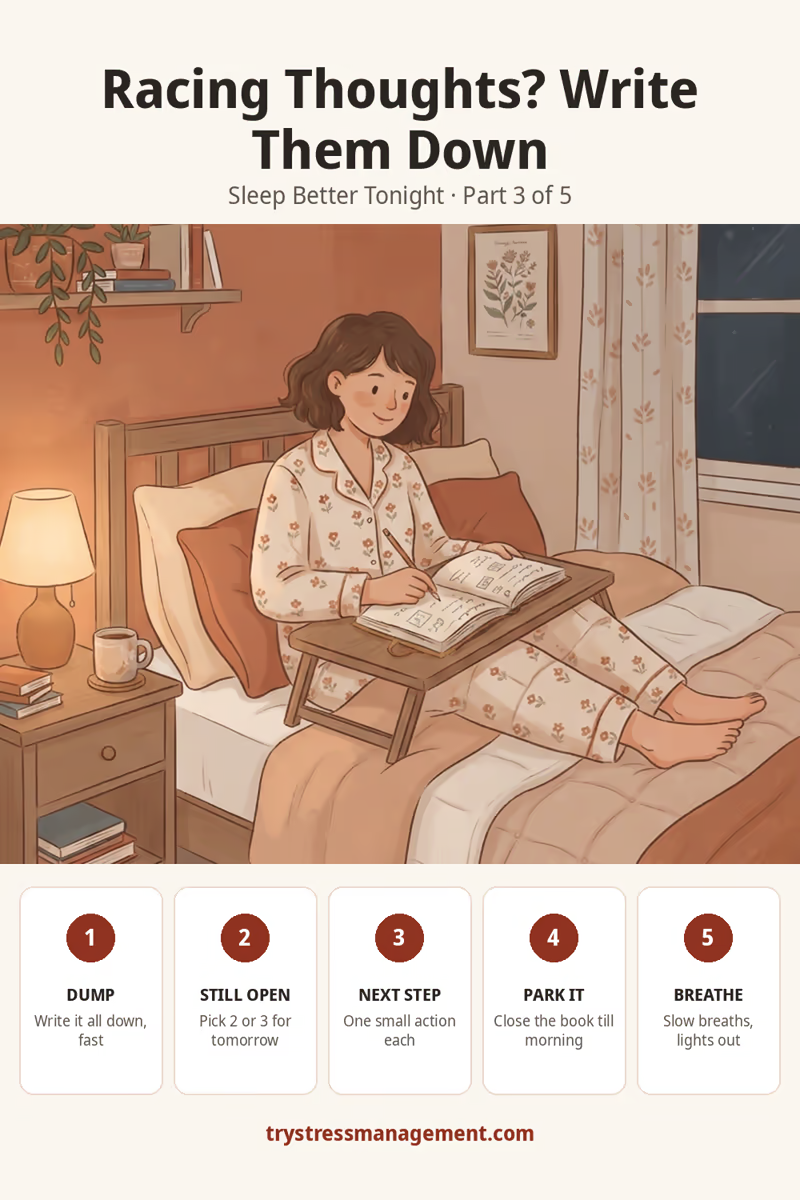
Prompt 1 — What is still open? Pick the two or three items from the dump that need attention tomorrow. Not ten items; two or three. If the list is long, the rest can wait, and saying so on paper is part of the exercise.
Prompt 2 — What is the next small step? For each open item, write the smallest concrete next step: “email Sam about the invoice,” not “sort out work.” A vague worry cannot be closed; a named next step can. This is the step the sleep-lab study points to: specificity is what lets the mind let go.
Prompt 3 — What can wait until morning? Write the rest down under a line that says “tomorrow.” The sentence does not need to solve anything. It only needs to record that the item has a place, so your brain does not have to keep holding it. Cross nothing out. The page is a parking lot.
Minutes 8–12: Park it — close the notebook, park the alarm
Close the notebook and put it somewhere you will see it in the morning, on top of your keys or by the coffee maker. The physical act of closing it is the signal that the day’s business is filed, a small reset that tells the evening the work is done, so the body can relax into the night. Then deal with the alarm, because for many people the alarm itself is the last open loop. Set it once, say the time out loud (“alarm set for 6:30”), and put the phone face down or in another room. If you check the alarm three times, the checking becomes the worry. One set, one sentence, done.
Minutes 12–15: One slow breath, lights out
Finish the way Part 1’s routine finishes: add one minute of muscle relaxation first. Tense your shoulders, hold for five seconds, and let them drop, then slow your breathing, four counts in and six counts out, shoulders down on the exhale. If counting helps, the 4-7-8 breathing technique (in for four, hold for seven, out for eight) is one pattern some people find calming. Then lights out. If a thought surfaces after the lights are off, you have two choices: let it pass, or turn the lamp back on, add one line to the notebook, and close it again. The second choice is the routine working — the notebook is there for exactly that.
Your printable 3-prompt checklist
Copy this onto a card and keep it inside the front of the notebook. It is the whole wind-down on one page. The paper wind-down is a grounding habit, and the same steps each night are what make it stick:
- Dump (3 minutes): write everything still buzzing, fast, no editing.
- Prompt 1 — What is still open? Pick two or three items that need attention tomorrow.
- Prompt 2 — What is the next small step? One concrete action per open item.
- Prompt 3 — What can wait until morning? Write the rest under “tomorrow” and leave it there.
- Park it: close the notebook where you will see it in the morning.
- Park the alarm: set it once, say the time out loud, phone face down.
- Breathe: four slow breaths, in for four, out for six. Lights out.
Use it for a week and notice which nights you sleep better.
The alarm problem: when the clock itself keeps you up
Some nights the racing thought is not a task at all. It is the alarm: the fear of oversleeping, of missing the start of the day, of the sound itself. Readers have described it plainly: unable to sleep with an alarm set because the pressure of the time makes the heart pound. That pressure is real, and it has a practical answer: make the alarm a decision you take once, early, instead of a question you keep asking.
Set the alarm when you start the wind-down, not when you get into bed. Say the time out loud as you set it. Then move the phone out of reach, or turn the clock face to the wall. Checking the time through the night feeds the loop. Each glance restarts the calculation of how many hours are left, so removing the display removes the trigger. If you wake in the night, resist the check: the notebook is closed, the alarm is set, and there is nothing to calculate. If mornings genuinely worry you, a second alarm as a backup, set once and left alone, can quiet the fear without adding a new ritual.
When the page stays blank
Some nights you will sit down and nothing comes. That is common, and it is not a sign the routine failed. A blank page on a calm night means there is little to park. On restless nights, one line is enough. Try one of these sentence starters and stop after a line or two:
- “Today went well when…”
- “The one thing I keep coming back to is…”
- “Tomorrow would feel easier if…”
- “I am letting go of… until morning.”
If even one line feels forced, close the notebook and move to the breathing. The wind-down is a tool for busy nights. On quiet, peaceful nights, the shorter version is the right version.
For more ways to use writing as a wind-down, journaling prompts can give a stuck evening a starting point: pick one prompt, write for five minutes, and stop. The series hub, How to Sleep Better with Anxiety & Stress, gathers the rest of the library in one place, including the breathing and light routines the other parts cover.
When racing thoughts are nightly
A paper wind-down helps with ordinary busy-mind nights. It is not a treatment, and it will not fix persistent sleep trouble that has been going on for weeks. If a busy mind keeps you awake most nights, if you are regularly lying awake for more than half an hour or finding it hard to stay asleep, or if poor sleep is starting to interfere with your days, that is worth a conversation with a qualified healthcare professional. That is the point to seek professional support, not to push through alone. Ongoing trouble sleeping can have many causes, and a professional can help sort out which ones apply to you. The routine above is still useful while you wait: it gives the evenings structure, but it is a support, not a substitute for that conversation.
If sleep troubles are part of a wider pattern of stress or mental health concerns, the hub covers the other pieces of the evening (light, temperature, breathing, and the fixed wake time that anchors the whole routine), so you can build the version that fits your nights.
Want the full Sleep Better Tonight routine on one printable page? Join the free email list at https://trystressmanagement.com/subscribe/ and the PDF arrives in your inbox.
Free printable: Sleep Better Tonight
The 3-prompt paper wind-down on one page: dump the day, name the next small step, park the rest until morning, plus the park-the-alarm routine for nights when the clock itself keeps you up. Join the free email list and the PDF arrives in your inbox. Print it and keep it by the bed.
Frequently asked questions
Does journaling before bed actually help you fall asleep?
Some research suggests it can, for some people. In a small sleep-lab study, writing a specific to-do list for five minutes before bed helped healthy young adults fall asleep faster than writing about completed tasks. The study measured how fast people go to sleep, not how rested they felt the next day. The effect is modest and the study was small, so treat it as a promising routine to try, not a guarantee.
What should I write about if my thoughts are worries, not tasks?
Write the worry down, then write the next small step attached to it. “Worried about the meeting” becomes “email Sam the agenda by 9 a.m.” If there is no step to take, write the worry under “tomorrow” and close the notebook. Give the thought a place instead of solving it at midnight. Writing it down helps calm your mind for the night.
How long should the paper wind-down take?
Fifteen minutes is the full version: three minutes to dump, five for the three prompts, four to park the notebook and the alarm, and three to breathe and switch the light off. Ten minutes covers most busy nights, and fifteen covers the worst ones. On quiet nights, five minutes is enough. Rushing the prompts is what leaves loops open.
Is it better to write on paper or type on my phone?
Paper, for this routine. A phone brings light and notifications into the last minutes of the day, and the phone is often the thing the wind-down is winding down from. A cheap notebook by the bed does the job, and the act of closing it is part of the signal.
What if I wake up at 3 a.m. with a new worry?
Keep the notebook and a pen within reach. Write one line, close the notebook, and lie back down. Do not turn on a bright light or open your phone to “just check one thing.” Keep the nighttime light low and the room dark.
What if I still can’t sleep after the wind-down?
Get up, keep the lights low, and do something quiet for twenty minutes: a few pages of a book, a short distraction that breaks the loop. Then try sleep again. Do not open your phone or start working. If thoughts may keep coming, write one more line in the notebook and close it again. If this happens most nights, talk to a qualified healthcare professional.
Can a warm shower in the evening help?
A warm shower an hour or so before bed helps some people feel sleepy as their body cools down afterwards. It is a small comfort. Part 4 of this series covers temperature in detail.
This article is general educational information about sleep and wellness, not medical advice. If you have ongoing trouble sleeping, a health condition, or concerns about your sleep, please talk to a qualified healthcare professional.
The Sleep Better Tonight series
- Part 1: The 10-Minute Wind-Down Routine
- Part 2: Light and Screens — Dim Your Way to Sleepy
- Part 3: Racing Thoughts at Bedtime — A Paper Wind-Down (you are here)
- Still to come: the warm-body cool-down, and a 3-minute version of the routine for busy nights
The full sleep library lives on the series hub: How to Sleep Better with Anxiety & Stress.
Sources
- Scullin, M. K., Krueger, M. L., Ballard, H. K., Pruett, N., & Bliwise, D. L. (2018). The effects of bedtime writing on difficulty falling asleep: A polysomnographic study comparing to-do lists and completed activity lists. Journal of Experimental Psychology: General, 147(1), 139–146. https://doi.org/10.1037/xge0000374
- Pennebaker, J. W., & Beall, S. K. (1986). Confronting a traumatic event: Toward an understanding of inhibition and disease. Journal of Abnormal Psychology, 95(3), 274–281. https://doi.org/10.1037/0021-843X.95.3.274
- Harvey, A. G. (2002). A cognitive model of insomnia. Behaviour Research and Therapy, 40(8), 869–893. https://doi.org/10.1016/S0005-7967(01)00061-4

Hi, I’m Sophia! Welcome to my blog Try Stress Management (trystressmanagement.com), where I share simple, down-to-earth ways to handle stress and bring more calm into everyday life. Think of me as your friendly guide, offering practical tips, reflections, and little reminders that we’re all figuring this out together.
When I’m not blogging, you’ll usually find me with a good book, sipping tea, or exploring new walking trails. I believe small changes can make a big difference—and that a calmer, happier life is possible for everyone.