

The busiest Thanksgiving travel days this year are Tuesday, November 24 and Wednesday, November 25, and the worst of it lands in the afternoon and evening. AAA’s Thanksgiving forecast, released November 16, projects 81.5 million people traveling at least 50 miles from home between Tuesday, November 24 and Monday, November 30. About 72.9 million of them will drive, and 5.96 million will take domestic flights. If your trip falls on one of those two peak days, most of the stress is a timing problem, and timing is something you can plan around. Below is a calm plan for the drive, a calm plan for the flight, and a short reset to use when a delay happens anyway.

The two windows that cause most of the stress
AAA expects the heaviest congestion on Tuesday and Wednesday afternoons and evenings, when people leave work and head straight out of town. City highways clog first, airport lines build through the afternoon, and a trip that takes three hours on a normal week can take five. The same two days have calmer edges. Mornings run lighter on both days, and Thanksgiving morning itself is often the quietest drive of the whole week. If your plans have any give in them, moving your departure to the morning is the single change that removes the most stress.
The two modes peak at slightly different hours. On the roads, the squeeze builds from late morning and is worst from mid-afternoon into the early evening, as long-distance drivers mix with local commuters. At airports, the pressure comes in waves tied to flight banks: early morning departures are busy but move, while afternoon and evening flights stack up delays as the day’s problems accumulate. A morning flight that runs late is an inconvenience. An evening flight after a day of knock-on delays is where cancellations live. If you are booking or rebooking, earlier in the day is the safer seat.
It also helps to say the quiet part out loud before you leave: this trip will probably take longer than the map says. A driver who expects five hours and gets four feels lucky. A driver who expects three and gets five feels cheated by the road. Same traffic, different day. Set the expectation early, tell the people waiting for you the longer estimate, and let any time you save be a pleasant surprise instead of a debt you owe the schedule.
A calm plan for the drive
Leave before the window, or after it. On Tuesday, try to be on the road before midday. On Wednesday, a morning departure beats an afternoon one by hours. If work makes both impossible, waiting until the evening rush thins out, around 8 p.m., can be calmer than joining the 4 p.m. crawl, as long as you are not too tired to drive safely. A late arrival with steady nerves is better than an early one that costs you the whole evening.
Finish the car the night before. Fuel up, check the tires, load everything that does not need to stay cold. Ten unhurried minutes on Monday night buy you a slow Tuesday morning, and a slow morning is where a calm trip starts.
Plan a stop about every two hours. Ten minutes out of the car, a short walk, water, a bathroom. Planned stops feel restful. Forced stops, the kind where everyone is desperate and the next exit is nine miles away, feel like emergencies. Put the stops on the route before you leave, and treat them as part of the trip rather than delays to it. If you are driving with children, the two-hour rhythm matters even more: a stop they can count on is easier than an open-ended “soon.”
Keep the right things in reach. Water and snacks in the cabin, a phone charger, tissues, a small bag for trash, and any medication in your bag rather than in the trunk. Download maps and music before you leave, in case the signal drops in a rural stretch. If you have a passenger, hand them the phone and the navigation entirely. The driver drives. Nothing spikes stress like trying to read a rerouting alert at highway speed.
Give your host a window, not a promise. “We should be there between 6 and 8” is honest on a peak travel day. “We’ll be there at 6” turns every slow mile into a small failure. People plan dinner around what you tell them, and a realistic window protects both their evening and your mood.
A calm plan for the flight
Arrive earlier than feels necessary. On Tuesday and Wednesday, treat two hours before a domestic departure as the floor, and three hours if you are checking bags, parking at the airport, or traveling with children. The buffer is the point. A slow security line with an hour in hand is an annoyance. The same line with twenty minutes in hand is a crisis, and you will carry that tension onto the plane.
Do the paperwork the night before. Check in online as soon as your airline opens it, download your boarding pass, and take a screenshot in case the app or the airport Wi-Fi misbehaves. Weigh your bag at home if it feels close to the limit. Small surprises at the counter are what turn a busy day into a bad one.
Pack a small calm kit in your carry-on. An empty water bottle to fill after security, real snacks rather than a plan to find food, headphones, a warm layer for a cold cabin, a charger and cable, something to read or watch that you downloaded at home, and any medication in your personal item where it stays with you even if your bag is gate-checked. If your checked luggage is delayed, that kit is the difference between a shrug and a scramble.
Give connections room. If your trip includes a layover, a tight connection is a gamble on the two busiest days of the year. An hour or more between flights gives a late first leg somewhere to land without ending your trip. If you are already booked on a short connection, find the later backup flight on the same route before you travel, so you know your Plan B by heart instead of researching it at a run.
Turn the alerts on. Install your airline’s app, add your flight, and switch on notifications. On the morning of travel, check where your aircraft is coming from: a late inbound plane tells you more about your departure than the departure board does. Knowing early is almost always calmer than finding out at the gate.
Free printable: Sleep Better Tonight
A 10-minute evening wind-down on one page: dim lights, screens off, tomorrow’s worries onto paper, a gentle stretch, and slow breathing. Join the free email list and the PDF arrives in your inbox. Print it and keep it by the bed.
When a delay hits: a four-step reset
Delays are likely this week, and a delay handled in a steady order feels very different from one handled in a spiral. Use the same four steps each time.
1. Breathe before you act. One slow minute first: in through your nose, out slowly, letting the exhale run longer than the inhale. It sounds too simple to matter, but it settles the surge that makes people snap at gate agents and say things they regret. Our guide to dealing with stress and anxiety covers the longer version of this kind of reset.
2. Rebook from the app while you stand in line. If your flight is cancelled or badly delayed, open the airline app and look at your options while you queue for the desk. App rebooking often shows the same seats the agent sees, and you can hold one before you reach the front. Drivers have a version of this too: reroute early, before you reach the jam, even if the new route adds miles. Moving slowly on a clear road beats sitting still on a blocked one.
3. Eat something and drink water. Hunger and dehydration make every setback feel bigger. Buy the snack before you think you need it, fill the water bottle, and sit down to eat it if you can. Ten seated minutes with food resets more than your blood sugar; it gives your brain a small, finished task in the middle of an unfinished day.
4. Message your host with the new ETA. One honest text, sent early: “Flight delayed, new arrival looks like 7:30. Please start dinner without us if you need to.” That single message removes the pressure of people waiting and wondering, and it stops you from refreshing the departure board on their behalf. Then put the phone away for a while.
One last thing worth remembering in the moment: a delay costs you time, not the holiday. Dinner tastes the same at eight as it would have at six, and the people you are traveling to see would rather have you arrive calm and late than rattled and slightly less late. If the trip home on Sunday is already on your mind, our day-after-Thanksgiving recovery guide covers the other end of the week.
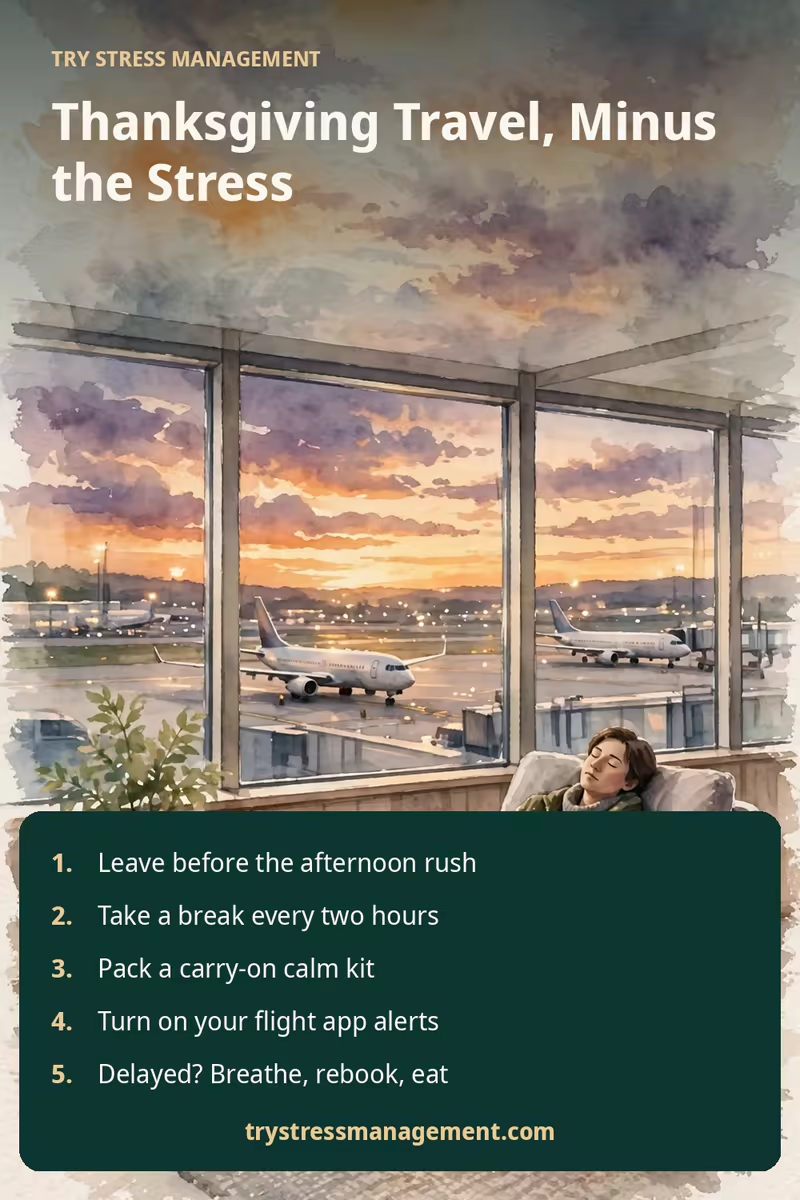
Frequently asked questions
What are the worst days to travel for Thanksgiving this year?
According to AAA’s forecast, Tuesday, November 24 and Wednesday, November 25 bring the heaviest congestion, especially in the afternoon and evening. The Sunday after Thanksgiving is usually one of the busiest return days, so the same morning-departure advice applies on the way home.
What time should I leave on Wednesday to avoid the worst traffic?
Morning is the safest bet, ideally before midday. If you cannot leave until later, waiting until the evening rush thins, around 8 p.m., is usually calmer than leaving between 3 and 6 p.m. Build in extra time either way, and plan a stop about every two hours.
How early should I get to the airport on Tuesday or Wednesday?
At least two hours before a domestic flight, and closer to three if you are checking bags, parking, or traveling with children. Those are the two busiest days of the travel week, and the extra buffer is what keeps a long line from becoming a missed flight.
What should I do first when my flight is delayed?
Take a minute to breathe, then check your airline’s app for rebooking options while you stand in line for the desk. Eat something, drink water, and text your host your new arrival time early. Acting in that order keeps the delay a logistics problem instead of an emotional one.
How do I keep the trip calmer with kids along?
Keep the same plan, and make it visible to them. Children handle travel better when the day has a shape they can follow: we stop here for a break, we eat at this town, we arrive before dinner. Pack their snacks and entertainment in their reach, download shows before you leave rather than trusting the signal, and keep one comfort item out of the trunk. When a delay hits, tell them the new plan in the same calm terms you would want yourself: what changed, what happens next, and when the next snack is.
Is driving on Thanksgiving morning a better idea?
For many people, yes. Thanksgiving morning is often the quietest drive of the week, and you can still arrive by lunch. It suits shorter trips best, and it trades an early start for empty roads, which is a good trade if your household can manage it.
This article is general educational information about handling travel stress, not medical advice. Everyone’s situation is different, and these suggestions do not replace guidance from a qualified professional. If travel anxiety feels severe or persistent, or stress is interfering with daily life, consider talking with a healthcare professional or a licensed therapist. And one practical note: never handle your phone while driving. Let a passenger manage messages and rerouting, or pull over safely first.

Hi, I’m Sophia! Welcome to my blog Try Stress Management (trystressmanagement.com), where I share simple, down-to-earth ways to handle stress and bring more calm into everyday life. Think of me as your friendly guide, offering practical tips, reflections, and little reminders that we’re all figuring this out together.
When I’m not blogging, you’ll usually find me with a good book, sipping tea, or exploring new walking trails. I believe small changes can make a big difference—and that a calmer, happier life is possible for everyone.