

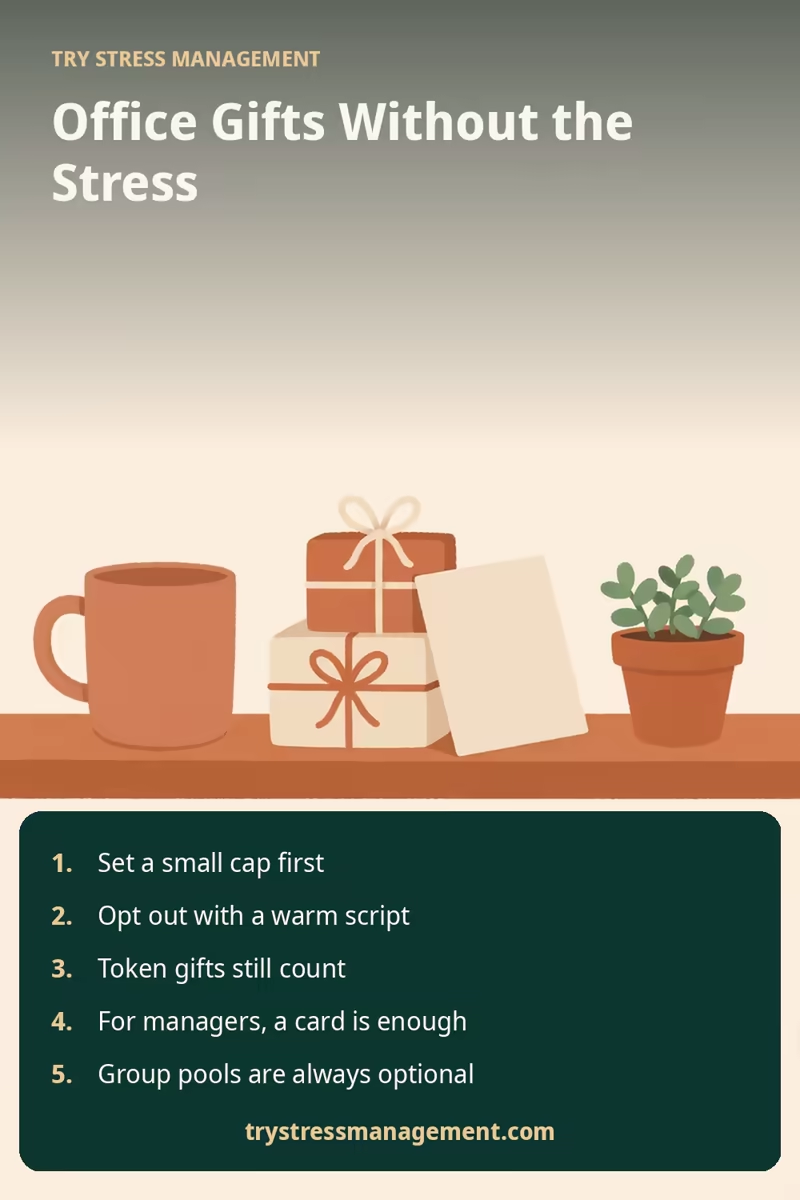
You do not have to buy workplace holiday gifts, and you do not have to join every exchange or gift pool that circulates in December. The calm approach is simple: decide one small spending cap for work gifts before the invitations start, stick to it, and use a short, warm script when you opt out. For your manager, a card is enough. Those four habits cover nearly every situation the season brings.
If the expectations feel heavy, you are not imagining it. In the Zety Workplace Holiday Gifting Report, a survey of 1,040 U.S. workers conducted through Pollfish on October 19, 2026, 43% of workers said workplace holiday gift expectations cause them financial stress, and 45% said they have felt obligated to buy a gift for a coworker or contribute to one. The pressure is common. It is also optional in most workplaces, once you look at how the unwritten rules actually work.

Why workplace gift-giving feels so loaded
Workplace gifts carry weight that family gifts do not. The exchange happens in public, in front of people who affect your working life. A sign-up sheet on the break-room wall turns a private money decision into a visible one, and nobody wants to be the only name missing from the list. Reciprocity adds a second squeeze: if a coworker hands you something wrapped, the urge to match it arrives instantly, whether or not you planned for it.
The expectations people fear are usually bigger than the expectations people hold. In the same Zety survey, 53% of workers said they do not expect a holiday gift from their employer, and 77% said they would prefer a cash bonus to a gift. Most colleagues are not keeping score. A modest gesture, given warmly, lands fine. A polite pass is forgotten by January.
Set your workplace spending cap before anyone asks
Pick the number early, ideally before the first sign-up sheet appears. A cap chosen in a calm moment holds; a cap improvised in front of the sheet, with a coworker waiting, tends to drift upward. Decide one total for all workplace giving combined (the exchange, any group pools, and any individual gifts you want to give) and let that single number answer every invitation that follows.
Keep the workplace total separate from your personal gift list. Family and friends are a different budget line, with different stakes. If you have not set that one yet, our guide to deciding your holiday gift budget before you shop walks through picking the personal total first, so the two numbers do not blur together in a December checkout line.
Then break the workplace total into a rough per-event guide. If your cap is the total and you expect two events, each event gets about half. Write the number down somewhere you will see it: a notes app, a calendar entry for December 1. When an invitation arrives, the question changes from “how much should I spend?” to “does this fit the cap?”, which is a much easier question to answer. If the cap is small, that is fine. The rest of this guide is about spending small amounts well, or spending nothing at all without awkwardness.
How to opt out of a gift exchange, with exact words
Opting out works best when it is early, short and warm. Reply before the organizer’s deadline, so pairs or lists can be finalized without you. Thank the organizer, state your pass in one line, and, if you want, attach yourself to the social part of the event instead. You do not need to give a reason, and a detailed reason invites negotiation.
For a Secret Santa or exchange sign-up:
“Thanks for organizing this. I’m keeping gifts simple this year, so I’ll sit this one out, but count me in for the team lunch.”
If someone asks directly why you are not taking part:
“Nothing’s wrong — I’m trimming holiday spending across the board this year.”
Then change the subject. The line works because it is about your December, not about the exchange or the people in it. If you would rather reshape the event than leave it, propose a cheaper format. Organizers are often relieved to hear it, because they have heard the same quiet complaints you have:
“Would people be up for a card exchange or a cookie swap this year instead of bought gifts? Happy to help organize.”
That version lowers the cost for everyone, and it puts you on the contributing side of the event rather than the refusing side.
Token gift ideas that still feel thoughtful
A token gift succeeds on specificity, not price. The strongest cheap option is a card that names something real: the afternoon a coworker stayed late to fix your slide deck, the notes they shared before your presentation, the cover they ran during your week off. Two concrete sentences in a card are remembered longer than most wrapped objects.
- A card with a specific thank-you. Name the moment and what it meant. No generic “thanks for everything.”
- Something homemade. Cookies, spiced nuts, a small loaf. Add a short ingredient note, since allergies are common and the note itself reads as care.
- Their usual coffee or tea. Showing up one morning with the drink they actually order says you pay attention.
- A small living thing. A plant cutting in a jar or a tiny desk plant costs very little and stays visible for months.
How you hand it over matters as much as the object. Give it without apology; “sorry, it’s only small” undercuts a perfectly good gift. A plain “I saw this and thought of you” is the whole ceremony a token gift needs.
If you do decide to buy, keep it ordinary. Most gift ideas lists push novelty, and novelty is what ends up in a drawer. The christmas gifts for coworkers that land best are useful, small, and easy to hand over at a desk. Drop the hunt for the perfect gift; a practical gift someone uses on an ordinary Tuesday does more than a clever one. The trick is to combine practicality with one specific detail that shows you know the person.
Drinkware is the classic category for a reason. A plain mug for the desk, a coffee mug in the color they always reach for, travel mugs for the commuter, or one sturdy tumbler all get used daily. If you go the tumbler route, a vacuum-insulated, spill-proof one will insulate a hot drink through a long commute; that is the whole feature list worth paying for. A small gift card to the coffee place downstairs does the same job with no guessing at all, and it slides inside a card.
Food travels well, too. A small holiday gift box of homemade gourmet treats (chocolate-covered pretzels, spiced nuts, shortbread) reads as generous and costs little, and a gift bag makes it look finished. Store gift baskets are the same idea at a higher price; putting together your own gift sets from two or three small items gives you the effect inside your cap. Even a grocery store gift, a good jam or olive oil you would not buy for yourself, works when it is something the person actually likes.
Desk items are the safest category of all. Office supplies sound dull until they are good ones: smooth pens and pencils, a mouse pad that is not peeling, a power bank for the person whose phone dies by three, earbuds for the open-plan worker, a laptop sleeve for the hybrid commute. Presented in a simple gift box with a short note, an ordinary christmas gift like that can make a lasting impression, because it gets used in the person’s real workspace. The same short list covers a name-draw exchange, a white elephant exchange, and the holiday party table, and you can find gifts like these in one trip, at every budget. It also covers most christmas gift ideas and the longer workplace roundups you will see elsewhere; the difference is that yours stops at the cap.
Gifts for your manager: the etiquette runs the other way
In the Zety survey, 35% of workers said they have felt obligated to buy a gift for a manager or supervisor. The obligation is widely felt, but workplace etiquette points the other direction: gifts traditionally flow downward, from the employer to the team, not upward from staff to the person who reviews their work. Your manager is not expecting a present from you, and many are quietly uncomfortable receiving one.
The standard move is a group card signed by the whole team, or a modest group gift where everyone contributes the same small amount. Both thank the manager without singling anyone out, and neither looks like an attempt to buy favor before review season. Solo gifts are where it gets awkward: an expensive bottle or a lavish basket from one employee can embarrass the recipient and put coworkers in a difficult spot.
If your manager gives you a gift, the complete and correct response is a genuine thank you, in person or in a short note. You do not need to match it, this week or ever. The downward flow is the design, not an oversight.
Group gift pools: etiquette that keeps them painless
Pools exist to turn one unaffordable gift into many affordable shares. Joining at the stated per-person amount is full participation. There is no extra credit for rounding up, and nobody respectable tracks who gave more. If you organize a pool, four habits keep it painless for everyone:
- Name the amount up front. “We’re collecting $10 each for a group gift for Sam” lets people decide in seconds.
- Collect privately, with a deadline. A direct message or a form, not a public list with names checked off.
- Make passing easy. Ask people to reply only if they are in. Silence then means no, and nobody has to announce it.
- Send one reminder, maximum. Chasing colleagues for gift money costs more goodwill than the gift buys.
If the suggested share is above your cap, you have two clean options. Ask the organizer privately whether a smaller share works (most will say yes without blinking) or sit the pool out and give the recipient a card on your own. Both are normal outcomes, and neither needs an announcement.
Employee holiday gifts from the employer’s side: appreciation that lands well
Everything above is written for the person who receives the invitation. The other side of the desk has its own version of the same problem. A corporate gift is meant to show appreciation, and the programs that work share a pattern: they are company-wide, they arrive without conditions, and nobody has to perform gratitude in a meeting to receive one. Employee appreciation lands when people feel appreciated as a whole team, not ranked as individuals. Corporate holiday gifts done simply count as year-end recognition; done lavishly, they can read as a performance, and the pressure starts to look like the expectations in the Zety survey, pointed the other way. Employee christmas gifts work best as one equal gesture for everyone, not a ladder of individual picks. Most fail on exactly that point: they single people out. Handled that way, workplace giving stays a gesture instead of becoming another bill.
If you organize the giving, a few habits help. The best gifts for employees are the ones nobody has to think about twice, and the best holiday gifts for employees are the ones that arrive before the break, not after it. Get buy-in early by asking the team which format they actually want, a small bonus, a team lunch, or gifts, rather than assuming. Curate a short list of options instead of leaving the spend open-ended. If any item involves personalization, order early, because production time and lead time on personalized orders stretch badly in December. A card lets you add a personal message in your own words, and it sidesteps the merchandise questions entirely: no company logo to print, nothing personalized with your logo to sit in a closet, no logo or message choice to get wrong. Keep picks unisex and neutral, avoid anything overly personal, and skip scented gifts, since different scents are a gamble in a shared office. If the year held a milestone worth naming, name it. Make the gift gift-ready and hand it over without ceremony, set no minimum anyone is expected to spend in return, and treat every employee gift as complete the moment it changes hands. A calm gifting experience like that is what helps people feel valued, and employee recognition done this way usually costs less than the elaborate version.
Free printable: Sleep Better Tonight
This one-page PDF runs a 10-minute evening wind-down: dim lights, screens off, worries onto paper, a gentle stretch, and slow breathing. Join the free email list and it lands in your inbox.
When you can’t afford to join in
December stacks its costs: rent, travel, family gifts, higher heating bills. A workplace gift pool sits near the bottom of that list, and treating it that way is a reasonable ordering, not a failing. The Zety figures at the top of this article are worth remembering here: when 43% of workers say these expectations cause them financial stress, the person who passes on the pool is not the exception. They are close to half the room.
Work down this ladder and stop at the first rung that fits:
- Opt out with the short script. Early, warm, one line, no reason attached.
- Give time instead of money. Offer to organize the list, book the room, take the team photo, or run the card around for signatures. Organizers remember helpers fondly.
- Give a card only. A specific, kind note costs almost nothing and is a complete gesture.
- Ask about a smaller share. Privately, to the organizer, once. A yes is common; a no costs you nothing you had not already decided.
One boundary protects all of this. You do not owe anyone your reason. “I’m sitting this one out” is a complete sentence. Your finances are private, and a coworker who pushes for details after a polite no has told you something about them, not about you.
The stress underneath the gift question
For some people, the dread is not really about money. It is about visibility: being judged by coworkers, choosing wrong in public, looking cheap in front of the team. That is ordinary social stress, and it responds to the same steady, unglamorous tools as other work stress: decide in advance, keep the action small, and let it be done. Our guide to dealing with stress and anxiety covers those tools in full for the days when December at work feels like a lot.
Frequently asked questions
Short answers to the questions that come up every December, the gift faqs without the long explanations.
Is it rude to opt out of a workplace gift exchange?
No. Organizers expect some people to pass every year, for every kind of reason. What reads as rude is silence: signing up and not delivering, or vanishing after names are drawn. A prompt, warm no before the deadline is good manners, and it is the version organizers prefer.
How much should I spend on a coworker gift?
There is no standard amount you owe. If the exchange sets a limit, treat that limit as a ceiling, not a target. Otherwise, let your pre-set cap decide: a token gift or a specific, well-written card sits comfortably inside almost any cap, and both are normal, complete gifts between colleagues.
Do I have to buy my boss a gift?
No. Many workers feel the obligation (35% in the Zety survey said they have), but etiquette runs gifts downward, from employer to staff. A team card, or a small equal share in a group gift, is all the thanks that is expected. An individual gift is never required, and an expensive one can backfire.
What if the group gift costs more than I can spend?
Ask the organizer privately whether a smaller share works, or skip the pool and give the recipient a card yourself. Both happen every year in every office. What a pool should never require is borrowing or skipping a bill to join. It is an optional gesture by design.
Should I say that money is the reason I’m opting out?
You can if you want to, but you do not have to. A short line like “I’m keeping gifts simple this year” gives people everything they need. Sharing more is a choice for close work friends, not a duty owed to an organizer.
Pick your cap tonight, before the first sign-up sheet starts making the decision for you.
This article is general educational information about workplace customs and everyday stress. It is not financial, career or medical advice, and it cannot account for your own workplace’s policies; if your employer has a gift policy, that policy wins.

Hi, I’m Sophia! Welcome to my blog Try Stress Management (trystressmanagement.com), where I share simple, down-to-earth ways to handle stress and bring more calm into everyday life. Think of me as your friendly guide, offering practical tips, reflections, and little reminders that we’re all figuring this out together.
When I’m not blogging, you’ll usually find me with a good book, sipping tea, or exploring new walking trails. I believe small changes can make a big difference—and that a calmer, happier life is possible for everyone.