
Most holiday overspending does not happen in one big purchase. It happens in small ones: a $22 add-on here, a $35 “perfect extra” there, shipping fees you did not plan for, and a January statement that lands higher than you expected. By then the stress is not really about the gifts. It is about the bill arriving in the coldest, darkest month of the year.
Holiday spending has a way of spreading across the whole holiday season, a card here and a small purchase there, until the total is anyone’s guess.
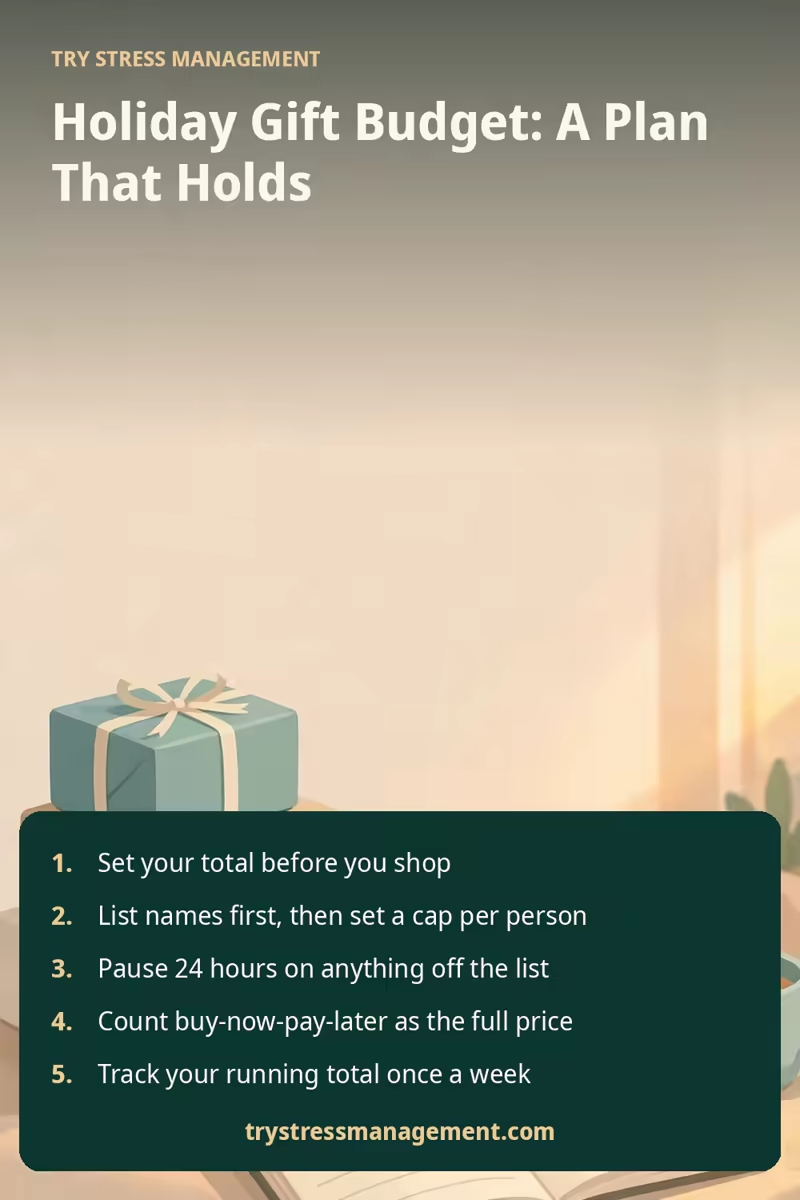
A holiday budget fixes that in a plain way. You decide one total number before you shop, build your list inside that number, and give yourself two simple rules for the moments when the plan wobbles: a cap for each person, and a 24-hour pause for anything that was not on the list. This guide walks through the whole system, with a worked example and the leaks that catch most people out. Whether this is your first attempt to create a holiday budget or you are tightening one from last year, the shape stays the same.
A note on scope: this is general educational information about planning, spending, and peace of mind, not personal financial advice. Your income, debts, and obligations are your own picture. If money decisions feel heavy or complicated, a qualified financial professional can look at your specific situation with you.

Start With One Number: Your Total Budget
The total comes first, before the list, before the shops, before the sales emails. If you start with a list of people and shop name by name, the total decides itself, and it usually decides on a number bigger than you wanted. Call it a christmas budget if December is your season, or a holiday budget if it is not. The label does not matter. Set a total that covers the entire holiday season, not just the presents: wrapping, shipping, cards, and food all belong in a total that includes everything.
Three ways to land on a total you can defend:
Look at last year. Your December bank or card statement holds the real figure, including the purchases you have forgotten. That figure is your true holiday spending, not the tidier number you remember. If last year’s total surprised you, treat that surprise as data. A total set 10 to 20 percent below last year’s actual spend is a common way people ease down without cutting anyone off the list.
Work from what January can carry. Pick a total you could pay off from a normal January, without skipping bills or dipping into money set aside for rent, food, or other essentials. If a number would still be hanging around in March, it is probably too high for this year.
Split it into weeks. A $400 total across the six weeks from mid-November to Christmas is about $67 a week. Some people find a weekly pace easier to hold than one big number, because a single expensive week shows up fast. It also spreads the holiday shopping itself, so no single week carries the whole season.
Write the number down where you will see it while you shop: the top of your list, a note on your phone, a sticky note on the fridge. A total that lives only in your head tends to grow. And don’t forget the extras when you set it — they get their own line in the worked example below.
Then Write the List, and Only Then the Caps
With the total set, list everyone you plan to buy for. Names first, amounts second. When the names come first, you can see the whole picture before any money moves. The number of people on the list matters as much as the total: the same $400 stretches very differently across six names than across sixteen. If the list is long, that is useful information, not a failure. Long lists are where caps earn their keep. It is much easier to buy gifts calmly when the deciding happened at the kitchen table, not in the aisle.
This list step is also where the emotional side of gift giving shows up: the coworker you feel obliged to include, the relative who always spends big, the worry that a modest present looks like a small feeling. Most of us want to buy gifts for everyone we care about, at the level we wish we could. Feeling pressured to buy more than you planned is one of the most common strains of the season, and it sits alongside the ordinary financial stress of December. For some people, giving is a love language, and a smaller present can feel like a smaller feeling; that worry deserves a kind answer, not a bigger receipt. Those pressures are real, and they are a separate problem from the arithmetic. Our guide to gift-spending stress and setting limits you can keep covers the scripts for the awkward conversations, including how to suggest a name draw or a spending limit to family without a scene.
Ways to shorten a list without dropping people entirely:
Draw names. Each adult buys for one other adult, so everyone on the list will get a gift that had real thought behind it. Many families find the exchange feels more thoughtful, not less, because one present gets real attention.
Group gifts. Siblings pool money for one parent gift. The present can be better, and each person pays less.
Move some names to a card list. A handwritten card with a genuine note is a complete gift for acquaintances, teachers, and neighbours. A card that simply says Merry Christmas, with two honest sentences inside, costs almost nothing and rarely reads as cheap.
Give gift cards where they genuinely fit. A card toward something a person already loves can be kinder than a guessed object, and it is easy to cap at an exact amount.
If charitable giving is part of your season, add it to the list as its own line, with its own amount. It deserves the same planning as any name.
Give Each Person a Cap
A cap is the most you will spend on one person. Write an actual dollar amount beside each name, not a feeling. Caps turn a vague intention (“I will not go overboard this year”) into a checkable fact (“Mum: $40, and this is $38, so it fits”).
Tiers work better than one flat number. In most families, partners and children sit in the top tier, parents and close friends and family in the middle, and everyone else in a smaller tier. What you spend per person matters less than that the caps add up to your total, with a little left over (the worked example below shows how). The exact split is yours.
Two habits make caps hold:
Cap the person, not the present. Two smaller items that total under the cap are fine. One item over the cap is over, even if it is perfect.
Shop the cap, not the person. When you browse, filter by price first. A $40 cap means you look at $40-and-under options, which quietly removes most of the temptation from the screen.
Set realistic caps, too. A cap you secretly know you will break teaches you to ignore the whole list.
A Worked Example: A $400 Budget for Ten People
Round numbers make the system easier to see. Here is one household’s plan:
- Total budget: $400
- Partner: $75
- Two children, $60 each: $120
- Two parents, $40 each: $80
- Three siblings, $25 each: $75
- Two close friends, $15 each: $30
- Buffer for shipping, wrapping, and stocking fillers: $20
- Total planned: $400
Notice the buffer. Most plans fail on the extras rather than the presents, so the extras get their own line instead of sneaking in as surprises. Notice, too, that the caps are uneven on purpose. The kids’ caps are the largest after the partner’s, which is common. Uneven is normal. A cap reflects your relationship and your year, and it does not need to match what anyone spends on you.
Your numbers will differ. The shape is what carries over: one total, a named list, a cap per name, and a buffer line, all decided before the first purchase. Every gift on the list has a home before a single shop is visited, and the buffer gives the plan a little wiggle room instead of a hard edge.
The 24-Hour Rule for Anything Off the List
Even a good plan meets the perfect unplanned find: the thing you spot in week three that a person on your list would love, priced just above their cap. Or something for someone who was not on the list at all.
The rule is simple. If it is not on the list, it waits 24 hours. Put it in the online basket, take a photo of it in the shop, write it on the list as a maybe, then leave it for a day.
A day does three things. It separates the gift idea from the rush of finding it. It gives you time to check the total and see what the purchase would displace. And a fair share of the time, the urgency fades on its own, which tells you the purchase was about the moment rather than the person. This is also where good deals do their damage: a discount on something you never planned to buy is still money out the door.
If, after 24 hours, you still want it and it fits within that person’s cap or the buffer, buy it with a clear head. The rule is a pause, not a ban. It exists because off-list buys are where most plans quietly break, and a pause is cheap insurance against a purchase you would not have chosen in the morning. Giving gifts should feel good. The pause protects the feeling.
Read the Small Print on Buy Now, Pay Later
Buy now, pay later plans split a purchase into smaller payments, often four, spread over several weeks. Used once, for one planned purchase, a plan like this can be manageable. The risk is how painless each individual plan feels, because the plans stack.
A $120 purchase split four ways is $30 a payment, which sounds minor. Five bought that way is twenty payments landing across December, January, and February. Each one is small. Together they are a second, hidden version of your holiday budget, one you may not have written down anywhere. It becomes easy to lose track of the combined total, and easy to tell yourself each checkout is affordable because each payment is.
Some other points worth knowing before you use one of these plans:
Many plans charge no interest if every payment lands on time, but a missed payment can bring late fees, and some plans do charge interest. The terms vary by provider, so the checkout screen is worth a slow read.
Splitting payments can also mean relying on money we don’t have yet: next month’s income, already spoken for by January’s bills.
Payments often continue well into the new year. A present given in December can still be coming out of your account in February, which is exactly the January squeeze this plan is trying to prevent.
Returns can get tangled. If something goes back, refunds and remaining payments do not always resolve at the same speed.
None of this makes these plans off-limits. It makes them a poor match for impulse buys. If you use one, write the full purchase price into your list and your tracker, not just the first payment. A thing costs what it costs, however it is sliced.
Track It Lightly: Five Minutes a Week
A tracking method you will actually use beats a detailed spreadsheet you abandon by December 10. The light version has three parts:
One list. Keep the names, caps, and purchases in one place: a notes app, a single sheet of paper on the fridge, or a simple document. Treat it as your one shopping list for the season, always the same list. A printable version by the fridge works well if paper is your medium; a phone note works if it is not.
One running total. Each time you buy, write the amount next to the name and update the total spent so far. Two numbers tell you where you stand: spent, and remaining.
One weekly check. Five minutes, once a week, coffee in hand. Compare spent against the plan. If one person is over their cap, the honest fix is to take it from the buffer or trim a later cap, not to pretend it did not happen.
That is the whole system. If tracking starts to feel like a second job, simplify it further: the running total alone will catch most problems while there is still time to adjust. None of these budgeting tips needs an app. The point is not perfection; it is to avoid overspending quietly, $20 at a time.
Where the Money Leaks
Certain costs slip past almost every first draft of a plan. Naming them in advance is most of the defence.
Shipping. Delivery fees, gift wrap add-ons at checkout, and the rush-shipping charge on December 22 when the planned item sells out. Buying earlier is the boring fix, and it works because stock and standard shipping both hold up better in November.
Stocking fillers and small extras. A trinket here, a novelty there: individually trivial, collectively a real line item. Give them a home in the buffer, or set a small stocking cap per person.
Panic buys. The last-minute purchase made because a present feels inadequate the night before. The 24-hour rule helps here too: most “inadequate” presents look fine again after a night’s sleep. A thoughtful card, added instead of a second item, closes most of these moments.
Workplace extras. The office exchange, the secret santa draw, the team collection, the client gift. Decide the amount in November and put it on the list like any other name.
Your own stocking. Self-gifting during the sales is common and rarely planned. If you want something in the sales, give yourself a small line in the plan for it. Planned beats smuggled.
If Money Is Tight This Year
Some years the honest total is small, and setting it can feel like admitting something. It is worth saying plainly: a small total is a plan, not a verdict on how much you care about people. A tight year is also where generosity changes shape: it stops being about the amount of money and becomes about attention. Most recipients cannot guess what a present cost, and the ones who love you are not scoring. Decide what you can do for gifts this year, and let that be the whole decision.
A few ways to make a tight year easier:
Lower every cap rather than cutting people. Smaller presents across the whole list usually feel better than full ones for some and nothing for others.
Start the name-draw conversation early. Other adults are often relieved, and around the holidays most people are quietly hoping someone else raises it first. Our guide to coping with holiday stress has more on pacing the season so money is not the only pressure building at once, and if money worries are spilling into the rest of life, our Talk Money Week guide on talking through money worries is a steadier place to work through it.
Give time where money is short. A promised afternoon, a cooked meal in January, help with a project. These are real presents, and people remember them. Or get creative: diy gifts — a framed photo, a jar of homemade granola, a playlist with a note — cost little and land well. You don’t have to spend money to show up for the people you love; presence and follow-through are the parts people actually remember.
A tight year asks you to prioritize the people and moments that matter most. It also helps to expect the feelings. Tight years bring up comparison and guilt, and both are normal responses to pressure rather than character flaws. Most people come out of a tight year feeling less stressed than the year they overspent, because January starts clean.
The best gifts are rarely the pricey ones. Ask a room of adults about a favorite Christmas and most will describe a person, a meal, or a joke. The meaningful presents are the ones tied to a memory, not the ones that cost the most, and the christmas gifts themselves blur within a year while the afternoon does not. Under most christmas trees, it is the same story.
A Small Head Start for Next Year
Some people smooth the whole thing out by saving throughout the year. The easiest way to start saving for December is in January, while you still remember how this one felt. If you started putting even $25 into a separate pot every month — a regular monthly habit, nothing fancy — next year’s christmas budget is mostly paid for before the season starts, with extra money waiting for the sales and money to spend that is already yours, instead of a scramble.
Frequently Asked Questions
How much should I budget for holiday gifts?
There is no standard figure that fits most households, because incomes, family sizes, and obligations differ too widely. A more useful starting point is last year’s actual total: find it on your December statement, then decide whether this year’s total should match it, sit a little below it, or come down further. Start from how much you can spend without borrowing from January’s essentials. The right number is one you can pay from a normal January without worry following you into spring.
What if my family is large?
Caps and name draws do most of the work. A cap per person keeps a long list from multiplying into an unpayable total, and a draw, where each adult buys for one other adult, cuts the list without cutting anyone out of the exchange. Group gifts for parents are another common route. If you propose a change, propose it early and as a relief for everyone, because it usually is.
Is buy now, pay later a bad idea for gifts?
Not automatically. A single plan for a planned purchase, with the full price written into your plan, can be manageable. The trouble starts when several plans run at once and the split payments make the total hard to see. If you use one, count the whole price against the person’s cap, and check the terms for late fees or interest before you confirm.
What if I go over budget anyway?
Most people do, somewhere. Adjust rather than abandon: take the overage from the buffer, trim a later cap, or return an unopened extra while returns are still easy. Then keep tracking. A plan that ends the season 10 percent over, with no surprise bill, has done most of its job. The guilt spiral is the part to skip; it spends energy without changing any numbers.
When should I start?
Earlier is easier, because standard shipping holds, stock holds, and the 24-hour rule has room to work. Starting now still counts. A total and a list written this week will do more for your December than a perfect plan written on December 20.
Your First Step, Today
Open last December’s statement and find the real number. Then write your total for this year, your list of names, and a cap beside each name. That page, scruffy as it may look, is the whole system working: decide the total, write the list, plan ahead while you are calm, and spend it wisely. Everything after it is just shopping inside lines you chose. A plan like this is how you enjoy the season instead of auditing it — and the same shape works for a birthday or any other expensive month.

Hi, I’m Sophia! Welcome to my blog Try Stress Management (trystressmanagement.com), where I share simple, down-to-earth ways to handle stress and bring more calm into everyday life. Think of me as your friendly guide, offering practical tips, reflections, and little reminders that we’re all figuring this out together.
When I’m not blogging, you’ll usually find me with a good book, sipping tea, or exploring new walking trails. I believe small changes can make a big difference—and that a calmer, happier life is possible for everyone.