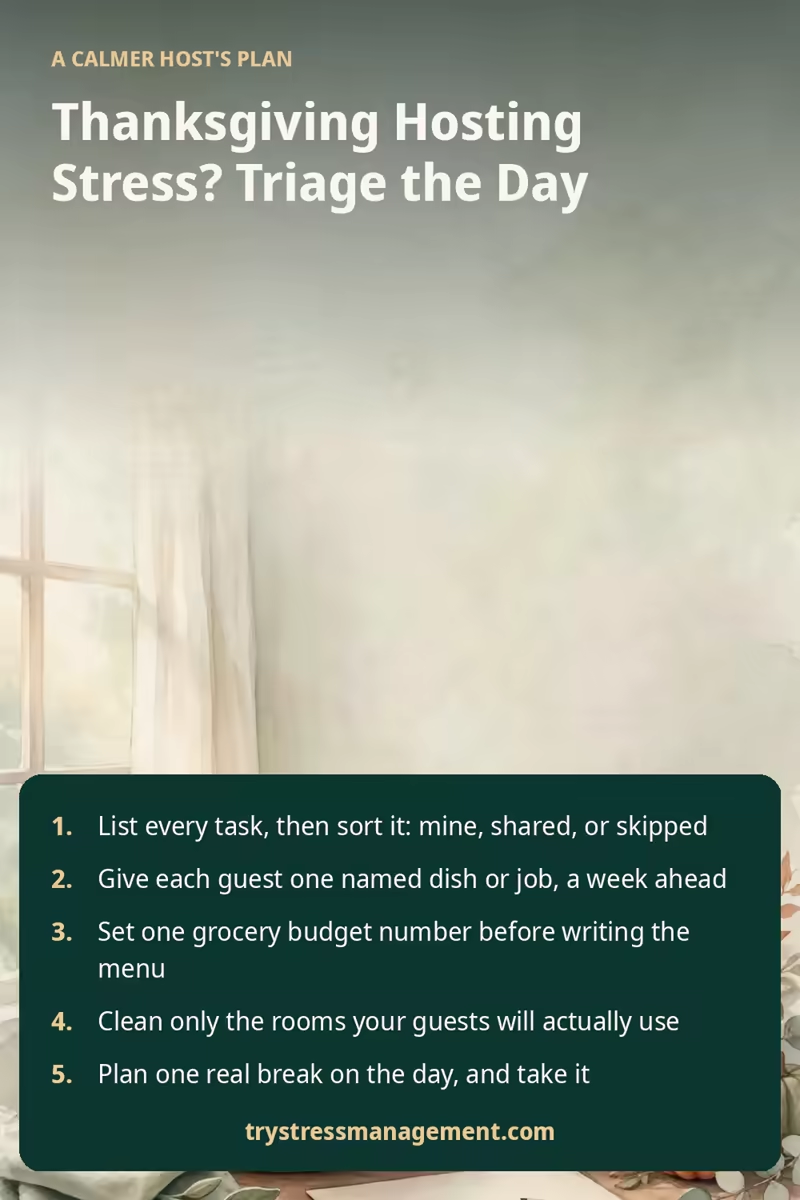
If you are hosting Thanksgiving this year and already feel tired, the problem is rarely the day itself. It is the three loads stacked on top of it: a full day of cooking and hosting work, the pressure to make your home look effortlessly presentable, and a grocery bill that keeps creeping up. Each load has a practical fix. Sort every task into what must be yours, what a guest can carry, and what you can skip or buy. Clean only the rooms your guests will actually use. Set one food budget number before you shop, not while you shop. The plan below walks through all three loads, with practical tips, a triage checklist and a two-week countdown you can follow as written.

Why hosting Thanksgiving feels heavier than the day itself
A guest sees one meal. A host sees a two-week project: planning the menu, shopping in stages, cleaning, cooking, serving, and cleaning again, often while also being the person everyone wants to talk to. That gap between the visible meal and the invisible work is where most Thanksgiving stress builds, and why the week can feel stressful even when you love the holidays. If you feel anxious just reading the list, that reaction is information, not weakness.
Three things tend to make it worse. First, the work is unevenly shared by default — you absorb tasks simply because nobody else was asked. Second, the standards creep: a holiday designed for magazines and social media quietly becomes the benchmark for an ordinary home. Third, the costs are real and arrive all at once, in the same month as every other holiday expense.
None of that means you should cancel or dread the day. It means the day needs treating like the project it is, with the same tools you would use for any overloaded week: fewer commitments, shared work, and decisions made ahead of time instead of at the last minute. If the wider season is already wearing you down, our guide to managing stress during the holidays covers the bigger picture; this article stays focused on the host’s chair.
Load one: the cooking and hosting workload
The single biggest workload mistake hosts make is treating every course and duty as assigned to them by default. Most guests are not unwilling to help; they were simply never given a specific job. Vague offers (“let me know if you need anything”) evaporate. Specific requests stick. It comes as a relief to most guests to be handed one real job instead of hovering, so ask for help early, while there is still time for a family member to say yes and mean it.
Ask early, and ask for specific things
A week or more before the day, send each willing guest one named assignment: “Could you bring the green bean casserole?” lands better than “bring a side.” Assign the jobs that travel well and reheat well — pies, rolls, cranberry sauce, a salad, ice, drinks. Keep the turkey and one or two things you genuinely enjoy making. Almost everything else can belong to someone else. Some guests prefer to bring food; others would rather take a job on the day, like arriving early to set up, or joining the cleanup afterwards.
Useful scripts, word for word:
- “I’m keeping the turkey and the gravy this year. Would you take the mashed potatoes? Yours are better than mine anyway.”
- “I’m trying to keep the day manageable. Could you arrive at two and be in charge of beverages and ice?”
- “No need to bring a dish — what would really help is staying twenty minutes after dessert for the first round of washing up.”
Buy the parts nobody will remember
Store-bought pie, bakery rolls, and pre-made gravy free up hours and oven space, and very few guests can tell or care. The honest test: will anyone remember this item a week later? If not, it is a candidate for the buy list. Your energy is a finite ingredient in the day too, and it runs out faster than flour. The Thanksgiving meal does not get graded item by item.
Spread the cooking across days
Cranberry sauce keeps for a week. Pie dough, casseroles, and chopped vegetables can be prepped two days ahead. Gravy can be built the night before from a stock base and finished with pan drippings. Cooking across four days in small sessions usually feels calmer than ten hours of it on the day — and the food is the same.
Load two: the pressure for a presentable home
The second load is the belief that your home must look like a holiday photograph before anyone crosses the threshold. It helps to remember what guests actually notice: a clear place to put a coat, a bathroom with a fresh towel and spare toilet paper in reach, somewhere to sit, and a host who is not visibly frazzled. Nobody inspects the baseboards.
Clean the guest map, not the whole house
Walk the route your guests will walk: entryway, living room, dining area, kitchen edges, one bathroom. Those spaces get the real clean. Bedrooms with closed doors, the laundry room, the office — these are not on the tour, and deep-cleaning them is work you are doing for an audience that does not exist. For a fuller reset of household stress, our comprehensive guide to dealing with stress and anxiety has a broader set of tools.
Set a “good enough” line before you start
Decide in advance what done means: surfaces clear, bathroom stocked, floors vacuumed in the guest areas, one scented candle if you like them. Write it down if you need to. A written finish line stops the familiar spiral where cleaning expands to fill every spare hour in the week before guests arrive.
Let some things be visibly lived-in
A home that looks slightly lived-in often puts guests at ease more than a showroom does; people relax when they are not afraid of disturbing anything. If a stack of mail or a kid’s art project is part of your real life, it is allowed to be part of your holiday too.
Load three: the grocery bill
The third load is money. Feeding a crowd is a genuine expense, and it lands in the most expensive month of the year, with the upcoming December holidays right behind it. For a benchmark: in the American Farm Bureau Federation’s most recent annual survey (2025), a classic Thanksgiving dinner for 10 cost $55.18, about $5.52 per person, down 5% from the year before — and that figure covers the core dishes only, before drinks, appetizers, extra desserts, and the second trip for forgotten ingredients, which is where real totals climb. You can read the survey on the Federation’s own site. Their 2026 survey is expected closer to the holiday.
One number, decided at home
Pick a total grocery budget before you make the list, and let the number shape the menu — not the other way around. Two side dishes instead of four is a menu decision that guests barely register and your budget clearly does. Your plate is already full enough without a menu that ignores the number. If money worries are a standing theme for you right now, our guide to money stress and small steps that count goes deeper than one holiday can.
Shop the plan in two trips
Trip one, a week out: shelf-stable and frozen items, beverages, baking supplies. Trip two, two or three days out: fresh produce, dairy, the bird if it is fresh. Two planned trips cost less than five reactive ones, because each extra trip tends to add unplanned items, and planned trips help you avoid the last-minute panic shop entirely. Store-brand staples — stock, flour, canned pumpkin, frozen peas — are usually the easiest savings on the list, since they disappear into cooked dishes anyway.
Let guests carry cost as well as dishes
A guest who brings a pie is also bringing fifteen dollars of your budget back. Framing potluck contributions as tradition rather than apology helps: many families already do this, and guests frequently prefer a named assignment to guessing. The same limit-setting mindset applies to gifts next month — see our guide to setting gift-spending limits you can actually keep.
The hosting triage: sort every task before you do any of them
This is the step that makes the rest of the plan work. Take twenty minutes, two weeks out, and list every Thanksgiving task you can think of — food, cleaning jobs, shopping, seating, ice, cleanup. Then sort each one into three columns. Be strict: the first column should end up much shorter than your original list.
| Must be mine | Hand off | Skip or buy |
|---|---|---|
| The turkey (or main dish) | Two or three named side dishes | Store-bought pie or bakery rolls |
| One dish you love making | Drinks, ice, and appetizers | Fancy table decorations |
| The grocery list and budget | Post-dinner dish crew | Deep-cleaning rooms guests won’t enter |
| Seating plan (if your table needs one) | Someone on coffee and dessert service | A second dessert “just in case” |
Two rules keep the triage honest. First, anything in the “hand off” column gets a name and a date attached — an unassigned task quietly returns to the host. Second, anything in that third column is closed: no revisiting it in a burst of ambition on the Wednesday before.
A two-week countdown for a calmer Thanksgiving
Two weeks out (by Thursday, November 12)
- Run the triage above and send out the specific guest assignments.
- Set the grocery budget number and write the list to fit it.
- Check your supplies: roasting pan, thermometer, containers for leftovers, chairs. Make a list of anything missing before you shop for it.
One week out (by Thursday, November 19)
- First shopping trip: shelf-stable, frozen, drinks, baking supplies.
- Clean the guest-map rooms in one or two short sessions, not a marathon.
- Confirm assignments with guests in one friendly message.
The weekend before (November 21–22)
- Make cranberry sauce and anything that freezes or keeps.
- Set the table if the room allows it — one less day-of job.
- Clear fridge space for the incoming food.
Wednesday, November 25
- Second shopping trip for fresh items; prepare the vegetables and casseroles for tomorrow.
- Build the gravy base; chill everything that needs chilling.
- Stop working by a set time in the evening. The plan is done; rest is part of it.
Thanksgiving Day, November 26
- Cook to the timeline you already wrote — no new dishes invented today.
- Sit down during the meal. Hosts who never sit rarely enjoy the day they built.
- Take one genuine break: a short walk, ten minutes of quiet, fresh air between courses.
- Let your crew clean up afterwards while you actually sit with dessert.
Looking after yourself on the day
Hosts often run on coffee and adrenaline until the guests leave, then crash. Get plenty of sleep the night before, even if the list is not finished. A few small protections make the day itself feel different: eat a real breakfast before cooking starts. If you meditate, keep the morning meditation, even shortened; dropping every routine is what makes a day feel unmoored. Drink water between tasks. Step outside once — daylight and a short walk are among the simplest ways to reset a frayed mood, and some research suggests brief time outdoors may help ease stress for many people. If a conversation at the table starts to raise your blood pressure, you are allowed to excuse yourself to “check on something in the kitchen” and take three slow breaths. Nobody needs to know the pie does not require checking. Setting boundaries helps too: a start time, an end time, and a shared agreement to leave one or two hot topics alone gives relatives who do not always get along an easier day. And give yourself grace when something goes sideways; a dry roll has never ruined a holiday. Small pauses like that protect your mental health across the holiday season, and they cost the day nothing.
For many hosts, the hardest part is giving themselves permission. And if this year is genuinely too much — because of grief, illness, a new baby, or an already full life — scaling down is a legitimate option, not a failure. A smaller table, a meal out, a potluck where you provide only the room, or skipping hosting entirely this year are all reasonable choices. The holiday survives every one of them.
If hosting feels lighter with a plan like this, you might like our free weekly emails — one short, practical idea for stress and everyday wellness each week, no noise. Join the list here and start with whichever topic your season is throwing at you.
Frequently asked questions
How do I ask guests to bring a dish without sounding cheap?
Ask early, ask specifically, and frame it as tradition or flattery: “Your sweet potatoes are the ones everyone asks about — would you bring them this year?” Most guests prefer a named dish to guessing, and many are relieved to know exactly how they can help. It is a hosting norm in plenty of families, not a shortcut.
What should I clean before Thanksgiving guests arrive?
Clean the rooms guests will use: entryway, living and dining areas, kitchen surfaces, and one bathroom with a fresh towel and spare toilet paper in reach. Closed-door rooms are not part of the visit. A clear, comfortable space in the guest areas does more for the feel of the day than a deep-cleaned bedroom nobody enters.
How can I keep Thanksgiving food costs down?
Set one total budget before writing the menu, trim the menu to fit it, shop in two planned trips, choose store brands for staples that disappear into cooked dishes, and let what guests bring carry part of the cost. For reference, the American Farm Bureau Federation’s 2025 survey priced a classic dinner for 10 at $55.18 for the core dishes, though drinks and extras raise real-world totals.
What if I feel overwhelmed on the day itself?
Eat breakfast, drink water, and take one real break — a short walk or ten quiet minutes counts. Lower the bar mid-day if you need to: a dropped garnish or a store-bought swap is invisible to guests. If overwhelm is a regular pattern rather than a holiday one, that is worth a conversation with a therapist or another healthcare professional you trust. Counseling and ongoing therapy are support, not a last resort, and either can help when a heavy season does not lift.
Is it okay to not host Thanksgiving this year?
Yes. Hosting is an offer, not an obligation, and you do not have to feel obligated just because you hosted last year. Declining in a hard year protects both you and the gathering. Offer an alternative if you want one — a smaller meal, a restaurant table, or hosting a simpler occasion later — and give people the news early so they can plan.
This article is general educational information about managing everyday stress. It is not medical advice, and it is not a substitute for guidance from a qualified healthcare professional about your own health. If stress feels persistent or overwhelming, please consider talking with a professional you trust.

Hi, I’m Sophia! Welcome to my blog Try Stress Management (trystressmanagement.com), where I share simple, down-to-earth ways to handle stress and bring more calm into everyday life. Think of me as your friendly guide, offering practical tips, reflections, and little reminders that we’re all figuring this out together.
When I’m not blogging, you’ll usually find me with a good book, sipping tea, or exploring new walking trails. I believe small changes can make a big difference—and that a calmer, happier life is possible for everyone.