
The clocks went back one hour on November 1, and the fastest way to reset your sleep after daylight saving time is to hold three anchors steady: wake up at the same time every morning, get outside into morning light within an hour of waking, and keep a wind-down routine before bed. Sixty minutes sounds small, but your body clock runs on light and routine, not on the time printed on your phone. Most people feel back to normal within a few days when those three anchors hold, and the extra hour of sleep on the first night can actually help you adjust. The plan below stretches that reset across three days, so it feels gentle instead of abrupt.

Why a one-hour change can leave you tired for days
Your sleep is timed by a circadian rhythm, an internal clock that takes its cues mainly from light, meals, activity, and the times you sleep and wake. When the clocks fall back, sunset arrives an hour earlier and your evenings suddenly feel longer and darker, while your body still expects the old schedule. The Sleep Foundation notes that even a small shift in time can leave people feeling groggy and out of sync for several days, because the internal clock adjusts gradually rather than all at once. The effects of daylight saving time on sleep are usually mild in autumn, and you can read their overview of how daylight saving time affects sleep for the background. The daylight-saving time shift itself is only sixty minutes. In the days before the time change, your evenings matched your clock; now they do not, and that mismatch is the whole problem. How much the time change affects you varies from person to person; its impact on your sleep depends mostly on how steady your routine stays. Unlike the spring change, nobody is losing an hour of sleep here: in March the clocks go forward an hour, in November they come back, and there is no lost hour to repay. Poor sleep quality for a few nights is common, and so is sleep disruption at either end of the night: falling asleep too early, then waking at 4 a.m. That is your body clock still running on last week’s schedule. It settles on its own for most people, and it settles faster when your days give it clear signals, because light and routine are what regulate sleep. Poor sleep can make an ordinary day feel twice as long, which is why a short, deliberate reset is worth doing. Individual responses vary. Some people barely notice the change, while others feel it for a week or more, and shift workers, parents of young children, and anyone already short on sleep may feel it more. If you don’t get enough sleep for several nights running, daytime sleepiness is the usual result. A few broken nights are not chronic sleep deprivation, and this does not need sleep medicine or a clinic visit. It is a short reset for an otherwise normal week.
Step 1: Keep the same wake time
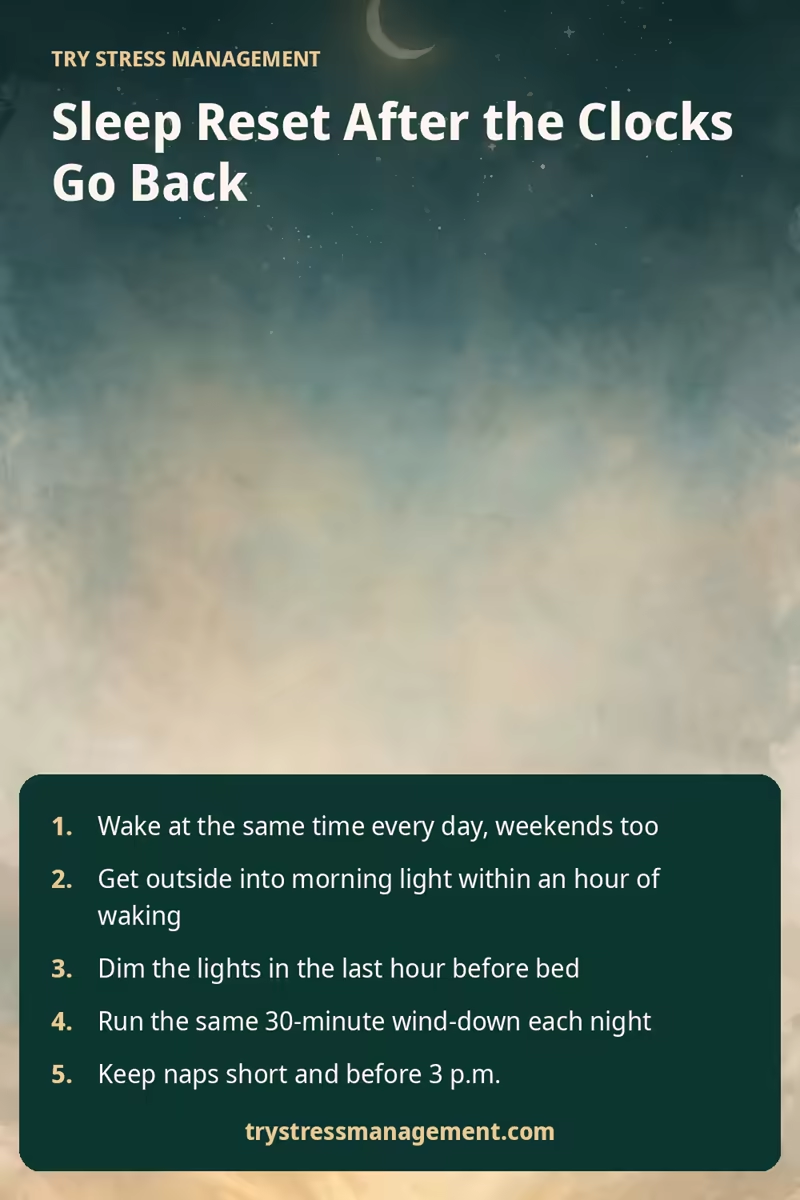
Of the three anchors, wake time is the one that does the most work. Pick the wake-up time you need for your normal routine and get up at that time every day this week, including the weekend. Your sleep schedule has two ends, bedtime and wake time, and the wake end is the one you can actually set. Sleeping in on Saturday feels like recovery, but it pushes your body clock later, and a shifting sleep schedule can disrupt sleep the following night by removing the sleepiness you need. If you are waking an hour early and lying there awake, get up rather than watching the clock. Start your day at the usual time, turn on bright lights, and let your body register that the day has begun. Your bedtime will take care of itself: go to bed when you feel genuinely sleepy, which may be a little earlier than usual for the first two or three nights, and let it drift back to normal as the week goes on. Going to bed only when you are sleepy also makes it easier to fall asleep quickly instead of lying awake counting the hours. Forcing yourself to stay up late to match the clock rarely helps, and forcing yourself to sleep before you are sleepy usually means an hour of tossing and turning. If a busy mind is part of what keeps you up, the wind-down guide to quieting racing thoughts before bed pairs well with this reset.
Step 2: Get outside in the morning light
Light is the strongest signal your body clock listens to. Getting outside within an hour of waking, even on a grey morning, tells your internal clock where morning is, and that timing helps set when you will feel sleepy at night. Natural light outdoors is the version your clock responds to best, and morning light can lift sleep quality within a few nights. Aim for 20 to 30 minutes outdoors if you can: a walk, the school run, coffee on the step, or the long way to the bus stop all count. Daylight outdoors is far brighter than indoor lighting, even when the sky is overcast. If your mornings start before sunrise, bright indoor light is a reasonable substitute, and you can take your outdoor time at the first break in your day. Daylight hours are short in November, which makes this step harder and more important at the same time. Morning light is one of the simplest ways to improve your sleep without changing anything else in your day. The same morning-light routine shows up in our guide to natural approaches for seasonal affective disorder, where steady morning light is a common first step for winter low mood as well. In the evening, do the opposite. Dim the lights as the evening winds down and keep screens from flooding your eyes with bright light at close range. You are bookending the day: bright at the start, dim at the end, so the clock gets an unambiguous message at both ends.
Step 3: Protect your wind-down
A wind-down routine is how you tell your body the day is ending. Keep it simple and repeatable: 30 to 60 minutes of the same few things in the same order. A shower, pyjamas, a paper book, a short stretch, lights low. The specific activities matter less than the repetition, because the routine itself becomes a cue. A steady sleep routine is also a way of maintaining good sleep habits through the darker months: same cues, same order, same time each day. Treat the final hour as leading to sleep, not as spare time, and give yourself time to wind down rather than dropping into bed straight from a bright screen. Keep your sleep environment working for you too: dark, cool, and quiet, with the phone charging outside it. Two practical points for this week. First, keep the routine at the same clock time each night, even if you are not yet sleepy when it starts; sleepiness tends to follow the routine within a few nights. Second, park your phone outside the bedroom or across the room. Scrolling in bed adds bright light and stimulating content at the exact moment you are trying to do the opposite. If stress is what follows you to bed, our pillar guide on how to sleep better with anxiety and stress covers the longer-term picture.
Your 3-day reset plan
Here is the whole reset on one page: the practical tips to help you adjust, day by day. Print it, screenshot it, or copy it into a note.
| Day | Morning | Daytime | Evening |
|---|---|---|---|
| Day 1 | Wake at your normal time. Outside for 20–30 minutes within the first hour. | Keep meals at normal times. If you nap, keep it before 3 p.m. and under 30 minutes. | Dim lights from 9 p.m. Wind-down starts one hour before bed. Bed when sleepy. |
| Day 2 | Same wake time, same morning light, even if you slept badly. | Last coffee by early afternoon. If the morning was dark, a daylight break at lunch still counts toward adjusting to the time change. | Same wind-down, same order. Phone charges outside the bedroom. |
| Day 3 | Same wake time and light. Note roughly how the night went in a line or two. | Normal schedule. Get some movement in, but not vigorous exercise late in the evening. | Same wind-down. By tonight, most people find bedtime and sleepiness line up again. |
If your schedule allows a slower version, you can spread the same plan across five or six days and shift your wake time by 15 minutes a day instead of holding it steady. Whichever pace you choose, adjusting to daylight saving time rests on the same anchors: a fixed wake time, morning light, and a calm last hour. Track your sleep and improve the weakest anchor first; a regular sleep pattern matters more than a perfect one. Expect to sleep at night in shorter stretches at first. That is normal while your clock catches up.
Habits that slow the adjustment down
Mild sleep deprivation after a bad night shows up as heavy eyelids by mid-afternoon, and these habits make it worse. There are no tips to make the adjustment instant, but these decide how fast it goes.
The long lie-in. One lazy morning is harmless, but two or three in a row move your clock in the wrong direction, shift your sleep patterns later, and recreate the problem next week.
The long afternoon nap. A short early nap can take the edge off a bad night. A two-hour nap at 5 p.m. borrows sleep from the night ahead, and you will feel it at 2 a.m. Long naps are also a quiet cause of sleep issues during reset week.
Late caffeine. Caffeine can still be active many hours after you drink it. During reset week, move your last coffee or energy drink to early afternoon and see whether your nights settle faster.
Making up for it with a huge early night. Going to bed two hours early usually means two hours of lying awake. Go when you are sleepy, and let bedtime find its level across the week.
Too little sleep overall. If you were already carrying a lack of sleep into the change, the week will feel harder. The fix is the same anchors, held for longer.
When a rough week is something more
For most people, sleep settles within a few days of the clock change. Ongoing sleep problems such as sleep apnea or other sleep disorders are a different matter from a clock change, and they deserve proper assessment rather than tips. Sleep and health are closely linked, and persistent poor sleep is worth taking seriously for your sleep and overall health. If you are following these tips and still sleeping badly after two or three weeks, or poor sleep is affecting your days in a way that worries you, that is worth a conversation with a qualified healthcare professional rather than another round of self-help tips. This article is general educational information about everyday sleep habits. It is not medical advice, it does not diagnose any condition, and it does not replace professional guidance about your own health. When daylight saving time starts again in March, the same anchors work in reverse: preparing for daylight saving time is mostly about protecting your wake time and your morning light.
Want more short, practical guides like this one in your inbox? Join the free Try Stress Management newsletter for a weekly email on sleep, stress, and calm routines that fit a real schedule.
Frequently asked questions
How long does it take to adjust to the fall time change?
Many people feel back to normal and back to better sleep within a few days, and some research suggests the fall change is easier than the spring one because you gain an hour. Most people settle into the new time smoothly within a week, although a drifting weekend schedule can stretch it. The effects on sleep usually fade as the same wake time does its work.
Should I go to bed an hour earlier after the clocks go back?
Probably not on the first night. Forcing an early bedtime often backfires, making it harder to fall asleep and leaving you frustrated. Going to bed before you feel sleepy often means lying awake, which can make the bed feel like a place for frustration. Let sleepiness lead, and your bedtime will usually drift back to normal across the week.
Is a nap okay during the adjustment week?
A short nap, roughly 20 to 30 minutes and before mid-afternoon, may help some people get through a rough day. Short naps do not undo a healthy sleep schedule; longer or later naps tend to make the following night lighter and more broken.
Does morning light really matter on a cloudy day?
Outdoor light on an overcast morning is still much brighter than typical indoor light, so a walk outside still sends a useful signal to your body clock. Daylight in the evening is fading fast this month, which is why the morning dose carries the adjustment. If you cannot get out early, bright indoor light in the morning and daylight later in the day are reasonable substitutes.
What if I am still waking up too early after a week?
Keep the same wake time rather than shifting your whole day earlier, keep evenings dim, and avoid bright light in the very early morning if you get up before your target time. Whether you fall asleep or wake at the wrong end of the night, the advice is the same, because light at the wrong time can affect your sleep more than the hour itself. If early waking persists for weeks or comes with low mood or daytime problems, talk to a qualified healthcare professional.

Hi, I’m Sophia! Welcome to my blog Try Stress Management (trystressmanagement.com), where I share simple, down-to-earth ways to handle stress and bring more calm into everyday life. Think of me as your friendly guide, offering practical tips, reflections, and little reminders that we’re all figuring this out together.
When I’m not blogging, you’ll usually find me with a good book, sipping tea, or exploring new walking trails. I believe small changes can make a big difference—and that a calmer, happier life is possible for everyone.