
A Sunday reset routine is one planned hour on Sunday that sets up the coming week. You review the week that just ended, pick three priorities for the one coming, prep the practical things (meals, clothes, the bag by the door) and wind down early enough that Sunday night feels like rest instead of a countdown to Monday. The version below takes about 60 minutes, and a 20-minute version covers the same ground when Sunday is already full. It works because the decisions get made while you are calm, not while the work week is already pulling at you. If you are starting a Sunday reset routine for the first time, keep it simple: this simple Sunday reset routine is the same four moves every week, and a weekly reset works best when it stays boring enough to repeat.

Why the routine works
Monday mornings go wrong for a fixable reason: too many small decisions arrive at once. What to wear, what to eat, which task comes first, whether that meeting moved, what the kids need for school. None of them is hard on its own. Together, before coffee, they set the tone for the day. The routine moves those decisions to a quieter hour, so the week starts with doing instead of deciding.
Writing the plan down matters more than keeping it in your head. In a small sleep-lab study, 57 healthy young adults spent five minutes before bed writing either a to-do list or a list of tasks they had already finished. The to-do list group fell asleep faster, about 16 minutes compared with about 25 minutes for the other group, and the more specific the list, the faster they fell asleep. The study compared two kinds of writing, not writing against nothing, and it tested healthy young adults in a lab, so it says nothing about insomnia. Still, the mechanism fits everyday life: getting the week’s open loops onto paper means your mind stops carrying them. You can read the study itself at PubMed (Scullin et al., 2018).
The routine also protects your wake time, which is the anchor the whole week hangs on. A steady wake time steadies the body clock more than a steady bedtime does, because morning light is the strongest signal your internal clock receives. The Sleep Foundation’s overview of how the circadian rhythm works explains why light and routine matter more than willpower here. Keeping Sunday’s wake time close to the weekday time, within an hour, not three, makes the first morning of the work week less of a shock. That is the whole trick behind the routine: small, steady signals, repeated weekly. For more on the planning side, our guide to 10 quick time management tips to crush stress covers the same ground from the weekday angle.
Sunday reset ideas: make the routine yours
The four moves below are the skeleton. The details of your Sunday routine are yours to choose, and choosing them is half the reason the habit sticks. To create a Sunday reset that lasts past January, create a simple version first: start with the steps below and adjust one thing a week until it fits your life. Most reset routines you will find online run two hours and ask for a full house clean; this one runs an hour. A few top tips from people who keep the habit: keep the same time slot, keep the list on paper, and never let the routine grow into a second workday.
Build in a little self-care on purpose. The reset is not only chores. Ten minutes with a book, a bath, a walk without headphones. That is part of the routine, not a reward for finishing it. A weekly reset routine that skips self-care turns into another shift, and nobody keeps a second shift for long. If you want ideas, TikTok and Pinterest are full of Sunday reset videos, but take them as a menu, not a standard: the idea of a Sunday reset is a calmer week, not a perfect home.
Use the hour to decide what’s most important, and setting intentions for the week takes one sentence each. Journaling helps here: five minutes of writing about the week to come (what you want more of, what you want less of) gives you time to reflect before the week starts moving. A habit tracker keeps you honest about the routine itself: tick the four steps each week in your planner, and the streak does the motivating. If paper helps, printables of the checklist below work well, and so does a plain notebook. Give yourself time to sit with a cup of tea at the end. A clean space can help you feel more prepared for the week, and a short routine can help you manage the week instead of reacting to it. That is why a Sunday reset matters: the plan is small, but it is written, and a written plan is easier to trust than a worried mind.
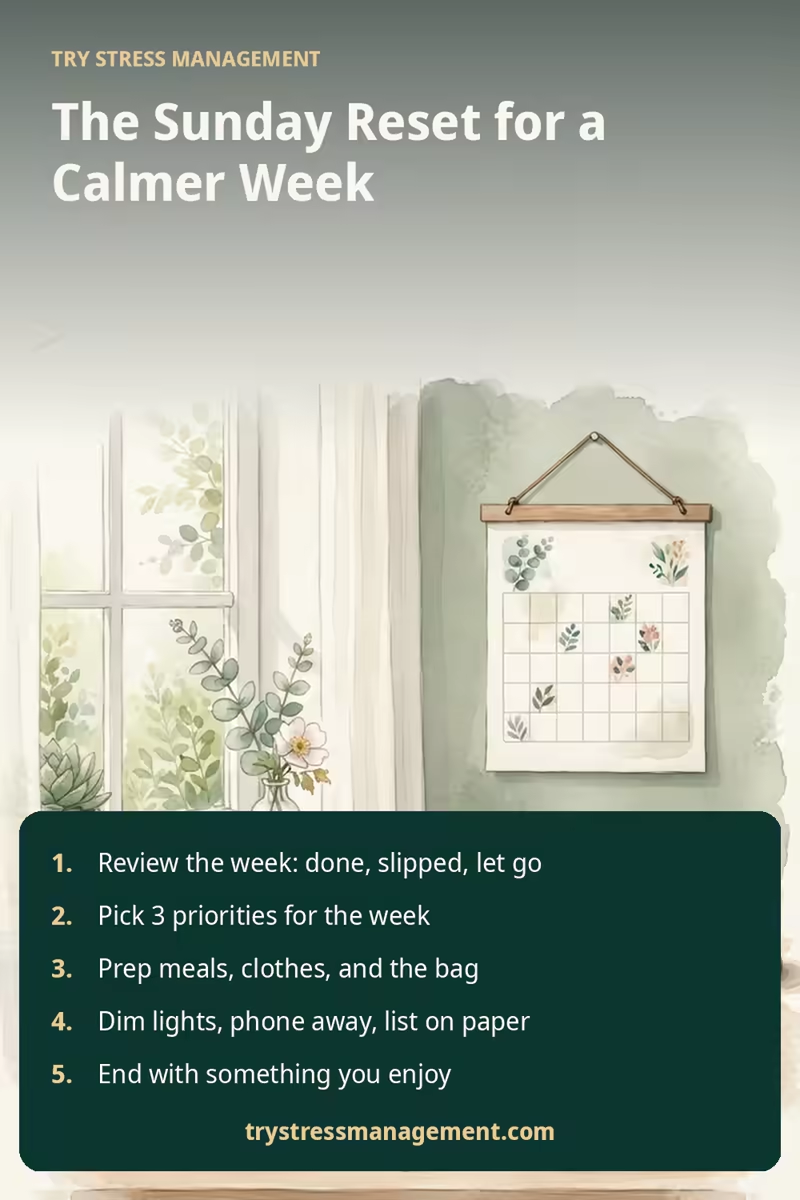
The 60-minute Sunday reset routine
Pick a regular slot. Late afternoon or early evening works for most people. Keep it the same each week so it becomes a habit instead of a decision. Set a timer for each step. The timer is the point: a reset with no end time turns into a second workday. On a typical Sunday, the whole thing fits inside an hour, and how you spend Sunday after that is up to you.
Step 1: Review the week that just ended (10 minutes)
Open your calendar and your to-do list from the past week. Ask three questions and write the answers down: what got done, what slipped, and what you want to let go of. The third question does the most work. Most weeks carry at least one obligation that no longer matters: a meeting you can decline next time, a task someone else could own, a “should” that was never really yours. Cross it off the list instead of carrying it into the new week. If something slipped twice, decide now whether it gets a real slot this week or gets dropped on purpose. A dropped task is a decision; a carried task is a weight.
Step 2: Plan the week ahead (15 minutes)
Look at the coming week’s calendar first, then pick three priorities, not ten. Three is small enough to remember and large enough to matter. One should be the hardest thing, scheduled early in the week while your energy is fresh. One should be something that moves a longer goal forward, even by a small step. One can be personal: a call you keep postponing, a walk you keep skipping, a repair you keep living around.
Then scan the week for collisions: two hard things on the same day, a meeting scheduled over lunch three days running, a deadline landing the same morning as a school event. Move one thing now, while moving it is still cheap. Leave room in the week for personal needs, not just obligations: rest, friends, the things that refill you. If the week looks overloaded, the routine is where you say so, to yourself and to whoever needs to hear it, instead of discovering it on Wednesday. Write the week in your planner in pencil, not pen: plans change, and a pencil plan is easier to adjust. The reset borrows one idea from productivity books: decide the next action, not just the goal. Our guide on how weekly planning can stop burnout before it starts goes deeper on this scan. Preparing for the week ahead this way means fewer last-minute scrambles, and the things you need to get done are already in order before the week begins.
Step 3: Meal prep and a quick tidy (15 minutes)
This is the unglamorous step, and the one that pays off most visibly on the first workday. Meal prep starts with a simple meal plan: three or four dinners for the week, not seven. It means choosing the dinners, writing the grocery list, and doing the small prep that saves time later: wash and chop the vegetables, cook a batch of grains, prep ingredients for the first two nights. Go grocery shopping on Saturday or order online, so Sunday stays for the reset, not for running errands. Plan the meals for the upcoming week around what is already in the fridge, and leave room for one easy night. A busy week will find its own shortcuts, so build one in on purpose.
Then do a quick pass through the house on Sunday: a 10-minute tidy of the room you wake up in, plus the kitchen. This is a cleaning routine, not a deep clean. Put away any clutter, wipe the surfaces, and leave the space clean and tidy. You are not cleaning your home top to bottom, and you are not deep-cleaning the entire house. Home cleaning on a Sunday is maintenance: a quick declutter of the counters, emptying the dishwasher, taking out the recycling. If you work from home, reset the home office too: clear the desk, close the extra tabs, and put the work tasks for the week where you can see them. Decluttering is not about owning less; it is about giving the week a clear surface to start from. If you have too much stuff in the way, the tidy step takes longer, so keep it small: one room, ten minutes, done. Waking up to a clear kitchen table changes the first ten minutes of the work week in a way no amount of planning can. If you live with other people, this is a good step to share: one person cooks, one tidies, and the reset finishes faster. Household chores go quicker when they are shared, and a tidy space at the end of Sunday is a small, visible win to start the new week with.
Step 4: Set up the wind-down (10 minutes)
Decide now what Sunday evening looks like, because an undecided evening drifts toward screens. Dim the lights an hour before bed. Put the phone to charge outside the bedroom, or at least across the room. Write tomorrow’s top three tasks on paper (the same three from Step 2) so they are out of your head and onto the page. That five-minute list is the one the sleep study tested, and Sunday night is when it earns its keep.
If screens are the hard part, our guide to light and screens before bed walks through dimming the house and setting a screen cutoff that actually holds. The wind-down does not need to be elaborate. It needs to start at a fixed time, not when you happen to feel tired. Move work tasks off Sunday evening entirely: the inbox can wait until the first morning of the work week.
Step 5: Shut it down (10 minutes)
The hour ends with something enjoyable, on purpose. Tea, a chapter of a book, a short walk, ten minutes of stretching. Anything that is not planning. This step is what makes the routine something you look forward to instead of a chore you dodge. Sunday is a refresh, not a reckoning: the week ahead gets a clean start, and you get an evening. When the timer ends, the planning stops. Anything you forgot goes on next Sunday’s list, not tonight’s.
The 20-minute version
Some Sundays are already full: travel, family, a long day out. On those days, run the short version. Five minutes to review the week and pick three priorities. Five minutes to scan the calendar for collisions. Five minutes to lay out the first day’s clothes and pack the bag. Five minutes to write tomorrow’s list on paper and put the phone to charge. The short version keeps the habit alive, and a kept habit beats a skipped perfect one. Starting the week with even the short version beats starting it with nothing.
The reset checklist
Print this list or copy it into a note. This reset routine checklist is the same every week, so the routine runs itself once you know it by heart.
- ☐ Reviewed the week: what got done, what slipped, what to let go of
- ☐ Picked three priorities for the coming week
- ☐ Scheduled the hardest task early in the week
- ☐ Scanned the calendar for collisions and moved one thing
- ☐ Planned three or four dinners and made the shopping list
- ☐ Laid out the first day’s clothes and packed the bag
- ☐ Tidied the room you wake up in for 10 minutes
- ☐ Wrote tomorrow’s top three tasks on paper
- ☐ Set the phone to charge outside the bedroom
- ☐ Dimmed the lights an hour before bed
- ☐ Ended with something enjoyable, not more planning
- ☐ Kept wake time within an hour of the weekday time
When the week falls apart anyway
Some weeks ignore the plan. A child gets sick, a deadline moves, a pipe leaks. The routine is a plan, not a promise, and its value shows up exactly in those weeks: because you wrote the priorities down, you know what to drop first and what to protect. When a week derails, run a five-minute re-plan on the first morning of the work week, before opening email. Pick the one priority that still matters, move the other two, and let the rest wait. That is the routine doing its job. A weekly reset routine helps you stay on track when a busy week hits. What matters is that you stay consistent, not that any single week goes perfectly. A successful week is not a perfect week; it is a week where the top three things got done. The routine does not lower your stress levels by itself; it removes the small frictions that add to them, one Sunday at a time.
If Sunday itself is chaos, move the routine instead of skipping it. The first morning of the work week, before email, works, and so does Saturday evening. The day matters less than the habit. And if you miss a week entirely, restart the next Sunday without making up for it. A missed week is not a failed routine. Two missed weeks in a row is where the habit breaks, so the rule is simple: never miss twice. Earlier in the week, when something slips, the same rule applies: re-plan in five minutes and move on.
Three mistakes that turn a reset into a second workday
Planning everything. A routine that tries to schedule every hour of the week collapses by Tuesday, and the collapse feels like failure. Three priorities and a calendar scan are enough. The rest of the week gets planned as it arrives.
Catching up on work. Answering the emails you avoided all week is not a reset. It is overtime, and it trains your brain to dread Sunday evening. If work is genuinely urgent, handle it in a separate, time-boxed slot, and keep it out of the reset hour.
Skipping the wind-down. The first four steps make the first workday easier. The wind-down makes Sunday night easier. Skip it and you arrive at the first workday tired, which undoes the planning. Dim lights, paper list, phone across the room: small moves, and they are the ones the research supports most directly.
If a calmer week sounds worth trying, join the free email list at https://trystressmanagement.com/subscribe/, one short note a week, and the Sleep Better Tonight printable comes with it.
Free printable: Sleep Better Tonight
A 10-minute evening wind-down on one page: dim lights, screens off, tomorrow’s worries onto paper, a gentle stretch, and slow breathing, the same wind-down that closes the Sunday reset. Join the free email list and the PDF arrives in your inbox. Print it and keep it by the bed.
Frequently asked questions
How long should the routine take?
About an hour for the full version, 20 minutes for the short one. If it regularly takes longer than an hour, something is wrong: you are probably planning too much detail, or using the hour to catch up on work. Trim the plan, not the routine.
What time of day works best?
Late afternoon or early evening, so the wind-down step leads naturally into Sunday night. Morning resets work too, but they tend to get eaten by the day’s errands. Whatever you pick, keep the same slot each week.
Do I need to do it every Sunday?
Every Sunday is the goal, but the habit survives an occasional miss. The rule that matters is never missing twice. Two skipped weeks in a row is where most routines quietly die.
What if I work weekends, or my week starts on a different day?
Move the reset to the evening before your first workday. The routine is tied to the week ahead, not to Sunday itself. Shift workers can run it on any quiet evening before a run of workdays.
Is a Sunday reset the same as weekly planning?
Weekly planning is one step inside it. The reset adds the review, the practical prep, and the wind-down. Those are the parts that make the first workday feel different, not just look organized on paper.
This article shares general wellness and planning ideas for everyday life. It is educational information, not medical advice. If sleep problems or low mood persist, consider speaking with a qualified healthcare professional about your own situation.

Hi, I’m Sophia! Welcome to my blog Try Stress Management (trystressmanagement.com), where I share simple, down-to-earth ways to handle stress and bring more calm into everyday life. Think of me as your friendly guide, offering practical tips, reflections, and little reminders that we’re all figuring this out together.
When I’m not blogging, you’ll usually find me with a good book, sipping tea, or exploring new walking trails. I believe small changes can make a big difference—and that a calmer, happier life is possible for everyone.