
You do not have to attend every holiday event you are invited to. A polite no, sent early and kept short, is a complete answer. This guide gives you a simple way to decide which invitations to accept, exact words you can copy for a text, a phone call, a family elder, and a work event, and a plan for the guilt and pushback that sometimes follow. The time you save can then go where you want it: rest, and the people you actually hope to see this season.
Most hosts handle a clear, kind decline well. What wears people down is usually the vague maybe, the late cancellation, or the yes that comes with visible resentment. A clean no is kinder than all three.

Why it feels so hard to say no
For many people, declining an invitation triggers guilt within seconds. You picture the host’s face. You hear an old family rule in your head: we show up for each other, no excuses. If you have spent years as the reliable one, the person who always comes and always helps, a no can feel like breaking a contract. If you struggle with this every December, you are in plenty of company.
There is also plain conflict avoidance. Saying yes costs you an evening. Saying no might cost you an awkward phone call, a disappointed parent, or a week of low-level unease. Plenty of people pick the evening because the discomfort is scheduled and familiar, while the awkward conversation feels uncomfortable and unpredictable.
None of this means you are bad at boundaries. It means the holiday season stacks several pressures at once: family history, limited weekends, travel, money, and the sense that everyone else is happily saying yes. If stress and low mood are already part of your season, our Mental Health guide covers the bigger picture and where to find support. Naming the pressure helps, because a decision made on purpose is easier to hold than one made in a panic.
Decide what you actually want before you reply
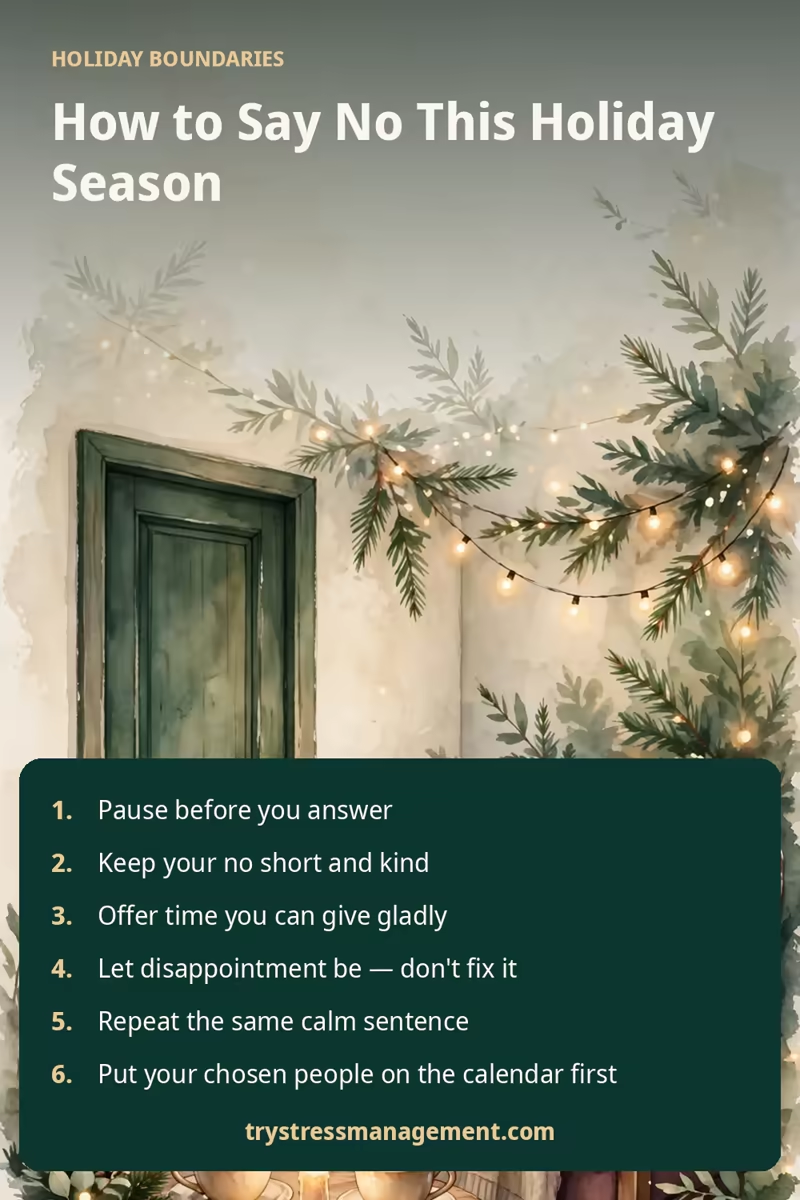
Do not answer an invitation in the moment unless your yes is wholehearted. “Let me check my calendar and get back to you tomorrow” buys you a night to think, a small, practical pause that harms nobody.
Then run the invitation through four questions:
- When I picture myself at this event, what do I feel: glad, flat, or dreading it?
- What will it cost in money, time on the road, and recovery time the next day?
- Who do I most want to see this season, and is this event actually a good way to see them?
- What have I already accepted, and is there room for this without crowding out rest?
Your answers usually sort invitations into three piles. Clear yeses get an immediate, warm acceptance. Clear nos get a decline within a day or two. Either way, the choice is yours, made calmly, not on the spot. The middle pile gets conditions: you will come for the first hour, bring your own car so you can leave, or skip the gift exchange. A conditional yes you can keep is better than a full yes you will resent.
Money belongs in this decision too. Getting there, outfits, and contributions to shared meals add up fast, and financial strain is a real part of the season’s pressure for many households. If cost is the blocker, our holiday gift budget guide shows how to set one total number before the season starts, so individual decisions get easier.
Scripts for declining an invitation
Short is kind. A decline needs three parts: thanks, a clear no, and warmth or an alternative. It does not need a detailed excuse. Long explanations invite negotiation, because every reason you give is a problem the other person can offer to solve. If saying no feels hard in every season and not just this one, our guide to learning the art of saying no politely covers the general skill behind these scripts.
The short text message
“Thank you for thinking of me. I won’t be able to make it this year, but I hope it’s a wonderful evening.”
If you want one sentence of reason, keep it general: “We’re keeping our weekends close to home this year.” General reasons close doors politely. Specific ones (“we have the Hendersons that day”) invite a follow-up about the other day.
The warm phone call
For a close friend or a sibling hosting, a call is warmer than a text:
“Hi, I wanted to tell you myself rather than text it. I can’t make the 20th this year. I’m so glad you asked me, and I want to hear all about it. Can we get coffee the following week instead?”
Notice the shape: early, personal, brief, and it ends with a real alternative. The alternative matters. It tells the person the no is about the event, not about them. That is healthy boundaries in practice: honest about the no, generous around it.
The family elder
Declining a parent or grandparent who treats the day as sacred needs one extra ingredient: respect for the tradition before the no.
“Mom, your Christmas Eve dinner is the heart of the holidays, and I know how much work goes into it. This year I need to stay home with the kids, and I won’t be there. I know that’s disappointing. I’d love to come by on the 27th with dessert and spend the afternoon, if that works for you.”
You are not asking permission. You are informing someone you care about, with enough lead time for them to adjust, and offering time that you can give gladly.
The work event
Office and team celebrations are the easiest declines on this list, because a short professional answer is expected:
“Thanks for including me. I have a family commitment that evening, so I’ll have to miss this one. Have a great time.”
If the event falls in work hours and there is a genuine expectation that you attend, treat it differently: go, stay for a reasonable stretch, and leave when others start to drift. Save your nos for the optional evening and weekend events, where they cost you the most and are noticed the least.
The partial yes
Sometimes you want the people but not the whole production. Arriving after dinner, coming for dessert, or hosting a small breakfast the next morning can keep the connection without the four-hour commitment. Offer the version you can do with good grace, and hold it: “We’ll come at eight for dessert and stay an hour” is a complete plan.
Handling the fallout: guilt trips, pushback, and disappointment
Some declines land softly. Others do not. A few responses cover most of what comes back.
Disappointment. A host is allowed to be sad you are not coming, and you are allowed to let them be sad without fixing it. “I understand you’re disappointed. I’m sorry to miss it” acknowledges the feeling without reopening the decision. Disappointment is information: read it as a sign of how much they value you. It is an emotional moment, not an emergency.
The guilt trip. “After everything I do for this family” or “Your sister would never skip this” is pressure dressed as information. Answer it once, calmly: “I love this family, and this year I need to sit this one out.” Then stop. Do not justify, argue, defend, or explain a second time. Each new round of explanation teaches the other person that enough pressure produces a new round.
The repeated ask. Some people ask three more times, hoping the answer changes. Keep your reply boring and identical: “I know, I wish the timing worked. I can’t this year.” The broken-record approach works because there is nothing new to argue with. If a call starts circling, it is fine to end it kindly: “I need to get going, but I’m glad we talked.”
Pressure by messenger. Family members who call on someone else’s behalf, or who report that “everyone is talking about it,” have handed you a triangle. Step out of it: “I’d rather talk to her directly about it, and I will.” Then do exactly that, briefly, if you want to.
Your own guilt. Guilt after you set boundaries is common, and it usually fades within a few days. Treat it as weather, not as evidence. If you feel anxious before a hard call, a short grounding exercise can steady you long enough to make it. And if, after sitting with it, you find you genuinely want to go, you may change your mind once. Decide from desire, not from pressure, because a yes extracted by pressure tends to sour the event for everyone.
Protect time with the people you do want to see
Boundaries are usually described as walls, but their better use is as a calendar. Before the invitations pile up, put your can’t-miss events in first: dinner with your partner or the friend who makes you laugh, the small gathering your kids look forward to, one slow morning that belongs to nobody. Then decline around them. “We already have plans that weekend” is an honest answer when the plan is rest or time with your favorite people, and you do not owe anyone the details of those plans.
A few habits help the chosen time survive the season:
- Keep the holiday gatherings you host small, early, and short. Two hours with food people can hold beats a five-hour production. If you are the one hosting Thanksgiving this year, our Thanksgiving hosting guide has a calmer way to plan it.
- Leave at least one unscheduled evening after every big event. Travel and late nights cost more than they appear to.
- Say yes slowly all season, not just to the events you dread. Every yes spends from the same budget of energy.
Protecting time this way is not selfish in any useful sense of the word. You show up better for the people you picked, because you are rested enough to be present with them.
What to do with the time you get back
An evening you declined is not an empty slot to fill with chores. Decide about it while your resolve is fresh: something that brings you a little joy, like a walk, a bath, a film with a favorite person, or an early night. A simple evening routine of your own makes the quiet night feel like yours. If the freed time quietly becomes laundry and email, you will feel the loss of the party without the gain, and next year’s no gets harder.
If this time of year still feels heavy after you have trimmed your calendar, the problem may be bigger than the calendar. Our guide to coping with holiday pressure looks at the other common drains, money, grief, loneliness, and family tension, and what tends to help with each. Small, mindful cuts in several places usually work better than one dramatic stand.
Start the season rested
Join the free email list and we will send you Sleep Better Tonight, a one-page 10-minute evening wind-down routine, plus one calm, practical email a week. Get the free routine
Frequently asked questions
How far in advance should I decline?
As soon as you have decided. Earlier is kinder, especially if the host is cooking, hiring help, or counting seats. A decline three weeks out is a minor adjustment. The same decline two days out is a problem you created. Decline early and the host still has a good time; the seat gets filled, or the table gets cosier.
Do I have to give a reason?
No. Thanks, a clear no, and warmth are a complete message. One brief, general reason can help with close family who would otherwise worry (“we’re keeping things very low-key this year”), but a detailed excuse invites solutions, exceptions, and debate. Clear, kind wording is how you set boundaries without starting an argument.
What if I already said yes and now I want out?
You can change a yes, once, with honesty and as much notice as possible: “I said yes too fast, and I need to step back. I’m sorry, I know that affects your planning.” Do not invent an illness. Do it rarely, because a reputation for cancelling makes future invitations, and future nos, harder.
What if the host stops inviting me in future?
That can happen, and it is usually slower and rarer than people fear. Stay warm in the other direction: invite them to something small, remember the birthday, ask about the event afterward. Relationships you maintain in ordinary ways survive a missed party. Small, regular chances to connect do more than one reluctant appearance.
Is it rude to decline a family invitation two years in a row?
No. Lives change shape: babies, jobs, distance, health, money. A pattern of absence paired with continued warmth reads very differently from withdrawal. Keep the connection alive in other ways, send a text on the day, plan to celebrate together in January, and let the record speak for itself.
A note on this guide
This article is general educational information about communication and stress, not medical or mental-health advice, and it cannot replace guidance from a qualified professional who knows your situation. If holiday stress feels overwhelming or constant, or you notice changes in your sleep, mood, or ability to cope, consider talking with a healthcare professional you trust.

Hi, I’m Sophia! Welcome to my blog Try Stress Management (trystressmanagement.com), where I share simple, down-to-earth ways to handle stress and bring more calm into everyday life. Think of me as your friendly guide, offering practical tips, reflections, and little reminders that we’re all figuring this out together.
When I’m not blogging, you’ll usually find me with a good book, sipping tea, or exploring new walking trails. I believe small changes can make a big difference—and that a calmer, happier life is possible for everyone.