

If stress has quietly pulled you away from the people in your life, the way back does not start with a big night out or a packed calendar. It starts with one small step: a short message, a ten-minute coffee, a walk with one friend. Small steps ask little of you on a day when you already feel stretched, and each one makes the next feel slightly easier. Left alone, though, a short spell of keeping to yourself can deepen into social isolation, and that is what this guide helps you avoid.
Pulling back when life feels heavy is common. In the American Psychological Association’s Stress in America 2026 survey, 47% of adults said they had pulled back from at least one form of social participation in the past year because of stress, uncertainty, or feeling overwhelmed. The pattern was strongest among younger adults: 62% of those ages 18 to 29 said the same, compared with 51% of adults ages 30 to 45, 47% of those ages 46 to 61, and 29% of those ages 62 to 80. The survey was conducted online by The Harris Poll from July 29 to August 24, 2026, among 3,132 adults ages 18 and older in the United States, and the report was released on October 22, 2026. You can read the full findings in the APA Stress in America 2026 report.
What the APA survey found
The 47% figure covers pulling back from at least one form of social participation, not cutting off friends entirely. The activities people cut most often were social activities and gatherings (31%), hobbies they once enjoyed (27%), and community activities (16%). The first things to go tend to be the optional, enjoyable parts of social life, the parts that take planning and energy, rather than obligations that cannot be skipped. What shrinks first is everyday social contact: the chat after a meeting, the hobby group, the regular call. Social interaction with friends, family, and community is usually the buffer that makes a stressful season bearable, which is why losing it matters.
The survey also asked about feelings of isolation. About half of adults said they at least sometimes felt isolated (51%), left out (49%), or lacking companionship (48%). Those numbers describe how people felt, not a diagnosis, and they sit alongside the withdrawal figures as a reminder that pulling back and feeling alone often travel together. Feeling left out is a small taste of social exclusion, and when it repeats it can color how you read every invitation that follows.
One caution matters. The survey asked people to report their own behavior and feelings, so it shows a link between stress and pulling back, not proof that one caused the other. Money worries, work pressure, health concerns, and plain exhaustion can all pile up at once (social stressors rarely arrive one at a time), and the survey cannot separate which did the pushing. What it can say is that stress-related withdrawal is widespread, and younger adults report it most.
Social withdrawal, social isolation, and loneliness are not the same thing
The three terms get used interchangeably, but they describe different things, and the difference helps you pick the right next step. Social withdrawal is the behavior: declining invitations, leaving messages unanswered, choosing to stay in. Social isolation is the state that can follow when social contact drops away for a long stretch — fewer conversations, fewer shared activities, a smaller circle. Loneliness is the feeling: the gap between the connection you have and the connection you want. Loneliness and social isolation often arrive together, but not always. You can be rarely alone and still lonely, and you can spend a quiet week by choice and feel fine.
In this article, social withdrawal and isolation are treated as points on one slope. A few weeks of withdrawal is common and usually reversible with small steps. The risk of social isolation grows when the weeks stretch into months and the decreased social contact becomes your new normal. That is the pattern worth interrupting early, while the steps back are still small.
Why it matters for your health
Researchers who study loneliness and social isolation have linked long stretches of low social connection with poorer mental and physical health. The reported health effects include higher rates of depression and anxiety, worse sleep, and strain on physical health over time, particularly for people who already live with other health conditions. None of that means a quiet month causes illness. It means social connection works a little like sleep or movement: a basic support your mind and body quietly rely on. Poor social support rarely makes headlines the way a single stressful event does, but it removes the buffer that helps you cope with everything else — the friend who listens, the relative who notices, the group that expects you.
The practical takeaway is modest. You do not need a packed social life. You need enough regular social contact that support is there when a hard week lands, and enough connection that your days do not narrow to work, screens, and sleep.
Why stress makes pulling back feel easier
When you are already running low, social plans can feel like one more demand. A dinner invitation means choosing clothes, driving somewhere, keeping up a conversation, and staying until a polite moment to leave. On a stressed week, each of those small tasks can feel heavy, and staying home feels like the only way to protect what little energy is left.
There is also the worry about showing up as less than your best self. Many people cancel because they do not want friends to see them tired, flat, or distracted. That choice makes sense in the moment, and it can quietly make the next invitation harder to accept, because now there is a gap to explain as well. For some people, social anxiety is part of the picture too: the worry about being judged or saying the wrong thing makes social situations feel costly before they even start. Occasional nerves are ordinary. Social anxiety disorder is a specific, diagnosable condition, and if fear of social situations is ruling your choices, a mental health professional can help you work out what support fits.
Stress can also shrink your sense of time. When the week feels full, a two-hour gathering can look like a luxury you cannot afford, even when the rest of the evening would otherwise go to scrolling on the couch. The cost feels concrete and immediate, while the lift from seeing a friend feels vague and far off. Your response to stress is doing what it evolved to do — conserve energy, avoid extra demands — but it cannot tell the difference between a threat and a friend’s birthday dinner.
None of this means you are bad at friendship. It means your capacity is low right now, and the social life you build has to fit the capacity you have: keep the steps small, keep the exits easy, and let contact stay light until it starts to feel good again. High levels of stress shrink everyone’s social behavior for a while; the goal is not to perform your old social life, but to keep a thread of connection intact until your capacity returns.
Signs of social withdrawal: withdrawal or a needed break?
Some time alone is rest; some is avoidance that slowly makes things harder. Telling the two apart helps you choose the next step instead of drifting. Understanding social withdrawal in your own life starts with honest pattern-spotting, not self-criticism.
The common signs of social withdrawal are quiet ones: invitations declined by default, messages left unanswered for days, hobbies dropped, calls avoided, and a growing relief when plans are cancelled. Experiencing social withdrawal like this for a week or two after a hard stretch is unremarkable. It deserves more attention when it spreads or sticks.
A break tends to have a shape. You know what you are resting from, you have a rough idea of when you will feel ready to return, and the time alone leaves you a little steadier. A break also tends to be selective: you pass on the loud party but still answer your closest friend’s messages.
Withdrawal tends to spread: one skipped plan grows into unanswered messages, avoided calls, and a shrinking circle of contact. The time alone does not restore you; it leaves you more tired and more convinced that reaching out will be awkward. Researchers sometimes group these patterns under social withdrawal symptoms, but you do not need a clinical label to notice the direction of travel in your own week.
If you are unsure which one you are in, try a small test: send one short, honest message to a person you trust. If the idea brings relief, even mixed with nerves, you are probably ready for a small step back toward people. If even that feels impossible for days on end, or if low mood, anxiety, or sleep problems have been heavy for weeks, that is worth raising with a qualified healthcare professional. Persistent withdrawal can travel with mental health problems such as depression, and mental health conditions are treatable — support exists, from your own doctor to local mental health services and national mental health resources, and asking early is a strength, not an escalation.
Five low-pressure ways to reconnect
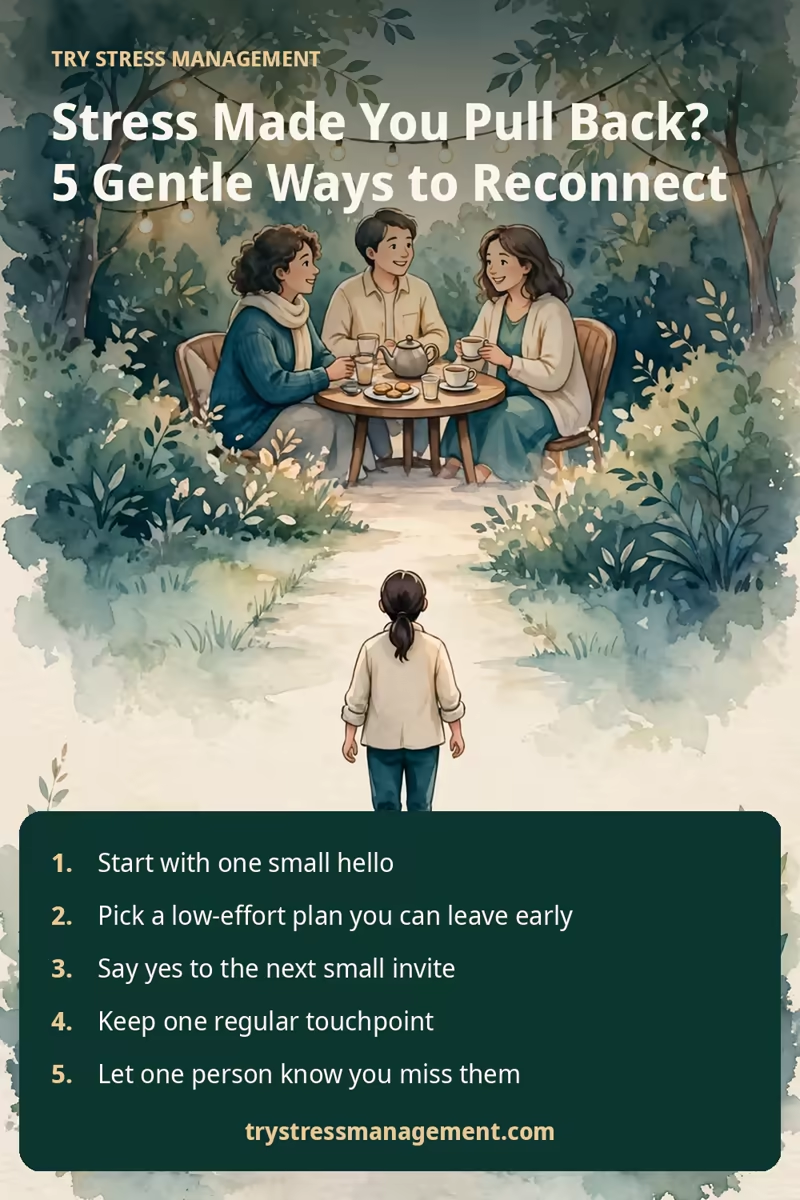
These five steps run from lightest to slightly more involved. Pick the one that feels most doable this week, and let the rest wait. Each one restores a little social engagement without demanding the full version of your old social life.
1. Start with one small hello
A full conversation is a lot to ask of yourself when you have been quiet for a while. A small hello is not. Send a short message to one person: a photo of something that reminded you of them, or a simple line like “Thinking of you, hope your week is going okay.” That is the whole step. You do not owe an explanation for the gap, and you do not need to promise a plan.
Short messages work because they reopen a door without asking you to walk through it. Most friends are glad to hear from you, and a brief note gives them an easy way to answer. Either outcome counts.
Pick someone low-stakes for the first hello: the friend who always answers kindly, or the neighbor who waves when you pass. Save the complicated relationships for later, when you have more energy to spare.
2. Pick a plan you can leave early
The hardest part of accepting an invitation is often the open-ended commitment. Fix that before you say yes: choose plans with a natural end, a coffee before an errand or a walk with a set route, and tell the other person your limit up front: “I have about forty minutes, and then I need to run.” Knowing the exit is there makes it far easier to walk in. Plans like these are social situations with the pressure removed: a defined start, a defined end, and one person you like.
Short plans also protect the quality of the time: forty present minutes beat two distracted hours.
If even forty minutes feels like a lot, shrink the plan further: a fifteen-minute walk around the block counts, and so does sitting on a porch with tea.
3. Say yes to the next small invite
When an invitation arrives while you are pulling back, the reflex is to decline first and think later. Try reversing the order: pause, and ask whether this particular plan is actually hard, or whether you are answering the whole pile of stress at once. If the plan is small and the person is kind, say yes and sort out the details after. Saying yes more often is also how social relationships quietly repair themselves: most friendships do not need a big conversation, they need repeated small evidence that you still show up.
One yes does not commit you to every invitation that follows. It is a single outing, not a new social calendar. Say yes to the kind of plan that suits your current energy: a quiet coffee over a loud party, a one-on-one over a group dinner.
If the day arrives and you feel flat, you can still go and keep it short. Showing up tired is allowed: listening and being there is enough, and most friends would rather have the tired version of you than no version at all.
4. Keep one regular touchpoint
One-off plans take effort to arrange, and that effort is exactly what stress makes hard. A regular touchpoint removes the arranging: one recurring thing with one person, such as a Sunday morning call with a sibling or a Wednesday walk with a neighbor. Same time, same person, no planning needed each week. It also protects the frequency of social contacts, which matters more than the size of any single gathering. Your social network does not need to be large; it needs a few live threads. Social network size is a poor score to chase — two or three people you actually speak to each week will carry you further than thirty names you never contact.
Regular touchpoints carry you through the weeks when your motivation dips. You do not have to decide to reach out; the slot is already there, and the other person knows where to find you.
Start with one, and keep it modest. A weekly ten-minute call beats a monthly three-hour dinner that keeps getting postponed. If you already have a touchpoint that faded, reviving it is often easier than building a new one. In-person social time counts double for most people, so when you can, make the touchpoint a walk or a coffee rather than another screen.
5. Let one person know you miss them
This is the most direct step, and often the most relieving. Tell one person, in your own words, that you have been keeping to yourself and that you miss them. You do not need to explain everything or apologize at length: “I have been overwhelmed and I have gone quiet, but I miss talking with you” says enough.
People tend to respond to honesty with relief: they have often been wondering whether they did something wrong. A short, honest message clears that worry and takes the pressure off the next meeting, because the gap is no longer unspoken.
If saying it face to face feels too much, write it. A message gives you time to choose your words, and it gives the other person time to take them in. One person now knows where you stand, and the friendship has a door open again. Honest moments like this are the raw material of social support: people cannot support you through a hard season if they do not know it is hard.
What to say when you decline, and when you come back
Declining well protects a friendship, and returning well restarts one. Both are easier with a few ready-made sentences.
When you need to say no, keep it short, warm, and specific about the limit rather than about the person. “Thank you for inviting me, I need a quiet evening tonight, but I would love to see you next week” is a complete answer. “I cannot make Saturday, but I am free for a walk on Sunday morning” keeps the door open. You do not need to give a reason beyond tiredness, and you do not need to apologize more than once.
When you are coming back after time away, lead with warmth and keep the explanation brief. “I have been lying low while life has been a lot, and I have been thinking about you” works for most friendships. “Sorry I went quiet, work has been heavy, how have you been?” works when the gap is short. Our guide to declining invitations kindly has more scripts for trickier invitations, including family gatherings.
One small step this week
Here is a seven-day version: one small thing a day. Skip any day that does not fit, and repeat a day you liked instead. The goal is contact, not a perfect week.
| Day | One small step |
|---|---|
| Monday | Send one short hello to one person you trust |
| Tuesday | Reply to one message you have been putting off, briefly |
| Wednesday | Take a ten-minute walk, and invite someone to join you next time |
| Thursday | Accept one small invitation, or propose a short coffee |
| Friday | Share something small: a photo, a song, a short note |
| Saturday | Keep one plan with a clear end time, and leave when it comes |
| Sunday | Set one regular touchpoint for next week, and tell the person |
At the end of the week, notice what happened rather than grading yourself. Keep the steps that felt good, shrink the ones that felt heavy, and drop the ones that did not fit.
If none of the steps happen, that is information, not failure. It may mean the steps were too big or the week was too full. Shrink the first step further: a single emoji reaction to a friend’s post counts as contact.
Our Mental Health pillar guide covers the wider picture, including mental health issues that can sit underneath a stressful season, and our guides on overcoming feelings of isolation and loneliness and how social connection eases isolation go deeper on the loneliness side of it.
Free printable: Sleep Better Tonight
A 10-minute evening wind-down on one page: dim lights, screens off, tomorrow’s worries onto paper, a gentle stretch, and slow breathing — the same wind-down that closes a long week. Join the free email list and the PDF arrives in your inbox. Print it and keep it by the bed.
Frequently asked questions
Is it normal to pull away from friends when stressed?
Yes. The APA survey found 47% of adults had pulled back from at least one form of social participation in the past year because of stress, uncertainty, or feeling overwhelmed. It is a common response, not a personal failing. The part worth watching is whether the pulling back keeps spreading after the stressful period eases.
How do I reconnect after ignoring messages for weeks?
Send one short, warm message and keep the explanation brief: “I have been overwhelmed and gone quiet, but I have been thinking of you.” Most people respond with relief rather than blame, and you do not need to answer every missed message before you can talk again.
What if I do not have the energy to be social at all?
Then shrink the step until it fits the energy you have: a two-minute message counts, and so does a ten-minute walk. If even that feels out of reach for days at a time, or if low mood or anxiety has been heavy for weeks, talk with a qualified healthcare professional about what support might help.
Should I tell friends I have been stressed?
Share as much or as little as you like. A simple “life has been a lot lately” is enough for most friendships, and it usually makes the other person more understanding, not less. You do not owe anyone a full account.
How long does it take to feel connected again?
There is no set timeline. Many people find that one or two easy, pleasant contacts make the next ones feel lighter, while rebuilding a whole social routine takes weeks. The pattern that helps most is small and regular, rather than large and rare.
This article offers general educational information about stress and social connection. It is not medical advice, and it is not a substitute for care from a qualified healthcare professional. If you are struggling with persistent low mood, anxiety, or thoughts of harming yourself, please reach out to a healthcare professional or a crisis support service in your country, such as the 988 Suicide and Crisis Lifeline in the United States (call or text 988).

Hi, I’m Sophia! Welcome to my blog Try Stress Management (trystressmanagement.com), where I share simple, down-to-earth ways to handle stress and bring more calm into everyday life. Think of me as your friendly guide, offering practical tips, reflections, and little reminders that we’re all figuring this out together.
When I’m not blogging, you’ll usually find me with a good book, sipping tea, or exploring new walking trails. I believe small changes can make a big difference—and that a calmer, happier life is possible for everyone.