
This is Part 1 of Sleep Better Tonight, our five-part series on building an evening that actually leads to sleep. Each part stands on its own, and each one adds a piece of the routine. Part 2, on light and screens, is already live.
A 10-minute wind-down routine helps you fall asleep faster because it gives your body the signals it needs to switch off: dim light tells your brain to release melatonin, a fixed wake time steadies your circadian rhythm, and putting the day’s worries on paper stops them looping once the lights go out. This nighttime routine takes ten minutes, uses nothing you need to buy, and works best when you do the same steps in the same order each night. If your nights currently run to 1 or 2 a.m. and eight hours still leaves you tired, this is the place to start.

Why winding down helps you fall asleep
Sleep is not a switch you flip. It is a slow handover, and your body runs it on cues: light, temperature, and habit. The science of sleep calls the master clock your circadian rhythm, a roughly 24-hour cycle that decides when melatonin rises and when your body temperature falls. Your sleep cycle runs on light and routine, and each cue is a signal to your body that sleep is coming. When you keep irregular hours, scroll in bright light late at night, and climb into bed wired, those cues contradict each other, and the time it takes to fall asleep (what sleep medicine calls sleep latency) stretches out.
A short, regular routine fixes the cue problem. Dimming the lights in the last hour before bed lets melatonin rise on schedule. A warm shower or gentle stretch lowers it as you cool down afterward, which is one of the body’s strongest sleep signals. Doing the same steps in the same order teaches your brain that this sequence means sleep is coming. That is the whole idea behind sleep hygiene: small, repeatable habits that protect the conditions sleep needs, rather than one big fix. Good sleep health is built from small habits like these, repeated nightly.
Some research suggests a regular evening routine can improve sleep quality more than any single trick, because it works on several cues at once. The Sleep Foundation’s guide to bedtime routines for adults makes the same point: consistency matters more than the exact activities you choose. Whether you call it a wind down routine or a calming bedtime routine, the shape is the same: ten minutes, five steps, in a fixed order. The simplest way to wind down before bed is to give the evening a shape and then repeat it.
The 10-minute wind-down routine, minute by minute
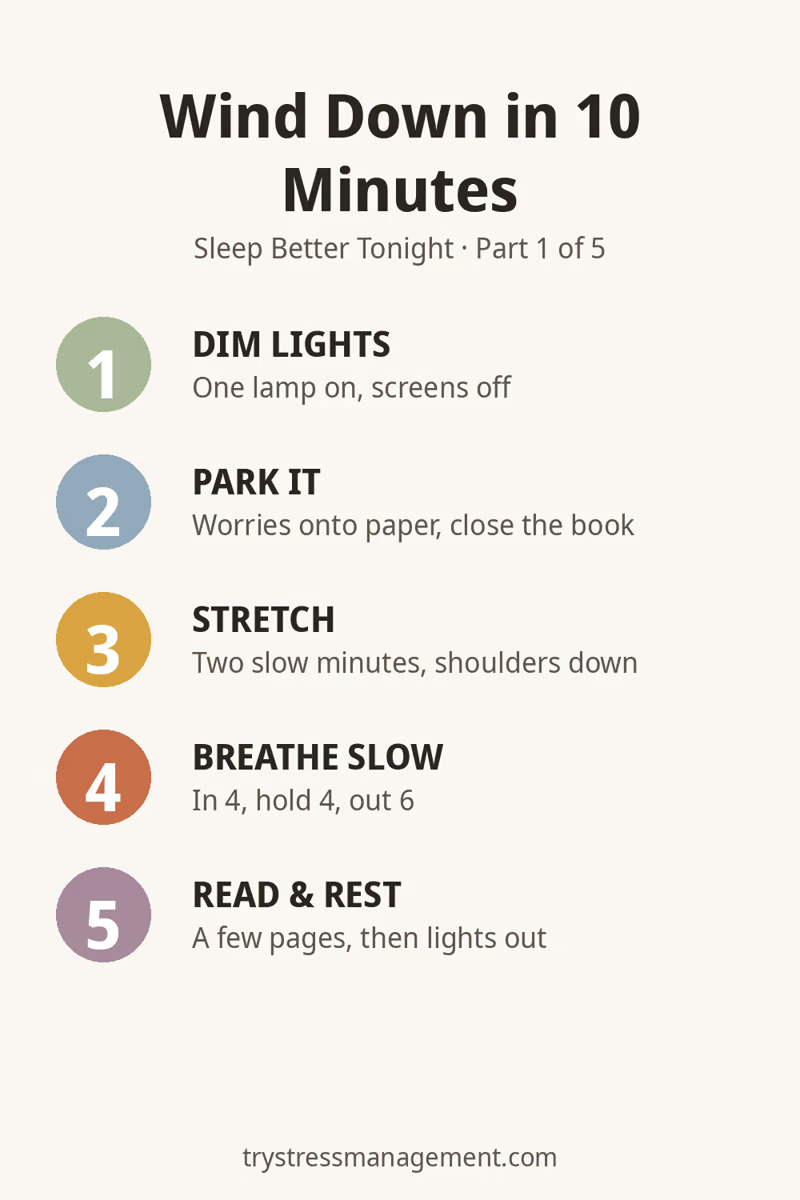
Start ten minutes before you want to be asleep, not ten minutes before you want to be in bed. Set a quiet alarm if it helps you begin on time. The point is not to rush through the steps; it is to do each one slowly enough that your body and mind notice the gear change.
Minutes 0–2: Dim the lights and put the phone to bed
Turn the overhead lights off and switch to one lamp. Move your phone to charge outside the bedroom, or at least across the room on silent. Bright screens and blue light late in the evening keep your brain in daytime mode, so this is the step that does the most work. If you usually work late, draw the line two hours before bed for email and news; the last hour belongs to the routine. This is wind-down time, not catch-up time.
Minutes 2–4: Write the day down and park it
Take a notebook and a pen. Write down anything still open: tomorrow’s tasks, the conversation you keep replaying, the worry that will probably surface the moment the room goes quiet. Two or three lines each is enough. Then close the notebook and leave it outside the bedroom. The paper holds the thought so your head does not have to. If racing thoughts are your main problem at night, our companion guide on quieting a racing mind before bed goes deeper into this step, with a longer paper wind-down for the nights when two minutes is not enough.
Minutes 4–6: Stretch and cool down
Stand up and stretch slowly: arms overhead, a gentle twist each way, shoulders rolled back, then a slow fold toward your toes. A warm shower works here too, and helps you unwind before bed. The cooling afterward is part of the effect: as your body temperature drops, sleepiness rises. Move slowly and breathe through your nose. Nothing here should raise your heart rate; the aim is to let your muscles and your mind unwind together.
Minutes 6–9: Slow breathing
Sit or lie down and breathe slowly for three minutes. Breathe in for four counts, hold for four, breathe out for six. Longer exhales nudge your body toward rest, and counting gives a busy mind something simple to hold. Slow breathing can help you relax before bed, and as your mind and body relax, your breathing slows and the day loosens its grip. Box breathing works the same way if you prefer equal counts.
Minutes 9–10: Read a page, then lights out
Reading a book helps you relax before bed (paper, not a screen), and a few pages are enough. In the last few minutes before bed, keep the light low and let your eyes get heavy. When you feel sleepy, put the book down and turn the lamp off. The last thing before getting into bed is the book, not the phone. The routine is done. You are ready for bed. Put the book down. It’s time for sleep.
Your printable 10-minute wind-down checklist
Keep this list by the bed and run through it to prepare for sleep, in order, every night until it becomes automatic.
- 10 minutes before sleep: dim the lights to one lamp
- Phone charging outside the bedroom, on silent
- Notebook: write down open tasks and worries, then close it
- Two minutes of slow stretching or a warm shower
- Three minutes of slow breathing, out-breath longer than in-breath
- A few pages of a book in dim light, then lights out
- Same wake time tomorrow morning, whatever tonight brings
Set your wake time first
The routine works best when it is anchored at the other end of the night. Pick one wake time and hold it every day, weekends included, even after a bad night. A steady wake time anchors the whole body clock more than bedtime does, because morning light and a fixed wake-up set the timing for the next night’s sleep signal. If you sleep in after a rough night, you borrow sleep from the night ahead and the cycle slips later again. If your body clock is still off after a time change, our 3-day sleep reset plan walks through the same anchors day by day: fixed wake time, morning light, calm last hour. Getting enough sleep starts with a steady wake time, and a set bedtime matters less than a set wake time, but it still helps to go to bed at roughly the same time each night.
This is also why the routine has to be a regular routine, not a sometimes routine. A consistent sleep schedule is what turns ten minutes of effort into a real change in sleep habits. Same wake time, same wind-down, same order. Give it a week before you judge it. Sleep debt built over months does not clear in one night, and the first two or three nights may feel no different. Most people notice the change somewhere in the second week, when the sequence starts to feel automatic: they drift off sooner, and researchers would call that faster sleep onset. People who keep the routine say they sleep more soundly, and a steady schedule protects REM sleep and deep sleep alike.
Wind-down activities that help, and ones that quietly hurt
Not every relaxing activity actually helps you sleep. A short routine can help you sleep better than any gadget. The test is simple: does it lower light, lower stimulation, and lower your heart rate? Reading a book passes. A warm bath passes. Gentle stretching, journaling, and slow breathing pass. To sleep well, protect the last hour of the day. Keep the last hour of the night before bed screen-free. What fails the test is anything bright, urgent, or open-ended: scrolling, news, work messages, a tense show, or a game that keeps you chasing one more round. When work and sleep collide after dinner, the work usually wins, so skip work email right before bed.
Two habits deserve a special mention because they feel harmless and quietly disrupt your sleep. The first is the long afternoon nap: a short nap before 3 p.m. is fine, but two hours at 5 p.m. steals sleep from the night ahead. The second is caffeine late in the day. Late caffeine’s impact on your sleep lasts for hours, so keep it away from the hours close to bedtime and move your last coffee to early afternoon while you are building the routine. And keep the bedroom for sleep: for optimal sleep, keep the room cool, dark, and quiet, since a good sleep environment makes the wind-down’s job easier while a bright room full of chargers and screens works against it. How light affects your sleep is simple: bright light late tells your brain it is still daytime.
When your mind races anyway
Some nights the routine will not be enough, and that is normal. A stressful day, a looming deadline, or a conversation you cannot stop replaying can keep your mind running long after the lights go out. When you want to sleep but your mind will not stop, do not lie there trying to force it. Trying to sleep is one of the fastest ways to stay awake. Get up, go to a dim room, read a few pages or write the looping thought down, and return to bed when you feel drowsy. Stay calm about a bad night; one rough night does not undo a week of steady evenings.
If racing thoughts are a nightly pattern rather than an occasional bad night, read our guide to quieting a racing mind before bed, which builds a longer paper wind-down for exactly this problem. And if sleep problems persist for weeks, or you suspect a sleep disorder such as apnea or chronic insomnia, talk to a qualified healthcare professional. A routine can improve sleep, but it cannot diagnose or treat a medical condition, and persistent sleep problems deserve a proper check.
Make it yours: a routine for better sleep that survives busy nights
Your best sleep comes from a routine you keep. There is no single perfect wind-down routine — the one that works is the one you actually do. Our guide to sleeping better with anxiety and stress covers the bigger picture: why stress disrupts sleep, and the full set of sleep habits that protect it. Start with the ten minutes as written. If a night is too short for all five steps, keep the order and shorten the steps: one minute of writing, one minute of stretching, one minute of breathing. A short version done every night beats a perfect version done twice a week, because routine matters more than length. The same steps, night after night, are what teach your body the sequence.
Over the next four weeks, this series adds one piece at a time. Part 2 covers light and screens: how to dim your way to sleepy when the whole house glows. Part 3 is a longer paper wind-down for racing thoughts, Part 4 covers temperature and baths, and Part 5 is the three-minute version for the nights when even ten minutes feels like too much. Each part stands alone, so you can start here and add the pieces that fit your evenings.
A few small choices make the routine easier to keep. Prepare yourself for sleep the way you prepare for the morning: lay out the notebook, set the lamp, charge the phone outside the room before the ten minutes begin. Keep the routine at the same time for bed each night so your body learns the signal. And notice what changes: many people find they drift off sooner within a week, wake less during the night, and feel less groggy in the morning. The goal is quality sleep, not just more hours in bed. A restful sleep leaves a different kind of morning behind it, and that is what a good night’s sleep is really about: not just more hours, but better hours. The payoff is a restful night and a clearer morning. By the last step you are ready for sleep, and the time to sleep has arrived.
If this routine helps, the free Sleep Better Tonight printable puts the whole ten minutes on one page: the checklist, the breathing counts, and the wake-time anchor, so you can keep it by the bed. Join the free email list at https://trystressmanagement.com/subscribe/ and the PDF arrives in your inbox.
Free printable: Sleep Better Tonight
The 10-minute evening wind-down from this guide on one page: dim lights, screens off, tomorrow’s worries onto paper, a gentle stretch, and slow breathing. Join the free email list and the PDF arrives in your inbox. Print it and keep it by the bed.
Frequently asked questions
How long before bed should I start the routine?
Start ten minutes before you want to be asleep. If you like a longer runway, begin dimming lights and putting screens away in the hour before bed, then run the ten-minute sequence as the final stretch. If ten minutes feels short, our relaxing pre-sleep routine stretches the same ideas across the whole evening. The hour before bedtime is for slowing down; the ten minutes are the routine itself.
What if I drift off during the routine?
That is a win, not a failure. If you drift off during the breathing or the reading, the routine did its job. Just make sure you drift off somewhere comfortable. If you doze off on the sofa most nights, move the last steps into bed.
Can this routine help if I have a sleep disorder?
A routine can help you fall asleep faster, and it is a reasonable part of looking after your sleep. But it is not a treatment. If you snore heavily, stop breathing during the night, or cannot sleep most nights for weeks, those are signs to talk to a qualified healthcare professional rather than trying a new routine alone.
Do I need to do the same routine every night?
Yes — that is the point. A consistent wind-down routine works because your brain learns the sequence. Same steps, same order, at roughly the same time. After a week or two it starts to feel automatic, and the sleepiness arrives earlier in the sequence.
What if I only have three minutes tonight?
Do the short version: one minute writing the day down, one minute stretching, one minute of slow breathing. Part 5 of this series is the full three-minute version, built for the busiest nights.
This article is general educational information about sleep and wellness, not medical advice. If you have ongoing trouble sleeping, a health condition, or concerns about your sleep, please talk to a qualified healthcare professional.
The Sleep Better Tonight series
- Part 1: The 10-Minute Wind-Down Routine (you are here)
- Part 2: Light and Screens — Dim Your Way to Sleepy
- Still to come: racing thoughts at bedtime, the warm-body cool-down, and a 3-minute version of the routine for busy nights
The full sleep library lives on the series hub: How to Sleep Better with Anxiety & Stress.

Hi, I’m Sophia! Welcome to my blog Try Stress Management (trystressmanagement.com), where I share simple, down-to-earth ways to handle stress and bring more calm into everyday life. Think of me as your friendly guide, offering practical tips, reflections, and little reminders that we’re all figuring this out together.
When I’m not blogging, you’ll usually find me with a good book, sipping tea, or exploring new walking trails. I believe small changes can make a big difference—and that a calmer, happier life is possible for everyone.