
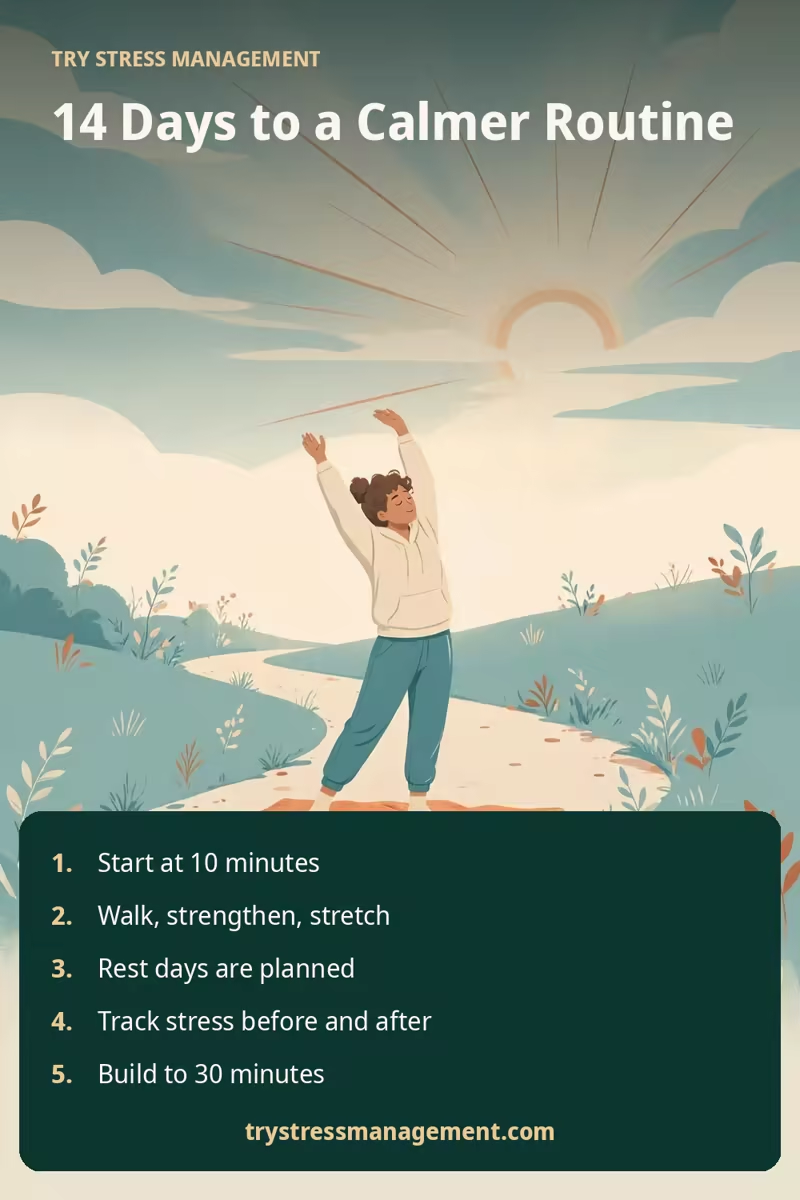
If you have already picked a workout you enjoy from our guide to the best exercises to reduce stress, the next step is a simple workout plan that tells you what to do on each day. This 14-day workout plan for stress relief starts with short sessions in week 1 and builds to 25–30 minutes in week 2, mixing brisk walking, gentle bodyweight work, yoga or stretching, and one longer outdoor session each week. It is a home workout plan — no gym, no equipment — and it is designed for a beginner or anyone getting back into movement after a stressful stretch. Every day is planned for you, rest days are built in, and a missed day never means starting over — you just pick up with the next session on the list.
This plan is a sequel. The original guide explains which exercises may help reduce stress and why movement can support mood and sleep. This one answers the follow-up question readers ask next: how do I turn that list into a routine I can actually follow for 2 weeks?
How this 14-day workout challenge works
Think of the two weeks as a gentle challenge: show up on the planned days, keep the effort moderate, and watch what happens to your stress ratings. Three rules run the whole plan.
First, minutes grow slowly. Week 1 sessions last 10 to 20 minutes. Week 2 sessions last 20 to 30 minutes. You are building the habit of showing up before you build fitness, and short sessions are easier to repeat on stressful days, which are exactly the days the plan is for. Twenty minutes a day is the ceiling in week 1, not the floor.
Second, effort stays moderate. Use the talk test: during the main part of a session your heart rate is up and you should be able to speak in short sentences, but not sing. If you cannot catch your breath, slow down. If you could chat without any change in your breathing, you can pick up the pace slightly. Moderate effort is the level the CDC uses in its adult activity guidelines, and it is enough for the stress-relief benefits most people are looking for. There is no HIIT here and no pushing through pain — intensity is not what makes this work. Consistency is.
Third, rest days are part of the plan, not a break from it. Days 4, 8 and 12 are planned rest or gentle-stretch days. Muscles recover and adapt between sessions, and a plan with no rest days is a plan most people quit by day nine.
What the evidence says, briefly
A 2023 umbrella review in the British Journal of Sports Medicine (Singh and colleagues) combined 97 systematic reviews covering more than 1,000 trials and about 128,000 participants. Physical activity showed medium-sized effects on symptoms of depression, anxiety and psychological distress across a wide range of adults. The authors also found that benefits tended to shrink in very long interventions, which is one reason a focused two-week start can be a sensible way in: it is long enough to notice how movement affects your own stress and anxiety, and short enough to finish.
The CDC’s physical activity guidelines for adults recommend at least 150 minutes of moderate-intensity activity a week, plus muscle-strengthening activity on two or more days. This plan does not reach 150 minutes in week 1, and it is not meant to. It builds toward that range gradually — week 2 lands near 130 minutes of planned movement, with two bodyweight days — so the guideline becomes a direction to travel in rather than a test you pass or fail on day one.
Individual responses vary. Some people feel calmer after a single walk; others notice changes in sleep or patience first, or need more time. Treat your own two weeks as a small experiment and watch what changes for you.
Week 1: start small (days 1–7)
| Day | Session | Details |
|---|---|---|
| Day 1 | Brisk walk, 10 minutes | Walk out of your door, five minutes out and five minutes back. Note your stress level from 1 to 10 before and after. |
| Day 2 | Gentle bodyweight session, 10 minutes | Two rounds of sit-to-stands from a chair, wall push-ups, and standing heel raises, resting as needed. Heel raises double as balance practice. |
| Day 3 | Yoga or stretching, 15 minutes | A slow flow or floor stretches for the neck, shoulders, back and hips — the places stress tends to settle. Work on a mat if you have one, and treat this day as restorative: flexibility and breathing, nothing forced. |
| Day 4 | Rest | Optional five minutes of easy stretching or slow breathing. |
| Day 5 | Brisk walk, 15 minutes | Add one gentle hill or a faster five-minute stretch in the middle if it feels comfortable. Brisk walking is the simplest cardio there is, and it is easy on your joints. |
| Day 6 | Bodyweight plus walk, 15 minutes | Five minutes of easy walking, then the day 2 moves, then five more minutes of walking. |
| Day 7 | Longer outdoor session, 20 minutes | Walk somewhere green if you can. Our guide to hiking for stress relief has route ideas if you want to take this session onto a trail. |
Week 1 totals about 90 minutes of movement across six active days. If a session feels too hard, repeat the previous day’s session instead of pushing through. The plan only works if you come back tomorrow.
Week 2: build the rhythm (days 8–14)
| Day | Session | Details |
|---|---|---|
| Day 8 | Rest | Optional gentle stretching. |
| Day 9 | Brisk walk, 20 minutes | With three faster two-minute intervals in the middle, easing back between each one. |
| Day 10 | Bodyweight session, 20 minutes | Three rounds of the week 1 moves, adding a slow squat to a chair and a standing row with a filled water bottle or light weight if you have one. Together, the week’s two bodyweight days form a simple full body workout plan: legs, pushing muscles, back, and calves all get worked without a single machine. |
| Day 11 | Yoga or stretching, 20 minutes | Hold each stretch a little longer than in week 1, add a minute of slow breathing and mindfulness at the end, and finish rested rather than worked. |
| Day 12 | Rest | Or a 10-minute easy walk if you feel restless. |
| Day 13 | Mixed session, 25 minutes | Ten minutes of walking, ten minutes of bodyweight moves, five minutes of stretching. |
| Day 14 | Longer outdoor session, 30 minutes | Repeat your day 7 route and compare how it felt. Note your stress ratings from the tracker and decide what week 3 looks like. |
Week 2 totals about 130 minutes. By day 14 you have a pattern worth keeping: three walking days, two bodyweight days, one stretch day, one longer outdoor session, and rest in between. That pattern is the routine. The two weeks were just how you installed it.
The 20-minute session template
On busy days, use this timed template with any activity from the plan. It is the same sequence as the 20-minute routine in the original exercise guide, extended with a proper cool-down, and it makes the plan easy to follow when you do not want to think.
- Minutes 0–3: easy warm-up. Walk slowly or march on the spot, roll your shoulders, and let your breathing settle.
- Minutes 3–15: main effort at talk-test pace. Walk briskly, cycle, swim, or repeat your bodyweight moves in a slow circuit.
- Minutes 15–18: ease down. Gradually slow until your breathing is close to normal.
- Minutes 18–20: stretch and breathe. Stretch calves, thighs, chest and neck, taking four or five slow breaths in each position.
Your 14-day tracker
Copy this tracker into a notebook or a notes app, and keep it where you will see it each morning. Two numbers per session — stress before, stress after — plus one word for sleep that night. It takes twenty seconds and it is the part of the plan readers say keeps them going, because after a week the pattern on the page is hard to argue with.
| Day | Session | Minutes | Stress before (1–10) | Stress after (1–10) | Sleep (one word) |
|---|---|---|---|---|---|
| 1 | |||||
| … | |||||
| 14 |
At day 14, look for three things: whether your after-scores are usually lower than your before-scores, which session type gives you the biggest drop, and whether your sleep word improved on active days. Build week 3 around the session that scored best. That is your workout now.
When you miss a day, and other plan problems
You will probably miss a day. Work runs late, a child is sick, the weather turns. The rule is simple: never double up, never restart. Do the missed session tomorrow, or skip it and continue with the next day on the list. A 14-day plan finished in 17 days works just as well, and getting back on the plan after a gap is the skill that makes any regimen stick.
If your stress is worse on a given day, shrink the session rather than skipping it: five easy minutes still counts, and it keeps the chain unbroken. If a movement hurts — sharp pain, dizziness, chest pain — stop, and talk to a healthcare professional before continuing. Soreness a day or two after bodyweight work is common when you are starting; pain during a movement is a signal to change the movement.
If you reach day 14 and hated every session, the plan did its job anyway: you learned the format works and the activities do not. Go back to the original guide’s list, pick a different exercise — swimming, dancing, cycling, tai chi — and run the same 14 days with it. The structure is reusable, and it is a kind way out of a rut: same plan, friendlier activities. For a wider menu of weekly routines, our fitness pillar guide to the top fitness routines to crush stress compares ten options side by side.
A note on scope
This article is general educational information about exercise and everyday stress. It is not medical advice, and it does not diagnose or treat any condition. Research findings are described in general terms and may not apply to your situation. If you have a health condition, an injury, or you have not exercised in a long time, check with a qualified healthcare professional before starting a new exercise plan, and seek professional support if stress is affecting your daily life.
Get more guides like this by email
If this plan helped, join the free email list at trystressmanagement.com/subscribe/. One short email a week with a practical stress and wellness guide — routines, scripts, and plans in the same plain style as this one. No noise, and you can leave whenever you like.
Free printable: Sleep Better Tonight
Movement in the day can make it easier to wind down at night. Get the 10-minute evening wind-down on one page: dim lights, screens off, tomorrow’s worries onto paper, a gentle stretch, and slow breathing. Join the free email list and the PDF arrives in your inbox. Print it and keep it by the bed.
Frequently asked questions
Do I need a gym or equipment for this plan?
No. Walking, bodyweight moves, and stretching cover all 14 days. A chair, a wall, and comfortable shoes are enough. You do not need a set of dumbbells; a filled water bottle can stand in for a light weight in week 2.
Is 10 minutes really enough to start with?
For building the habit, yes. Research on physical activity and mood includes short sessions, and the CDC notes that activity adds up across the day and week. Short daily sessions will do more for your routine than one long session you dread repeating.
What if I already exercise regularly?
Start at week 2, or keep your current sessions and use this plan’s structure — the mix of walking, bodyweight work, stretching, and one longer outdoor session — as your weekly template. Add time or intervals gradually rather than jumping both at once.
Can I swap the days around?
Yes. Keep the pattern — alternate harder and easier days, keep rest days between bodyweight days — and move sessions to fit your week. The order matters less than the alternation.
What should week 3 look like?
Repeat week 2 and add about 10 percent: five extra minutes on the long session, one extra round on bodyweight day, or one extra two-minute interval on the walk. Small additions, kept for another two weeks, will take you close to the CDC’s 150-minute weekly guideline without a single punishing session.

Hi, I’m Sophia! Welcome to my blog Try Stress Management (trystressmanagement.com), where I share simple, down-to-earth ways to handle stress and bring more calm into everyday life. Think of me as your friendly guide, offering practical tips, reflections, and little reminders that we’re all figuring this out together.
When I’m not blogging, you’ll usually find me with a good book, sipping tea, or exploring new walking trails. I believe small changes can make a big difference—and that a calmer, happier life is possible for everyone.