

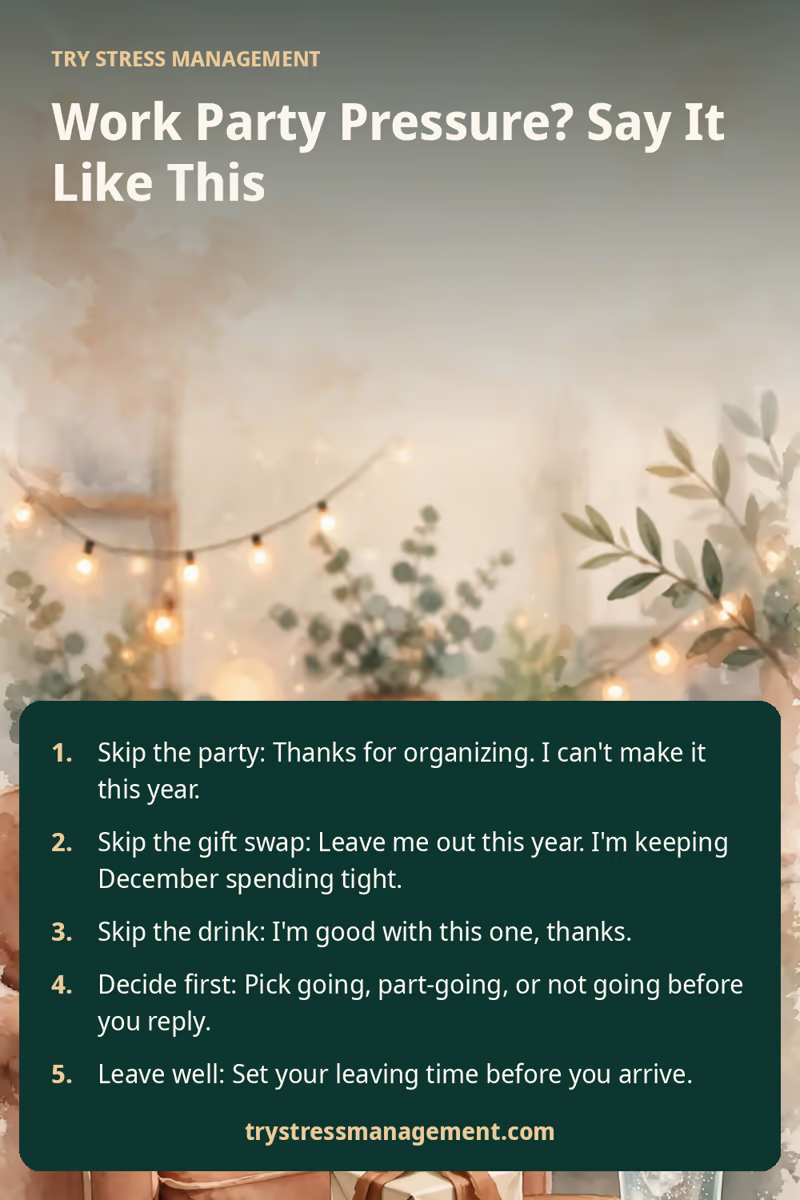
You can skip the office party, sit out the gift exchange, and turn down the drink. Each one takes a single short sentence, said early and said warmly, and none of them needs a detailed excuse. In a FinanceBuzz survey of 1,000 workers, 70% said they had felt pressured to attend a company holiday party, 66% had felt pressured over gift exchanges, and nearly 40% had felt obligated to drink when they did not want to. That squeeze is ordinary, and so is declining. This guide gives you exact words for the three moments that cause most of the stress, plus a short plan for deciding what you actually want before you reply to anyone. The name on the invitation varies — Christmas party or end-of-year dinner — but the three hard moments are the same.

Why a work party feels harder to skip than a friend’s party
A friend’s party has one audience. Office parties have several at once: your manager, the colleague who organized it, the team you will sit with on Monday morning. That is why a simple scheduling choice can start to feel like a career statement, even when nobody intends it that way. What feels at stake is your standing as a team player. A promotion is not decided over canapés, and colleagues gather to celebrate the end of a year, not to score attendance.
Three things tend to pile up in December. The first is visibility: attendance is easy to notice, and absence can feel just as visible. The second is money. Gift exchanges, outfits, travel, and a bar tab add costs to a month that is already expensive for many households. The third is the gathering itself, which often involves alcohol, unstructured small talk, and a late finish on a work night. Underneath the logistics, it is a celebration: a marker at the end of a working year. A celebration does not require a full evening from every guest.
For some people, there is a mental health layer underneath the logistics. Social anxiety can make a room full of colleagues feel closer to an exam, and you do not need a diagnosis to feel anxious in the days before a big office event. Much of the strain is anticipation: the judgment you anticipate beforehand and the replay you run afterward. Psychology has a name for one part of it: the spotlight effect, our habit of overestimating how much other people notice us. A psychologist might add that the dread before an event is often worse than the event. Even without any diagnosis, plenty of people find the run-up to office parties genuinely stressful, and dreading one says nothing about how good you are at your job.
The American Psychological Association’s holiday stress guidance makes two points that apply directly here. In that guidance, the APA’s experts say you may feel pushed to be everything to everyone, and that taking time for yourself is a reasonable response. The APA also suggests keeping expectations realistic: no celebration runs perfectly, and a misstep or an absence rarely matters as much a week later as it seems to on the day. It is one evening in a long working relationship. How you handle it, kindly and clearly, counts for more than whether you were in the room.
Decide what you want before you answer anyone
Most party stress comes from answering before you have decided. The invitation lands, someone asks in the corridor, and a vague yes comes out because a clear answer was not ready. Ten quiet minutes with three questions usually settles it and puts your mind at ease.
Do I want to go at all? Some people look forward to the party itself and feel the strain only around parts of it. Others would rather have the evening back. Both answers are fine, and they lead to different scripts below. Your holiday plans for the rest of the month count here too: an evening at home counts as a plan in its own right.
Which part is the problem? It might be the cost of the gift exchange, the drinking culture, the late hour, the travel home, the feeling that you ought to work the room and expand your network, or the sheer number of December evenings already booked. Naming the specific part matters, because each part has its own fix. You can attend and sit out the exchange. You can attend, hold a glass you chose yourself, and leave at nine.
What is my version of yes, if I give one? A partial yes is a real option at work events: arrive for the first hour, sit out the exchange, bring a card instead of a gift, leave after the meal. Deciding your version in advance means the scripts below become simple deliveries of a decision you have already made, rather than arguments you have to win on the spot.
If the holiday season as a whole feels heavy this year, our pillar guide on dealing with stress and anxiety covers the wider picture, from daily routines to knowing when extra support might help.
Script 1: Skipping the party
A good decline has four parts: thanks, a clear no, one brief reason or none, and a warm close. Send it early. A polite no, sent in good time, gives the organizer a real headcount and reads as considerate. An early answer is the whole of your responsibility here. The evening itself is optional. A late no, or a maybe that quietly becomes a no, is what actually creates friction.
To your manager or the organizer, by email or message:
“Thanks for organizing this. I won’t be able to make the party this year, but I hope it’s a great night. Please don’t hold a place for me.”
If you want to offer something in place of attending:
“I can’t make the evening work this year. I’d still love to mark the season with the team, so I’ll bring something in for our last morning before the break.”
To a coworker who asks if you are going:
“I’m sitting this one out. December evenings are spoken for this year. Tell me how it goes.”
Notice what these leave out. There is no apology tour, no invented emergency, and no detailed account of your December. Long explanations invite negotiation, because every reason sounds like a problem someone could solve for you. If someone pushes, repeat the short version once, kindly, and let the subject change: “I appreciate you asking. This year I need the evening at home.” Then ask them something about their own plans. Most people accept a calm, repeated answer without taking offense.
Family events bring their own version of the same squeeze. Our guide to holiday boundaries has scripts for declining invitations from relatives, including the family elder conversation and what to do when you said yes and need to back out.
Script 2: Opting out of the gift exchange
The strain often peaks at the gift exchange, because opting out feels public, whether your office runs a Secret Santa, a white elephant swap, or a simple name draw. In the FinanceBuzz survey, more workers reported pressure over gift exchanges (66%) than over almost any other party activity. Budgets are the usual reason, and a budget is a complete reason. You do not need to disclose your finances to use it.
Timing helps here too. Opt out when the exchange is announced, before names are drawn. Once names are drawn, leaving creates a gap someone has to fill, so early is kinder as well as easier.
To the organizer, privately:
“Could you leave me out of the gift exchange this year? I’m keeping December spending tight. Happy to help with the setup or the playlist instead.”
In the group chat, if the sign-up is public:
“I’ll sit the exchange out this year, thanks. Looking forward to seeing what everyone gets.”
If you would join at a lower spend:
“I’d love to join if we keep it to cards or homemade treats this year. A set gift budget is more than I can do this December.”
That third script does something useful: it gives the organizer information they may act on. Plenty of colleagues quietly share the same constraint, and a lower-cost format sometimes replaces the exchange for everyone. If the answer is no, accept it gracefully and hold your own line. One more option costs nothing and often lands well: write a genuine thank-you card to the person you would have drawn. Specific appreciation tends to be remembered longer than a wrapped novelty gift.
The squeeze over gifts is rarely only about the office. Around the holidays, the office version and the family version tend to arrive in the same fortnight. If awkward questions and expectations from family are also on your December list, the scripts in our guide to handling awkward holiday questions cover the family-table version of the same skill.
Script 3: Turning down a drink
You do not owe anyone a reason for what is in your glass. The easiest drink to decline is the first one, declined early, with a full glass of something you chose already in your hand. Order or pour your own when you arrive: sparkling water with lime, a soda, a mocktail, whatever you like. People offer refills to empty hands far more often than to full ones. If you would rather keep it plain, drink water with a slice of lime in a real glass; it reads as a choice. An unwanted cocktail can go straight onto the nearest table, untouched, and be left there.
At the first offer:
“I’m good with this one, thanks. What are you having?”
When someone brings you one anyway:
“That’s kind of you. I’ll pass on this one. Do you want it, or shall I find it a home at the bar?”
When the refill push starts:
“I’m set for the night. I’m on water from here, and honestly I’m enjoying it.”
When someone asks why you are not drinking:
“No big reason. I sleep better and I have an early start. How’s your December looking?”
The pattern in each script is the same: a short answer, no debate, and a question back. Turning the conversation toward the other person works because most people who ask are making conversation, not conducting an audit. If one person keeps pushing after two clear answers, you are allowed to end the exchange: “I’ve given you my answer on that one. Let’s talk about something else.” Said evenly, that line closes the topic without a scene.
A short note on scope: these scripts are for handling social pressure in the moment, whatever your reasons for not drinking, and they work whether you are off alcohol for one night or for good. If cutting down or stopping has felt difficult to do on your own, that is a different and more personal question, and a healthcare professional or a support organization can offer real help with it. There is no script-shaped fix for that, and you deserve proper support rather than a party tip.
Your December checklist
Copy this into your notes when the invitation arrives. At this time of year, invitations land faster than decisions, and five minutes with this list replaces most of the rumination.
- Decide: going, going for part of it, or not going. Write the answer down.
- If not going, send the decline within two days of the invitation, using Script 1.
- If the gift exchange worries you, opt out before names are drawn, using Script 2.
- Decide your plan for the bar before you arrive, and pour your own first glass.
- Set your leaving time in advance, and have the trip home arranged.
- Prepare one exit line: “I’ve got an early start, so I’m heading out. Great seeing you.”
- Put one recovery block in the calendar the next day, even if it is only a slow morning.
If you do go: three small things that make it easier
Arrive early. The first half hour is the calmest part of any work party. Conversations are short, groups are still forming, and arriving early makes leaving early feel natural rather than abrupt. Like most social gatherings, it loosens as it goes, and the early part is the easy part. If you are an introvert, this matters twice as much: the early conversations are one-to-one, and one-to-one is how you socialize best. You also catch the festivity while it is still gentle, and you are home before the loud part.
Give yourself a job. Taking photos for the team, helping the organizer with music, or stopping to say hello to the new starter gives the evening a shape. A small role works as a strategy. It removes the standing-around feeling that makes parties draining, and it helps take the pressure off.
Use your exit line and go. Lingering at the door for forty minutes of goodbyes is its own stressor. If your nerve wobbles at the door, give the evening ten minutes before you judge it. Say your line to the host and one or two people nearby, thank them, and leave. Nobody tracks your departure time on Monday.
Boundary skills like these get easier with practice, and they transfer. The same short, warm, early answer works for the extra project, the weekend email, and the meeting that should have been a message. Our guide to setting healthy boundaries walks through the broader pattern.
December will keep arriving with more invitations than evenings. Most people cope with December by choosing a few evenings and protecting the rest. The protected evenings belong to family and friends, the loved ones who would rather have you rested than everywhere. If party dread follows you home and wrecks your sleep, our free email list sends one practical stress guide a week, and new readers start with Sleep Better Tonight, a short printable wind-down routine for busy minds. Join the list here and take the parts of the season you actually want.
Free printable: Sleep Better Tonight
Step 3 on one page: a 10-minute evening wind-down with dim lights, screens off, tomorrow’s worries onto paper, a gentle stretch, and slow breathing. Join the free email list and the PDF arrives in your inbox. Print it and keep it by the bed.
Frequently asked questions
Is it unprofessional to miss the office holiday party?
For most workplaces, no. No employee handbook turns a party into a duty, and unless your employer has stated in writing that attendance is mandatory, it is an invitation, not a requirement. A polite, early decline is a normal professional act, and your boss will read a clear, early answer as ordinary professionalism. What can read badly is a vague maybe followed by a silent no-show. A clear answer, sent early, protects both the organizer’s planning and your standing.
Do I have to give a reason when I decline?
No. “I can’t make it this year” is a complete answer. One brief, general reason can soften the message if you want to offer one (“December evenings are spoken for”), but details invite problem-solving from people who mean well. Keep it short and warm, and repeat the same answer if asked again.
How do I opt out of a gift exchange without it becoming a thing?
Tell the organizer privately, early, and before names are drawn. Name the constraint plainly (“I’m keeping December spending tight”), leave out the detailed finances, and offer a small alternative contribution such as setup help or a card. Most organizers would rather know on day one than discover a gap on the day.
What if a coworker keeps pushing refills on me?
Give the short answer twice: “I’m set, thanks.” If the pushing continues, close the topic directly: “I’ve answered that one. Let’s talk about something else.” Then move, physically if needed, toward other people or another part of the room. You are not obliged to stay in a conversation that ignores a clear answer. How a coworker chooses to behave after that is their responsibility, not yours.
What if I said yes and now I want to back out?
Back out early, briefly, and once. “Something has changed at my end and I can’t make the party after all. I’m sorry for the short notice, and I hope it’s a great night.” Then stop explaining. A single honest change of plan is ordinary; a week of agonizing followed by a no-show is the outcome worth avoiding.
A note on this guide: this article is general educational information about handling social pressure at work events. It is not medical advice, and it does not diagnose or treat any condition. If stress is affecting your health, work, or daily life in a way that concerns you, a qualified healthcare professional can offer support that fits your situation.

Hi, I’m Sophia! Welcome to my blog Try Stress Management (trystressmanagement.com), where I share simple, down-to-earth ways to handle stress and bring more calm into everyday life. Think of me as your friendly guide, offering practical tips, reflections, and little reminders that we’re all figuring this out together.
When I’m not blogging, you’ll usually find me with a good book, sipping tea, or exploring new walking trails. I believe small changes can make a big difference—and that a calmer, happier life is possible for everyone.