

You can set holiday gift boundaries this year, and you can do it without a family meeting, a long explanation, or a January credit card bill. A boundary here is plain: you decide who you are buying for, what the whole season may cost, and which gift obligations you are stepping out of. Then you say each one early, warmly, and once. The boundaries you need to set are few. Set boundaries once, kindly, and the plan carries the rest of the season: holiday gift-giving boundaries are simpler than they feel in November. A November 2026 survey of holiday shoppers found that 79% of holiday gift-giving is guilt-driven, and 45% of respondents expected to take on holiday debt. When most giving runs on guilt, a clear limit is not a character flaw. It is the normal response to a season that asks for more than most budgets hold.
This guide gives you the words first, because the words are the hard part. You will find scripts for opting out of a gift exchange, proposing a family draw, and scaling back with a close friend. After that comes a spending cap you set on paper before you shop, and a short list of gifts to skip, because each skipped guilt purchase is money and stress that never happen. If the wider season is already weighing on you, our pillar guide to dealing with stress and anxiety covers the bigger picture.

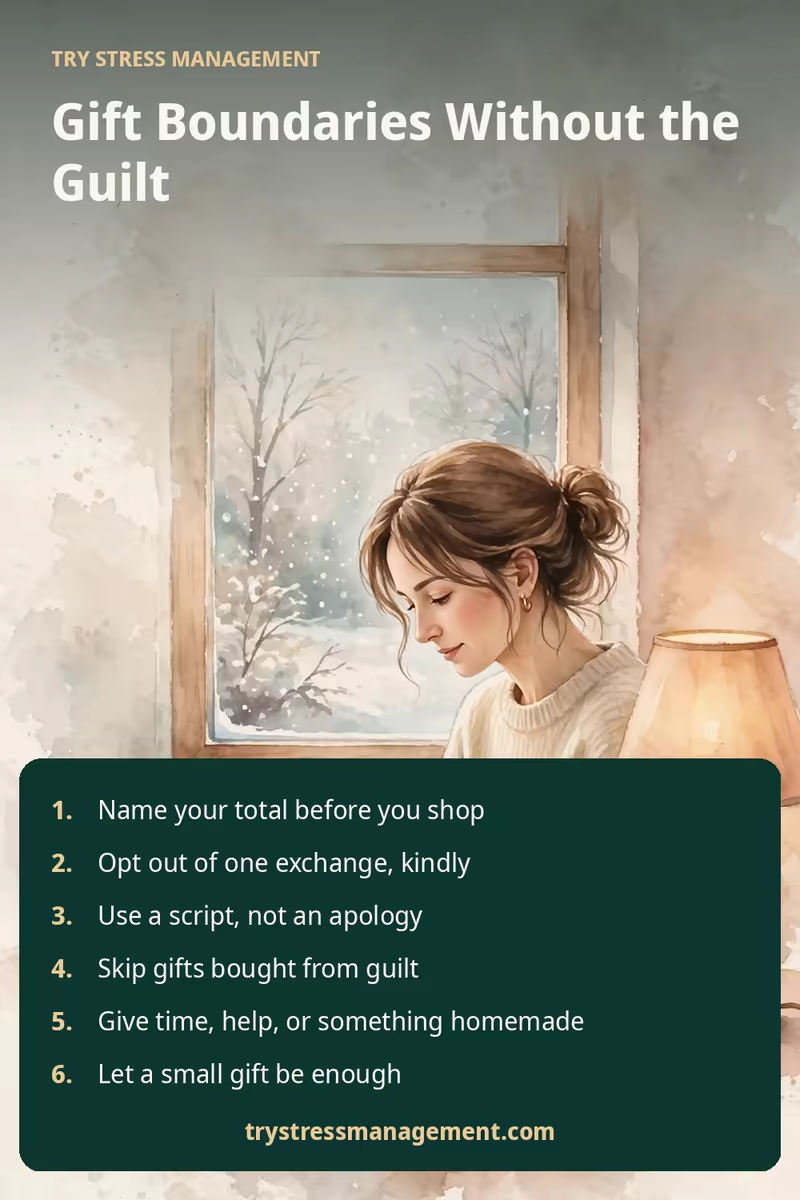
Why guilt runs the gift list
Gift pressure rarely comes from the gifts. It comes from what a gift seems to say. Gift giving runs on unspoken rules, and guilt is the enforcement mechanism. A smaller present can feel like a smaller feeling, even though recipients almost never do that math. Most people remember whether a gift was chosen with them in mind; the price fades within days. The worry lives in the giver, in the days before the exchange, and it grows in the dark.
Three forces usually stack up at once. Reciprocity is the first: someone gave generously last year, so matching them feels compulsory. Comparison is the second: a sibling or coworker spends visibly more, and your own plan suddenly looks thin. Obligation is the third, and it is the quietest. Exchanges, draws, and group gifts renew themselves every year because nobody says the sentence that ends them. The November 2026 survey figures (79% of giving described as guilt-driven, 45% expecting holiday debt) suggest these forces are the season’s default setting, not a personal weakness. By mid-December the holiday stress compounds, and it is easy to feel overwhelmed by a list that guilt wrote. A boundary changes your setting. It cannot change anyone else’s reaction, and it does not need to.
Decide three things before December decides them for you
Boundaries hold when they are decided once, early, in a calm moment. They collapse when they are re-decided in a shop doorway with a basket in hand. Make three decisions this week, while the season is still mostly in front of you.
Decide who is on the list. Write the names down. A written list ends the slow creep of additions (the neighbour, the teacher’s aide, the cousin you see twice a year), each added one guilty thought at a time. People not on the list can still get a card, a call, or an invitation. The list governs presents, not kindness.
Decide the total. One number for the whole season, wrapping and shipping included. The cap section below walks through setting it on paper.
Decide which obligations you are leaving. Pick the exchange, draw, or group gift that costs you the most stress, and plan your exit line now. One exit, said early and kindly, does more for your December than a month of quiet resentment. You can stay in the gatherings. You are only leaving the transaction.
Clear boundaries are just healthy boundaries with a date on them. Decide early and you set healthy boundaries once, instead of renegotiating at every checkout.
Scripts for saying no, word for word
A good boundary script has three parts: warmth first, the limit stated plainly, and an alternative that keeps the relationship in view. It does not include an apology tour, a detailed budget defence, or a promise to reconsider. Say it once, in a normal tone, earlier than feels necessary. Early is what makes it gentle; the same sentence in the final week lands as a cancellation. Boundaries with kindness are still boundaries; the kindness is in the timing and the tone.
Opting out of a gift exchange or Secret Santa
“I am sitting the exchange out this year — I am keeping gifts simple. I would still love to come to the lunch, and I will bring the biscuits.” This works at work, in a book club, or in any group draw. You name your plan, you keep the social part, and you bring something small that is yours to offer. If the organiser pushes, repeat the first sentence once, unchanged, and let the pause do the rest. For the office version of this moment, including the collection that goes around in an envelope, our guide to holiday party pressure at work has scripts for the room itself.
Proposing a family draw or a kids-only year
“Can we try something this year? Names in a hat, one gift each, or gifts for the kids and a long lunch for the rest of us. It would take the pressure off everyone.” Propose it to the family’s organiser first, not to the whole group chat. Many families keep the old system purely because nobody has offered a replacement; a draw keeps the ritual and cuts the list by most of its length in one move.
Scaling back with a close friend
“I love our gift swap, and I am cutting my list right back this year. Can we do cards and a walk instead? I would rather have the hour with you.” Close friends usually receive this with relief, because the same thought has often crossed their mind. Offer the replacement in the same breath, and put a date on it if you can.
When a gift arrives from someone you did not buy for
Accept it warmly and stop there: “Thank you — this is kind of you, and I love it.” Then let the moment close. The scramble to reciprocate within the week is guilt talking, and a rushed return gift pleases nobody. If you want to respond, a handwritten note or an invitation in January carries more weight than a panic purchase, and it arrives when both of you have time to enjoy it.
A spending cap you set on paper, before you shop
A cap works when it is a number with a list attached, not a feeling about the season. Set it this way, once, somewhere quiet:
- Write every name from your list in a column. Nobody gets added later without someone else coming off.
- Choose one total for the whole season that January can carry without skipped bills or money moved from essentials. If last year’s total surprised you, treat that surprise as data and set this year’s below it.
- Divide the total across the names, unevenly if the relationships are uneven. Write each person’s ceiling next to their name.
- Add one line for wrapping, cards, and shipping. These costs are real and they are the usual reason a careful plan still overruns.
- Keep one small buffer line, unlabelled. A plan with no slack breaks at the first surprise; a plan with a named buffer bends.
- Shop from the paper. Anything not on it waits 24 hours before it can be bought, and most of those purchases quietly cancel themselves overnight.
That is the whole method. One number, written down, is how you simplify a month of small decisions. If you want it in more depth, with a worked example and the leaks that catch most people, our holiday gift budget guide walks through deciding the total before you shop. This article is general educational information about stress and spending habits, not personal financial advice. Your income, debts, and obligations are your own picture; if money decisions feel heavy or complicated, a qualified financial professional can look at your specific situation with you.
Gifts to skip this year
Some gifts cost stress out of proportion to any pleasure they give. Skipping them is a boundary too, and it needs no conversation at all. If you are the giver in any of these, the same list is your permission slip.
The guilt purchase. Bought in the final days, at whatever price, because the list felt thin. If a gift’s whole purpose is to quiet your own worry, the worry is the problem to solve, and it is cheaper to solve directly.
The matching purchase. Spending up to someone else’s level from last year. Their budget, debts, and motives are unknown to you; matching a number you guessed helps nobody.
The just-in-case gift. A generic present kept in a cupboard against a surprise visitor. It usually goes to someone it does not suit, and both of you can tell. If one is already in the cupboard, donate it in January and let it do some good. A card and a warm welcome cover the moment better.
The apology gift. Something expensive standing in for time, attention, or a difficult conversation. It rarely lands as intended, and it sets a price on the relationship that neither side chose.
The second gift. The add-on bought at the till because the first one suddenly looked small. It looked fine in the shop where you chose it. Trust the earlier decision.
Grandparents, extended family, and the gifts that arrive anyway
The hardest limits are rarely with coworkers. They are with family: a grandparent whose love language is a full shopping cart, an in-law who hosts and expects a matching spread, aunts and uncles who compare notes. Grandparent boundaries deserve their own conversation, held early and kindly, because grandparents usually hear a limit on gifts as a limit on affection, and it is not one. The aim is to honor the generosity while shrinking what actually arrives.
Start from what many parents quietly agree on: the kids’ rooms cannot absorb another Christmas morning of plenty, and the clutter is what lingers after the joyful hour is over. Treat it as a parenting decision, not a gift negotiation, and frame the ask around the children, not the giver: “We are setting gift limits this year so the celebration stays calm. One gift per kid from each grandparent is plenty, and experience gifts beat objects here: a trip to the zoo together is the present they will talk about in March.” If a number helps, agree the gifts per household in advance: one book, one thing to wear, one outing. That is a collaborative plan, not a ban, and it respects mom’s wish list instead of replacing it with a duplicate.
For the wider extended family, the aunt who ships to every niece, the uncle who arrives with a car full, the same early, warm line works: “We are keeping Christmas gifts small this year and spending the holiday on time together instead.” Say it in November, before anyone has shopped. Most relatives are relieved; the ones who push back usually soften once they see the plan is about the Christmas season, not about them. If they still want to spoil the grandkids, redirect the spoil: a grandkid day out, a baking afternoon with grandma and grandpa, a contribution to something the child is saving for. Affection lands the same. The wrapping is what changes.
One caution: do not set boundaries around children in front of the children, and do not recruit a child to deliver the message. Adults set gift limits with adults, briefly and with respect, and then let it rest. If the same argument returns every year, it is a relationship question rather than a December one; it deserves a calmer month, and some families find family counseling helps reset the pattern.
When the boundary wobbles
Guilt spikes are predictable: the group chat fills with plans, a colleague announces what they spent, a relative asks pointed questions. Resentment grows in the gap between what you spend and what you meant to spend, and you are not going overboard with gifts this year; you are keeping it simple this year, on purpose. Expect the spike and give it less room. Re-read your list and your total. Remind yourself of the survey finding you started with: most of the giving around you is running on the same guilt, and some of the people envying your calm have quietly set limits of their own.
If you still want to give more widely, give in ways that cost time and thought rather than money. Our guide to useful DIY gifts you can make in an evening covers presents built from a short materials list, and a batch of one good thing, baked, bottled, or written, given to six people beats six separate errands. The best gift in that batch is usually the one that took thought, not money. A boundary on spending was never a boundary on generosity.
Get the free Sleep Better Tonight printable. December evenings go better with a short wind-down. Join the free email list below and the PDF arrives in your inbox, along with one practical stress guide each week.
Free printable: Sleep Better Tonight
A 10-minute evening wind-down on one page: dim lights, screens off, tomorrow’s worries onto paper, a gentle stretch, and slow breathing. Join the free email list and the PDF arrives in your inbox. Print it and keep it by the bed.
Frequently asked questions
Is it rude to opt out of a gift exchange?
No. Opting out is rude only in the manner: late, silent, or announced to the whole group at the last moment. Said early, warmly, and once, it is ordinary information about your plans. Most organisers would rather know in November than watch someone participate resentfully in December.
What if my family reacts badly to a draw or a smaller list?
Some pushback is common in the first year, because you are changing a ritual, and rituals feel personal. Keep the warmth, keep the limit, and let time work. Families often report the second year is easier, because the replacement, one drawn name, a longer table, gifts for the children, has had a year to become the new normal.
How much should a holiday spending cap be?
There is no correct figure, and any guide that names one for you is guessing at your life. A workable cap is a total your January can carry without skipped bills or money moved from essentials, divided across a written list with a line for wrapping and shipping. The worksheet above sets it in about fifteen minutes. The aim is a calmer January, not a bigger December.
What can I give instead of a bought gift?
Time and skill travel well: a cooked meal delivered in the busy week, an evening of childcare, help with a repair, a handwritten letter that says the specific thing. Homemade gifts made in one evening also work, provided they suit the person’s ordinary week. The common thread is that the gift was chosen, not panicked into. When you give gifts from generosity instead of guilt, the season gets quieter fast.
When is the best time to say I am scaling back?
Now, or as close to now as you can manage. Every week earlier makes the sentence kinder, because people can plan around it. The same words in the final week before the holiday read as a withdrawal; in November they read as a plan. Early words are the cheapest gift of the holiday season.

Hi, I’m Sophia! Welcome to my blog Try Stress Management (trystressmanagement.com), where I share simple, down-to-earth ways to handle stress and bring more calm into everyday life. Think of me as your friendly guide, offering practical tips, reflections, and little reminders that we’re all figuring this out together.
When I’m not blogging, you’ll usually find me with a good book, sipping tea, or exploring new walking trails. I believe small changes can make a big difference—and that a calmer, happier life is possible for everyone.