

Put sleep first and studying gets easier, not harder. Sleep is when the brain files away what you studied, so a full night after a focused study session does more for a final than an extra hour awake at 2 a.m. This plan protects your sleep through Thanksgiving break and into finals week, with short morning study blocks, quizzing instead of rereading, one fixed wake time, and a wind-down that holds. Better sleep is a study tool, not a reward for finishing. Students who get enough sleep in the nights leading up to an exam walk in with the material filed away; students who trade those hours of sleep for extra pages usually walk in with neither.
The timing is tight. In flytedesk’s Fall 2026 Student Survey: Finals Season (940 college students, fall 2026), 57% of students say finals season begins right after Thanksgiving break, 52% start preparing at least two weeks before their first final, and 66% plan to study over the break. Finals fall mainly in the weeks of December 7 and December 14, so the break is the last stretch of open time. The same survey found that 66% of students sleep less during finals, with stress or anxiety (58%) and procrastination (58%) named as the top challenges. Sleeping less is so common that it looks like effort, but even mild sleep deprivation dulls next-day recall and alertness. A plan that guards sleep addresses both challenges at once: rested students procrastinate less, and a plan with a start time beats a plan that begins “sometime tonight.”
Why sleep counts as studying
Studying puts information in. Sleep is when the brain sorts it. During sleep, the brain replays and strengthens what you practiced during the day, a process researchers call memory consolidation: it is how the brain works to consolidate facts, procedures, and problem patterns into longer-term storage, and it supports next-day cognitive performance. That is part of why a topic that felt shaky at midnight can feel clearer after a full night. Some research suggests that sleep supports memory and next-day focus, and that cutting sleep to study longer can leave you with more hours logged and less of the material actually kept. Both sleep duration and sleep quality matter here — a long but broken night files away less than a shorter, steady one.
That trade rarely feels like a trade at the time. At 1 a.m., one more chapter feels like progress. The cost shows up the next day as slower reading, more rereading of the same paragraph, and a shorter fuse with the people around you. Short sleep also leaves cortisol, the body’s stress hormone, running higher into the next day, which makes the next study session feel harder than it is. A tired brain also reaches for the easiest task, which during finals usually means scrolling, not studying. Protecting sleep is not a break from the plan. It is the part of the plan that makes the rest of it work.
If your sleep has been rough for a while, not just during finals, our pillar guide on how to sleep better with anxiety and stress covers the wider picture, from evening routines to what to do when worry keeps you up.
The break plan at a glance
The plan runs from Thanksgiving Day through the first Wednesday of December, and it fits around a real holiday: one full day off, two study blocks a morning at most, and evenings that end the same way every night. Finals weeks start December 7 and December 14 for most students, so this is the runway, not the finals themselves. Read the table as a sleep schedule as much as a study schedule — across the whole exam period, the sleep column barely moves, and that is deliberate.
| Day | Morning study | Afternoon | Evening wind-down |
|---|---|---|---|
| Thu Nov 26, Thanksgiving | Day off. No studying. | Family, food, rest. | Screens off by 10. Same bedtime as usual. |
| Fri Nov 27 | Two 50-minute blocks, hardest subject. | Light review, make quiz cards. | Wind down at 9:30. Bed by 11. |
| Sat Nov 28 | Two 50-minute blocks, second subject. | Practice problems or past papers. | Wind down at 9:30. Bed by 11. |
| Sun Nov 29 | Quiz yourself on Friday and Saturday. | Pack, plan the week, one easy task. | Early wind-down. Bed by 10:30. |
| Mon Nov 30 | Two morning blocks, weakest topic. | Office hours or a study group. | Wind down at 9:30. Bed by 11. |
| Tue Dec 1 | Quiz, then fill the gaps it found. | Review notes, one-page summaries. | Wind down at 9:30. Bed by 11. |
| Wed Dec 2 | One last quiz round. | Light review only. Stop by 6. | Early night before finals week. |
Two details in the table do most of the work. The first is that study blocks are always in the morning, when focus is freshest. The second is that the lights-out time barely moves across the whole week, including Thanksgiving Day. Hold those two and the rest of the plan is forgiving.
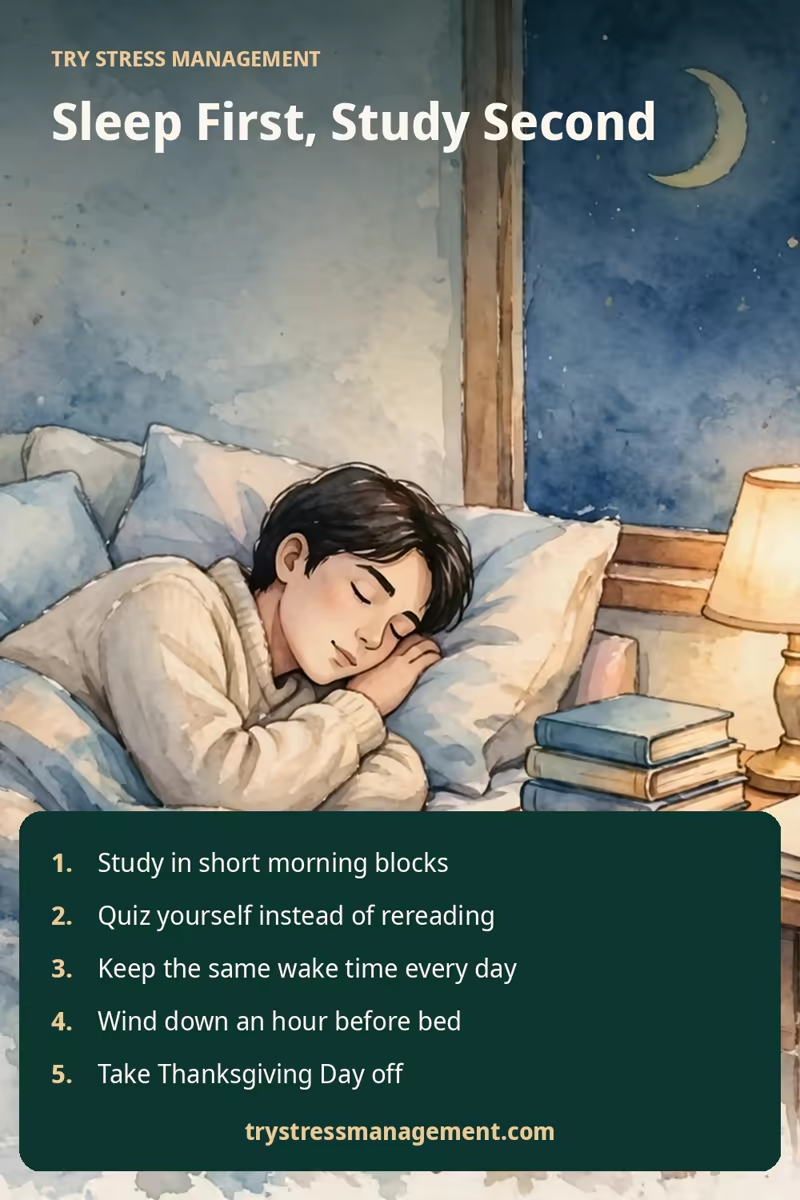
Study in short morning blocks
A study block is 50 minutes on one topic, then a 10-minute break away from the desk. Two blocks a morning is the whole assignment — two study sessions, done early in the morning, and the studying is finished before lunch. That sounds small against a finals pile, and that is the point: a small plan you finish beats a large plan you abandon by Tuesday.
Each block needs one goal written down before it starts, such as “finish chapter 7, problems 1 to 12” or “outline the essay question on the French Revolution.” A goal with a finish line tells you when the block is done, and it stops the session from drifting into rereading the same page. Put the phone in another room for the 50 minutes. A phone on silent beside the book is not a plan, it is a negotiation you lose most days. Use the breaks to actually refresh: water, daylight, a short walk — not a feed.
Mornings work because willpower and focus are usually strongest early, and because a finished block before lunch changes the whole day. You have already done the hard thing, so the afternoon can be lighter without guilt. If mornings are not your time, pick your best two hours and keep them sacred in the same way. What matters is that the blocks happen at the same time every day, so starting them takes no fresh decision. A short daily routine that survives busy weeks is a skill in itself, and our guide to making a habit that survives busy weeks uses the same idea: shrink the task until skipping it feels stranger than doing it.
Quiz yourself instead of rereading
Rereading feels productive and tests nothing. Your eyes move, the page looks familiar, and the material slides past without sticking. Quizzing yourself is slower and clumsier, and that is why it works: pulling an answer from memory is the same move a final asks for.
Close the book and write down everything you remember about the topic, in your own words, on a blank page. Then open the book and check what you missed. The gaps are your next study list, and they are usually shorter than you feared. Flashcards work the same way, as do practice questions and past papers. Even explaining the topic out loud to a roommate, a sibling, or an empty chair counts, because teaching forces you to find the words instead of nodding at someone else’s.
Fifteen minutes of quizzing usually beats an hour of rereading. Build it into every block: the last 10 minutes of a 50-minute session are for closing the book and testing what the first 40 put in. By the second or third day, the quiz itself shows you what is solid and what still needs work, which is a better guide than any highlighter. Quizzing is also the plan’s built-in way to avoid cramming later: small tests all week mean there is no mountain left for a last-minute cram the night before.
Keep one wake time
Pick a wake time and keep it every day of the break, including Thanksgiving Day and the weekend. Sleep regularity matters more than any single long night, and a steady wake time is what anchors it. Your body runs on rhythm — your circadian rhythm — and a wake time that jumps by three hours on Saturday reads as a small time-zone change every week. Get natural light exposure early, ideally within an hour of waking; daylight is the strongest signal that tells the rhythm where the day starts.
One extra hour after a late night is fine. What costs you is the four-hour lie-in that pushes the evening later, which makes it harder to sleep earlier that night, which pushes the next wake time later, until Monday morning arrives with a body clock set to the weekend. If you nap, keep it short, 20 to 30 minutes, and before mid-afternoon, so it does not steal from the night. If a nap is not possible, 10 to 20 minutes of non-sleep deep rest (NSDR) — lying down with a guided rest audio, a quiet form of meditation — can take the edge off without borrowing from the night.
Choose the wake time by working backward from the bedtime you want, not forward from when you feel like getting up. If bedtime is 11 and you aim for 8 hours, wake time is 7. You will not get 8 hours every night of finals week, and you do not need the whole night perfect — but aiming at roughly eight most nights beats drifting between five and ten. Write it on the plan, set one alarm, and let the alarm do the deciding. Mornings stop being a debate when the time is already chosen.
The wind-down hour
The last hour before bed belongs to slowing down, not to one more chapter. Think of it as a pre-bedtime routine with one job: help you fall asleep and stay asleep without a fight. Screens go off, or at least dim and move out of the bedroom — the blue light from a phone close to bedtime tells your brain it is still daytime and suppresses melatonin production, the signal that starts sleep. Dim the room lights too, thirty minutes before bed if you can. Get tomorrow’s worries onto paper: three lines are enough, one for what you will study first, one for anything you are carrying, one for something you are done with for the day. A warm bath or shower about an hour before bed, a short stretch, or a few slow breaths closes the hour. Keep stimulating activities — arguments, rankings, breaking news, one more episode — away from this hour. The routine does not need to be long, only the same every night, so your body starts to recognize it as the signal that the day is over. Set up your sleep environment while you are at it: cool room, pillow where you like it, earplugs or a white noise machine if the dorm or the house is loud.
When thoughts race anyway, which they will do at least once during finals, do not lie there arguing with them. If you can’t fall asleep after about twenty minutes, get up, sit somewhere dim, and write the thought down, or run a short grounding exercise. Our guide to quieting racing thoughts before bed walks through a full wind-down routine for exactly that night, and box breathing gives you a four-count breathing pattern you can use in bed without getting up: inhale for four, hold for four, exhale for four, hold for four, eyes closed, shoulders down. A short guided meditation or a few minutes to listen to music — calm playlists, low volume — can soothe a mind that is still replaying the day. If the worry has a body to it, tight shoulders, a fast heartbeat, the 5-4-3-2-1 grounding technique brings your attention back to the room in about two minutes. One rough can’t-sleep night before an exam is not insomnia; it is a normal stress response, and it usually passes once the exam does. Sleep medicine is not part of this plan — anything beyond routine and environment belongs in a conversation with a clinician, not in a finals-week experiment.
Caffeine has a cutoff too. Nothing with caffeine after early afternoon during finals week, and that includes the energy drink that feels like a study tool. Caffeine within 2-3 hours of bed is the obvious problem, but even an early-afternoon coffee can disrupt a light sleeper’s night. It is a loan against tonight’s sleep, and the interest is due the next morning. Save high-intensity exercise for earlier in the day for the same reason: a hard late workout leaves some people wired for hours.
The night before your first final
Sleep before the exam is the last study session you get, so treat it that way. Stop studying by early evening — finish at least 3 hours before bed if you can. One light quiz round in the morning, then stop. The night before an exam is for logistics, not learning: pack your bag, lay out clothes, check the exam time and room, set one alarm, and charge your phone outside the bedroom if you can. Avoid heavy meals late; a light snack is fine if you are hungry. Go to sleep at your normal time. How you sleep the night before matters more than one more chapter: the goal is to get a good night’s sleep and wake up clear.
The all-nighter is the one move this plan rules out, and it rules it out on its own terms. A night without sleep does not add a night of learning, it subtracts a morning of recall. You will sit the exam with the material less available, not more, and the second final in the week will be harder too, because the debt carries over. All-nighters feel like dedication; they are usually just sleep deprivation with better branding. Students who protect their sleep before finals are not being soft. They are protecting the one thing the exam actually tests: what they can remember and use under pressure. On exam day itself, eat a normal breakfast, get some daylight, and arrive with time to spare.
When the plan slips
Procrastination was the joint-top challenge in the flytedesk survey, named by 58% of students alongside stress and anxiety, so a slipped plan is the normal case, not the failure case. A missed morning is not a ruined week. The restart rule is simple: the next block, not next Monday. Shrink the block to 25 minutes if a full 50 feels impossible, and do the smallest version of the task, one quiz round, one page of notes, one problem set. Treat the block like a deadline you set yourself — small, near, and non-negotiable once it starts.
Two things help more than willpower. The first is telling someone your plan: a roommate, a friend, a parent. Say the time out loud and the block becomes a commitment instead of a private intention. The second is making the start easy. Open the book the night before, leave it on the desk with the goal written on a sticky note, and put the phone to charge in another room. Mornings go to the person who prepared the night before.
If stress is the thing blocking the start rather than laziness, name it that way. Feeling overwhelmed at the start of a study block is common during finals, and it is part of how you manage stress across the week, not a character flaw. A short walk, ten slow breaths, or five minutes of writing down what is worrying you can alleviate the pressure enough to begin. Starting is the hard part. Once you are ten minutes into a block, the work usually carries itself.
Get the free Sleep Better Tonight printable. Finals week goes better with a short wind-down. Join the free email list below and the PDF arrives in your inbox, along with one practical stress guide each week.
Free printable: Sleep Better Tonight
A 10-minute evening wind-down on one page: dim lights, screens off, tomorrow’s worries onto paper, a gentle stretch, and slow breathing. Join the free email list and the PDF arrives in your inbox. Print it and keep it by the bed.
Frequently asked questions
How much sleep do I need during finals?
Most adults do best with around 7 to 9 hours a night, and students are no exception. Enough sleep for you is the amount that leaves you rested: the exact number varies by person, so use how you feel the next day as the guide: if you are rereading the same paragraph three times, you are probably short.
Is it better to study late or wake up early?
Early wins for most people. A morning study block uses your freshest focus, and it ends with a night of sleep that files the material away. Students who study late and stay up late to do it pay for it twice: the late session costs the sleep that would have done the filing, and the next day starts tired. If you are genuinely a night person, keep the late session short and protect the wake time the next morning.
What if I already fell behind?
Triage. Pick the two subjects with the most weight in your finals and give them the morning blocks. Use quizzing from the start, because it finds the gaps fastest, and skip the chapters you already know. A short plan you follow beats a complete plan you never start.
Can I catch up on sleep over the weekend?
One long night helps a little, but it does not repay a week of short nights, and a very late wake-up usually pushes the next bedtime later too. A steadier fix is a regular wake time plus a short afternoon nap when you need one. Think of sleep as a daily wellness habit during finals, not a debt you settle on Sunday. A restful weekend routine — same wake time, daylight, an early night — does more for your wellbeing than one marathon sleep-in.
What if my mind races at bedtime during finals?
Write the racing thoughts down before bed, on paper, and leave the paper outside the bedroom. Take the time to unwind properly: a few slow breaths or a short grounding exercise can help once you are in bed. If the same worries return night after night, our wind-down routine for racing thoughts covers the full sequence, and your campus counseling service can help if the worry feels bigger than exam week.
This guide is general educational information about sleep habits and study routines, not medical advice. Sleep needs vary from person to person, and this plan does not diagnose or treat any sleep problem. If sleep troubles persist beyond finals, or if worry and low mood are getting in the way of daily life, talk to a qualified healthcare professional or your campus health service.

Hi, I’m Sophia! Welcome to my blog Try Stress Management (trystressmanagement.com), where I share simple, down-to-earth ways to handle stress and bring more calm into everyday life. Think of me as your friendly guide, offering practical tips, reflections, and little reminders that we’re all figuring this out together.
When I’m not blogging, you’ll usually find me with a good book, sipping tea, or exploring new walking trails. I believe small changes can make a big difference—and that a calmer, happier life is possible for everyone.