

If last Christmas is still sitting on your credit cards, you have plenty of company. A National Debt Relief survey released on November 18, 2026, conducted by Censuswide among 2,000 U.S. adults, found that 66% of Americans with unsecured debt are still paying off last year’s holiday spending. More than eight in ten of them, 81%, say that leftover balance adds stress heading into this season, and 78% of adults plan to cut back this year. Many Americans plan to spend less, yet still take on holiday debt by December, often without noticing it happen. Cutting back works better when you set a budget than when you rely on willpower. This guide walks through one calm way to handle holiday debt this year: one single total, split by person and category, written down where you will actually see it, so you can keep your spending in check from the first sale to Christmas Eve and Christmas Day.

Why last year’s balance makes this season feel heavier
Part of it is simple arithmetic. Last year’s gifts were bought in a few weeks and paid for across twelve months, with interest added along the way. The season ended in January. The bill did not. So this year does not start from zero: you are shopping for this December while still paying for the last one, and the money available feels smaller before you have bought a single thing. For many households the leftover credit card debt takes months or longer to clear, and some are still carrying credit card balances well into the new year, while interest rates are still high.
Part of it is emotional, and worth naming plainly. A bill that will not go away can carry guilt about last year’s choices, dread about January’s statement, and pressure to match last year’s gifts so nobody feels shortchanged. Those feelings tend to show up at the worst moments, in a store, in a sale’s final hours, with a cart already half full. Our guide to money stress and the small steps that count covers that side of it in more depth.
The holiday season itself adds pressure from every direction. Sales run on countdown timers. Social feeds fill with other people’s trees, trips, and tables all through the winter holidays. Offices organize exchanges, schools organize collections, and every one of them is small on its own. Nobody overspends on one thing; the season overspends on forty things, each too small to argue with. That is why the fix has to be a holiday spending plan set in advance, in a quiet moment, rather than forty small decisions made in loud ones.
The survey points at the trap to watch for. Americans with unsecured debt were 4.5 times as likely as those without debt to put their purchases on credit cards that already carry a balance. That is how one season’s spending becomes next year’s financial burden: new charges rack up interest on top of old ones, at the exact moment the old ones feel heaviest. A spending limit set in advance is mainly a way of stepping out of that loop: avoid holiday debt this season, and do not take on debt that follows you into next November.
Set one number before the sales start
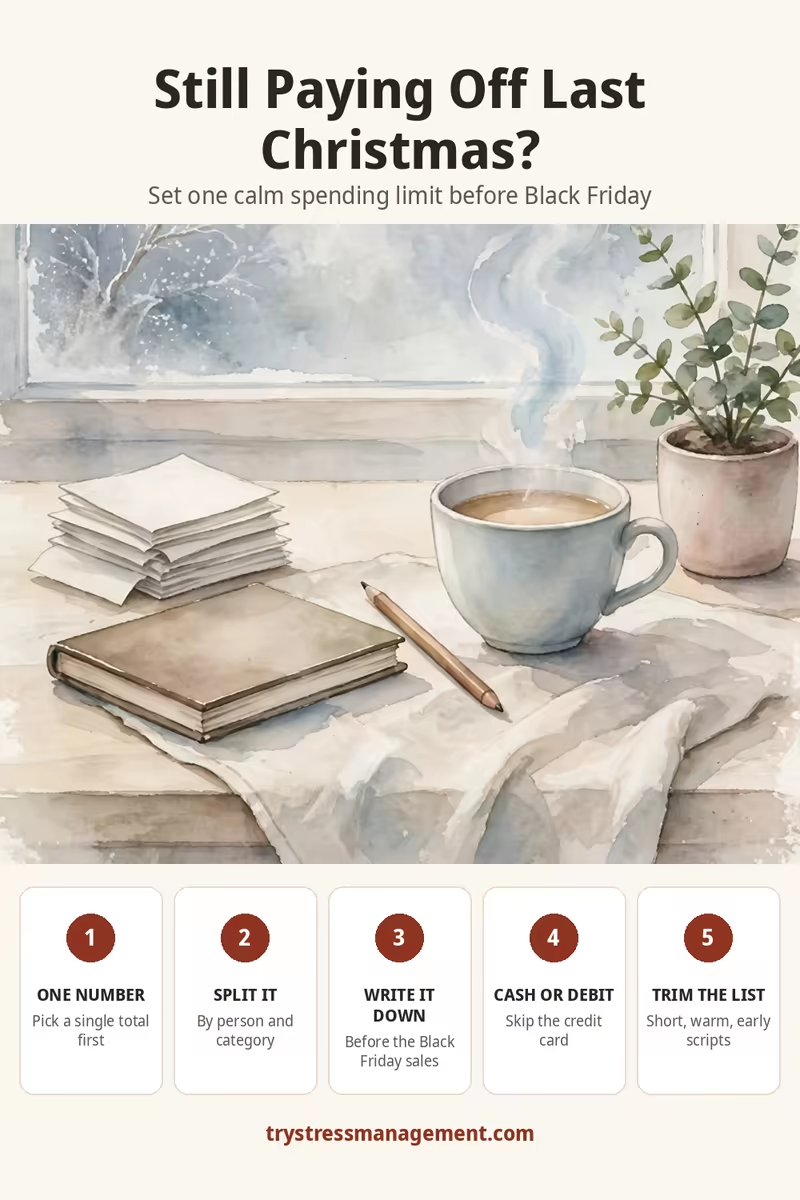
The method is deliberately plain. It has four steps and takes about twenty minutes with a notebook or a notes app. Think about how much you can afford to spend before you decide how much you plan to spend, and let that honest number lead.
Step 1: Start from what you can pay, not what you spent. Last year’s total is a poor guide, because last year’s total is the problem. Instead, look at the money you could realistically pay toward the season’s costs by the end of January without touching what is set aside for rent, regular bills, and essentials. That amount is your ceiling, the money actually available to spend. Determine how much room you really have, and write that number down. If you are living paycheck to paycheck, the ceiling may be small, and a small, fully paid season is still a real season. If it is smaller than last year’s spending, that is not a failure. It is the survey’s majority position: 78% of adults are cutting back this year.
Step 2: Write one single total at the top of the page. This is your holiday budget: one number for the whole season, covering gifts, holiday food, travel, decorations, events, all your holiday expenses in a single total. A single total is easier to hold in your head while shopping than five separate budgets, and it cannot quietly grow by being split across categories and credit cards nobody is tracking. This number is a limit, not a target. Spending less than it is a good outcome: saving money is the point, not a side effect.
Step 3: Split the total by person and by category. Begin with the gifts: what you spend on gifts, person by person, then the other categories. Under the total, make a list: each person on your gift list gets a share, and the other categories, food, travel, decorations, get a share each. The shares should add up to the total, no more. When a person’s share is spent, that line is done, even if you later see the perfect extra thing. That rule feels strict in the store and kind in January, and it is the hardest moment for any shopper. Leave one small line for the things every list forgets: wrapping paper, a teacher gift, postage, the ingredient you have to buy twice.
Here is what the finished page can look like, with round example numbers. Say the total you can pay by the end of January is $600. The split might read: partner $120, each of two children $100, parents $60, siblings and friends $80, holiday food $90, travel $0 this year, decorations $20, and $30 left on the forgotten-things line. The exact figures will be yours, and they will not look like these. What matters is the shape: every dollar of the total has a name on it before the season starts, so a purchase is never competing with money that was secretly promised to something else. If you are traveling to visit family, travel costs get their own line, so they cannot quietly eat the gift money.
Step 4: Write it down before the sales start, and keep it where you shop. Black Friday is Friday, November 27 this year, and the limit only works if it exists before the first sale email lands. Think of the written limit as an end-of-year promise you make in a calm moment. Paper on the fridge works. So does a photo of the page on your phone, checked before each purchase. The format does not matter. What matters is that the number is outside your head, where a tired evening of scrolling cannot renegotiate it.
Free printable: Sleep Better Tonight
A 10-minute evening wind-down on one page: dim lights, screens off, tomorrow’s worries onto paper, a gentle stretch, and slow breathing. Join the free email list and the PDF arrives in your inbox. Print it and keep it by the bed.
Pay with cash or debit while the limit is new
A limit you cannot feel is easy to drift past, and a card statement is hard to feel mid-purchase. Using credit hides the total until the statement arrives. Cash and debit behave differently: the money leaves, and you can watch the total shrink. For the first season of using a limit, that feedback is the guardrail. Rely on credit cards and the total only becomes real in January.
The practical version is simple. Keep holiday money separate, in a cash envelope for in-person shopping or in one account you use only for holiday spending, and pay from that pot. When the pot is empty, the season’s spending is done, and it is done without an argument with yourself at the register. Sticking to your budget is much easier when the pot, not your memory, does the counting. If you prefer a card for a specific purchase, move the same amount out of the holiday pot the same day, while the purchase is still in front of you, so the pot always tells the truth.
Holiday shopping online needs the same treatment, because a saved card and a one-click checkout are designed to skip the moment where you feel the cost. Pay with the debit card tied to the holiday pot, keep the credit cards out of your saved checkout, and keep a running note of each order against the right person’s share. That pause matters most on the higher-priced items, where one click can eat a whole person’s share. If you use buy now, pay later (BNPL) plans at checkout, count each instalment against the same pot on the day you order: pay-in-four arrangements are still spending, and BNPL loans still come due in January. If typing the card number in each time feels like friction, that friction is the guardrail working.
Treat this as a tool, not a test of character. The point is not to prove discipline. A simple plan can help more than a perfect one. The point is that January’s statement should hold no surprises, because every purchase was counted on the day it happened, and your account should not go into the red for the sake of December.
Trimming the list, with words that work
For many households the limit means a shorter list this holiday season, and the hard part is rarely the arithmetic. It is the conversations. If you’re struggling to see how the numbers fit, you are not behind: most people doing this maths are cutting back too. Short, warm, and early beats long, apologetic, and late. Say it before lists are exchanged and plans are set, and remember that most people you tell are quietly doing the same maths.
To family: “We’re keeping gifts smaller this year and putting the focus on time together. Let’s do one gift each, or a shared meal instead of a pile of presents.”
To a friend group: “Money is tight this year, so I’m going to sit out the gift exchange. I’d love to host a potluck night instead, my place, early December.”
To your kids, in age-appropriate words: “This year we’re each choosing one special gift, and we’ll pick them together. Making the list is part of the fun.”
At work: suggest a card, a bake-off, or a small fixed cap for the office exchange. Our guide to holiday gift boundaries has more scripts for saying no without the guilt, including for the exchanges you cannot skip.
Notice what these scripts share. None of them explains your finances. None of them apologizes twice. Each one swaps the thing being reduced, spending, for something that is not being reduced: time, food, company. In practice, the most common response is relief, because the other person was dreading the same conversation. Spending less on gifts this year is not the same as caring less. For many families it is how they avoid getting carried away in December and going into debt by January.
Frequently asked questions
How much should I spend if I am still paying off last year’s holiday debt?
There is no single right figure, and anyone who gives you one does not know your bills. The method in this guide is to build the budget backwards, from what you could plan to pay by the end of January without touching money set aside for essentials. That amount, whatever it is, becomes the season’s total. Most people pay off their holiday balances in monthly pieces rather than all at once, and a smaller, fully paid season beats a bigger one that follows you into next November.
Should I clear last year’s card bill before buying anything this year?
It helps to understand one mechanic: on many cards, once you are carrying a balance, new purchases can start accruing interest right away rather than after a grace period, and high interest rates make that head start expensive. That is a reason to keep this year’s spending small and, where you can, on cash or debit, so you don’t charge the new season on top of the old one. Whether to clear the old bill first depends on your full situation. Options people sometimes weigh, like debt consolidation or chasing a lower interest rate, come with trade-offs, which is exactly the kind of question a nonprofit credit counselor can help you think through. The Consumer Financial Protection Bureau (CFPB) also publishes free guidance on managing credit card debt.
How do I tell family I am spending less without making it a big conversation?
Keep it short, warm, and early, and offer a swap: one gift each, a shared meal, a potluck. You do not owe anyone your bank balance as an explanation. Most years, the person you are nervous about telling is planning to cut back too; in this year’s survey, 78% of adults said they plan to.
Should I skip gifts altogether this year?
You can, and some years that is the right call, but most people find a small limit easier to keep than a total ban. A ban tends to break at the first emotional moment, and then there is no plan at all. A short list with a share for each person keeps the ritual, the part people actually remember, at a cost the season can carry, and it can help you avoid a January debt hangover. If you do skip gifts, say so early and offer the swap: a meal, a visit, a day out in January when the diary is empty, so you can enjoy your holidays without the dread.
What if I have already spent too much before setting a limit?
Set the limit anyway, today, for the rest of the season. Return what you can of what you bought, then split what is left of the number across the people and categories still to cover. A limit set late still protects December, cuts the months to pay off what is already owed, and gives you a starting point that next year gets to build on.
This article is general educational information about holiday spending and stress. It is not personal financial advice, and it does not recommend a specific product, account, or course of action for your situation. Money decisions depend on your own circumstances. If debt feels unmanageable, or money stress is affecting your sleep or daily life around the holidays, consider talking with a nonprofit credit counselor, a qualified financial professional, or a healthcare professional.

Hi, I’m Sophia! Welcome to my blog Try Stress Management (trystressmanagement.com), where I share simple, down-to-earth ways to handle stress and bring more calm into everyday life. Think of me as your friendly guide, offering practical tips, reflections, and little reminders that we’re all figuring this out together.
When I’m not blogging, you’ll usually find me with a good book, sipping tea, or exploring new walking trails. I believe small changes can make a big difference—and that a calmer, happier life is possible for everyone.