Part 2 of Sleep Better Tonight, a five-part series on the evening wind-down. Every part stands on its own. Together they build one calmer night, and the Sleep hub collects them all.
Plenty of people end the day tired and still lie awake at 11 p.m. wondering why sleep will not come. One common reason is easy to miss because it feels so ordinary: the light in the room. Bright light in the last hour or two before bed tells your body the day is still going. That signal can hold back sleepiness and push it later into the night.
Understanding technology’s effect on sleep starts with light. This guide covers how evening light and screens affect sleep, what a widely cited study found when people read on a glowing screen before bed, and six changes that can make the last hour of the day work in your favor instead of against you.
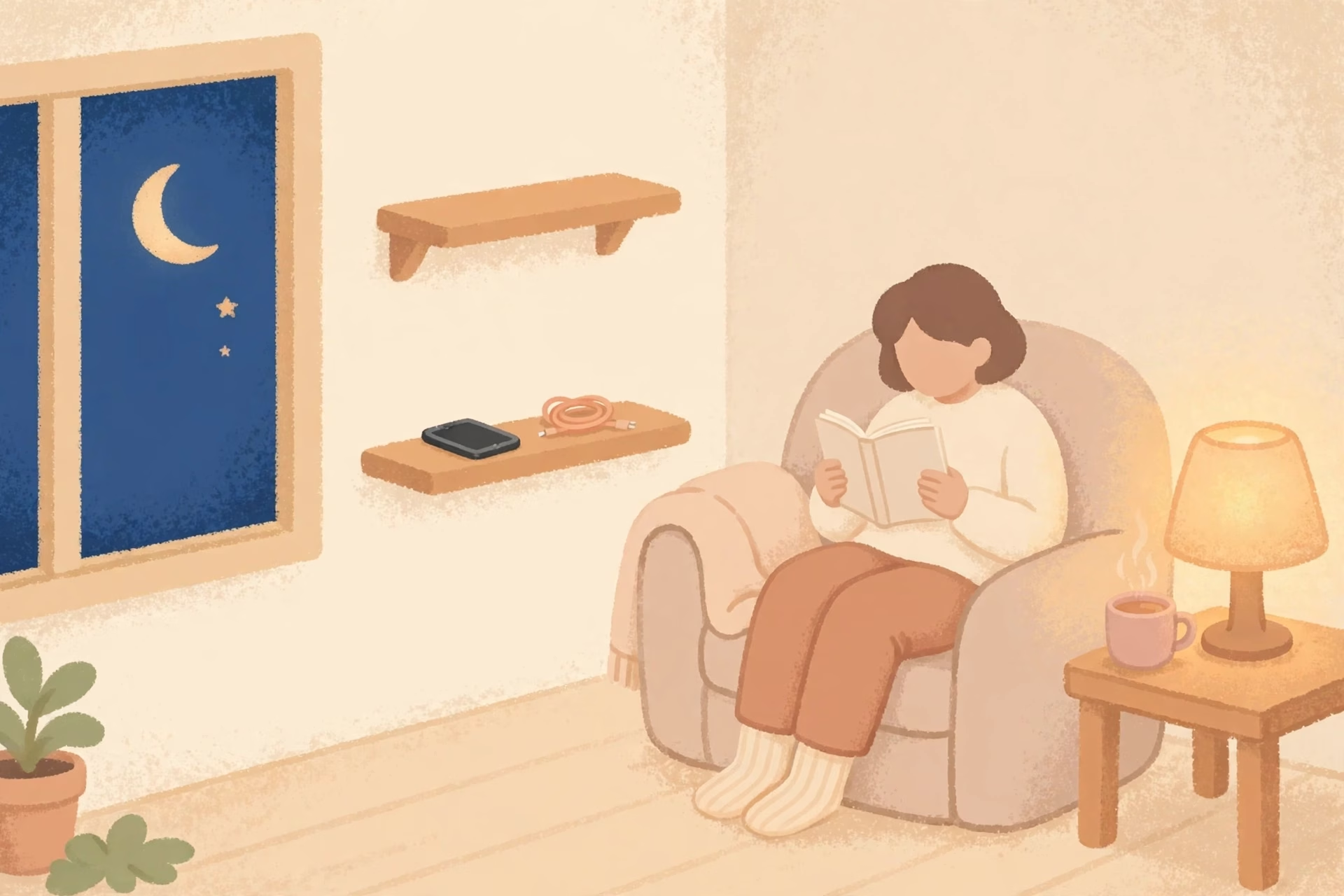
Your body reads light like a clock
Your natural sleep-wake cycle runs on an internal clock, and light is the strongest signal that sets it. The effect is physiological: light reaches the clock whether you notice it or not. As darkness falls, dimming light allows melatonin levels to rise naturally. Melatonin is the hormone that regulates the timing of sleep and helps you feel drowsy as bedtime gets closer. Bright light does the opposite. It can mimic daytime closely enough to convince the clock it is still afternoon, which can suppress melatonin and shift the whole cycle later.
Three things decide how strong that signal is:
- Brightness. A lit room sends a louder signal than a dim one. Bright overhead lighting is stronger than a single low lamp.
- Distance. A phone or tablet held close to your face delivers more light to your eyes than a television across the room.
- Duration. Ten minutes of scrolling matters less than two hours of it. The longer the exposure, the more time the clock has to take the hint.
Short-wavelength blue light gets most of the attention, and screens do emit a lot of it. Evening exposure to blue light is one reason researchers single out screens rather than lamps. But brightness, distance, and duration all count. A dim screen held far away is a weaker signal than a bright one at arm’s length, whatever its color temperature.
What the e-reader study found
The study most often quoted on this topic comes from Chang and colleagues, published in 2015 in PNAS (Proceedings of the National Academy of Sciences). Twelve healthy adults spent two weeks in a sleep laboratory. For five evenings, they read on a light-emitting e-reader for the four hours before bed. On the other five evenings, they read a printed book under dim light.
Compared with the printed-book evenings, the e-reader evenings suppressed melatonin by about 55%. The readers also took longer to fall asleep, spent less time in REM sleep, and rated themselves groggier the next morning. Their body clocks had shifted later, as if the glowing page had convinced them it was still afternoon.
Two honest caveats. The study was small, and a sleep lab is not your bedroom. Nobody reads for four straight hours on most nights, and evenings mix screen time with other activities. But the direction of the result matches what sleep researchers see in larger bodies of work. That work includes televisions and room lighting, not just e-readers, and studies of evening media use in real homes point the same way: light close to the eyes, late in the evening, tends to delay sleepiness. Your own evenings probably involve smaller doses of the same signal, spread across the TV, the kitchen lights, and the phone in your hand.
Modern e-readers sit somewhere between the two conditions in that study. Many now have warm, adjustable frontlights that can be turned down low, which makes them a gentler option than a phone or tablet at full brightness. They still emit light near your face, so settings and session length matter. If an e-reader is your evening habit, run its light warm and low, and keep the same cut-off time you would give any other screen.
Screen time before bed keeps your brain busy, too
Light is only part of the story of bedtime screen use. The other part is what the screen asks from your brain. A television across the room mostly delivers light. Tablets and phones add the rest, and they sit a foot from your face while they do it.
Start with content. News feeds, arguments in comment threads, a cliffhanger ending, a match that goes to a deciding round: whether you watch a show, play a game, or scroll a feed, all of it is built to hold attention. Stimulating content can still keep you awake after the screen goes dark, because your mind keeps working on storylines. Sleep researchers call this cognitive arousal, and it is a common reason people feel exhausted yet still take a long time to fall asleep. Researchers tend to study screen time before bed as a package, because the light, the content, and the hour it eats arrive together.
Then there are the disruptive alerts. Nighttime notifications are designed to get a reaction: a work email wanting an answer, a message thread that expects a reply, a news alert written to sound urgent. Each one is a small demand, and one notification checked in passing often turns into ten minutes of replies. Bring the phone to bed without silencing notifications, and every demand feels urgent. The same buzz that is easy to shrug off at noon lands differently at nighttime, when part of you is already trying to switch off. You do not have to out-resist any of it. Silence the demands instead: switch on do-not-disturb for the last hour or two, let non-urgent apps wait until morning, and give the few people who might need you a way through.
Social media adds its own pull. Feeds are endless by design, and checking social media tends to stretch. One post leads to another, and doom-scrolling through bad news can leave you more wound up than when you picked it up. Video games and streaming shows use a different lever to the same end: one more level, one more episode. Each extra round spends the hour directly. An episode that ends at midnight leaves you trying to fall asleep at 12:15 with a head full of plot, and an hour of screen time at 11 p.m. is an hour taken out of time for sleep.
Smartphones bundle all of this together, which is why they are the hardest screen to manage. How you use your smartphone in the last hour matters as much as how bright it is. If you keep your phone on the nightstand, it stays within reach for every ping, headline, and cliffhanger. Moving it across the room, the step covered below, works because it removes the temptation instead of asking a tired brain to resist it at midnight.
The last hour still needs filling. Give it a replacement that can help you wind down rather than wind you up: listening to music, choosing to journal for a few minutes, stretching, or making a cup of tea. Part 1 of this series builds a full routine out of options like these.
Why it matters beyond one rough night
One late night is a nuisance. A habit of them is different. When bedtime drifts later night after night, most people cannot move their mornings to match, so the shortfall comes out of sleep itself. Researchers link habitual short or delayed sleep with reduced alertness and a flatter mood the next day, and, over time, with effects on metabolism and the immune system. People who regularly get less sleep also report poorer alertness throughout the day, even on days when the previous night felt normal. Chronic short sleep is associated in research with higher risk of conditions such as high blood pressure, which is part of why sleep sits alongside diet and exercise in most public-health advice.
Public-health guidance points in the same direction as the lab studies. The CDC recommends limiting screen time before bed as part of getting the sleep you need, and the practical version of that advice is plain: reduce light exposure in the final hour, with dimmer rooms and dimmer screens.
None of this means one bright evening does damage. Difficulty falling asleep after a wired, well-lit night is common and usually sorts itself out within a night or two. The fix usually starts with reducing screen time in the last hour. The pattern is what the steps below are aimed at: small changes, repeated most nights, that give your clock a clearer signal.
A quick check of your own evenings
What you do before bed affects how fast sleep comes. If you are sorting through the possible causes of a wired evening, run through the last hour of a typical night and count how many of these show up:
- Overhead lights on full until you get into bed
- A bright television in the room where you spend the evening
- Your phone in bed with you, checked after lights-out
- A brightly lit bathroom mirror as the last light you see before bed
- A laptop open on the bed for “one more episode” or one more email
None of these ruins a night on its own. Stacked together, night after night, they can keep telling your clock it is earlier than it is.
Six changes for the last hour
You do not need a new house, new lamps in every room, or a life without screens. The changes below are behavioral ones: settings, lamps, and habits. Start with them and keep the ones that fit your evenings.
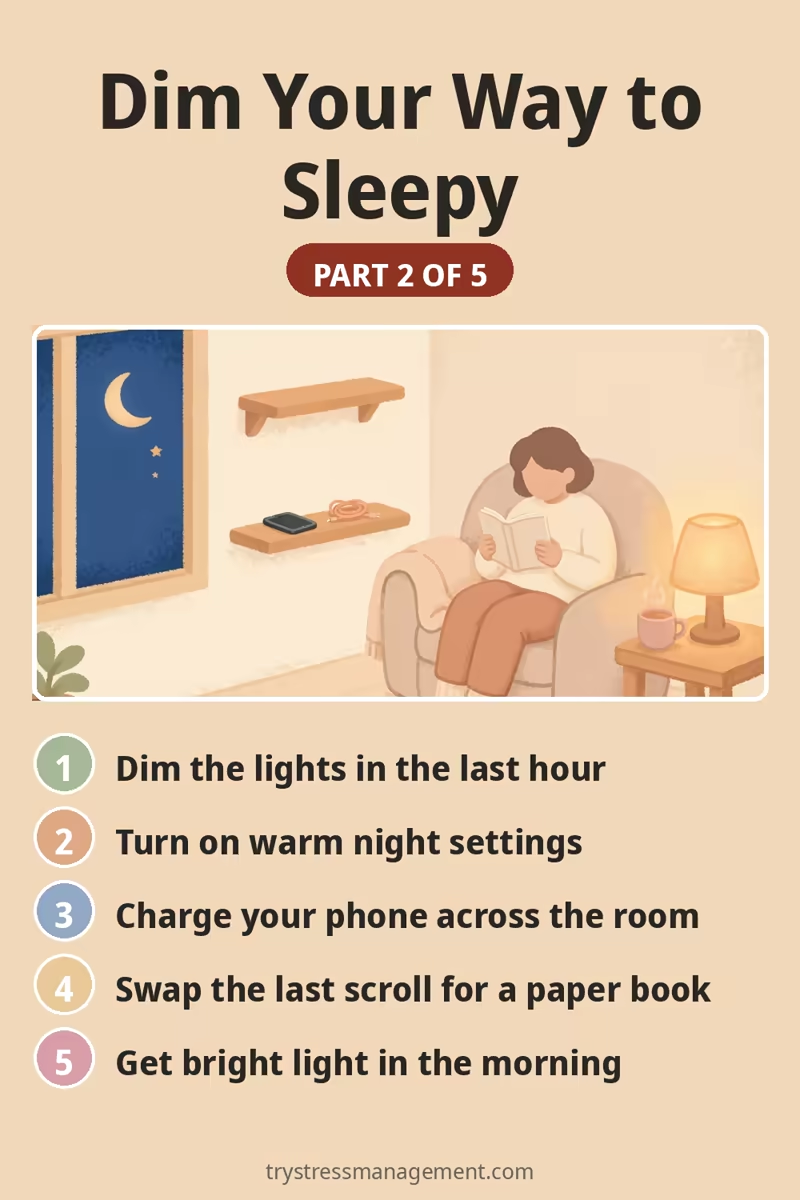
1. Dim the house lights in the last hour
Switch off overheads and use one or two low lamps instead. If your bulbs have dimmers, bring them down as bedtime gets closer. The goal is a room that looks like evening, not like an office at noon. Many people find this one change also makes the hour feel calm, which helps the rest of the routine land. Start well before bedtime, so the dimming has time to register.
2. Turn on warm night settings, then lower the brightness too
Most phones, tablets, and computers have a night setting (Night Shift, Night Light, or similar) that works as a filter, warming the screen color after sunset and cutting some of the blue light it puts out. Schedule it to turn on an hour or two before bed so you do not have to remember. Then drop the screen brightness as low as you comfortably can. Night settings soften the signal; they do not erase it. A warm, dim screen still beats a cool, bright one, and both lose to putting the screen down.
3. Give your phone a bed that is not yours
Charge the phone outside the bedroom if you can. If it has to stay in the room, charge it across the room instead of on the nightstand, and switch it to do-not-disturb. If the phone is your alarm clock, a basic alarm clock costs a few dollars and removes the most common reason the phone sleeps next to the pillow. The point is friction: a phone three steps away is easier to leave alone than a phone in your hand.
4. Swap the last screen session for a paper book
The Chang study compared screens with a printed book for a reason. Paper reflects the room’s light instead of emitting its own, so a book under a low lamp is one of the gentlest light sources in the house. Magazines, puzzle books, and comics count too. Pick something pleasant but not gripping enough to keep you reading until 1 a.m.
5. Tie a screen curfew into your wind-down
Choose a cut-off time, 30 to 60 minutes before bed, and let it trigger the start of your wind-down rather than the end of your day. Screens off, phone on its charger, then the short routine: change into sleep clothes, brush your teeth, lower the lights, settle with the book. Part 1 of this series lays out a 10-minute wind-down routine in full. If you want that routine on a single page you can keep by the bed, the free Sleep Better Tonight PDF is on the subscribe page.
6. Get bright light in the morning
Evening dimness works better when the other end of the day is bright. Daylight soon after waking anchors your clock, so the evening drop in light reads as a clearer signal. A walk outside, breakfast near a window, or any outdoor time in the first part of the morning can help. Morning light helps prevent one late night from becoming a late week. Daytime screen use is a different matter: your clock expects light then. The sleep reset guide for the clock change uses the same morning-light anchor to pull a shifted schedule back into place.
One more note: screens going off can leave a busy mind with nothing to compete against. If your thoughts speed up the moment the room goes quiet, the companion guide on quieting racing thoughts before bed covers that piece of the night.
A sample last hour
Here is how the pieces fit together on an ordinary night. Adjust the times to your own bedtime.
- 60 minutes before bed: Overhead lights off, lamps on. Night settings kick in on any screen still in use.
- 30 minutes before bed: Screen curfew. Phone on its charger across the room or outside the door.
- 10 minutes before bed: Wind-down routine. Sleep clothes, teeth, a few pages of a paper book in low light.
- Lights out: The room is dark, the phone stays where it is, and the day is done.
Give a schedule like this a week or so before judging it. Clocks adjust gradually, and one late night does not erase the pattern.
FAQ
Do blue-light glasses solve the problem?
Blue-light glasses block some of the blue light from screens, but the evidence that they improve sleep is mixed, and they are best treated as an add-on rather than a fix. Dimming the room, lowering screen brightness, holding devices farther away, and keeping a cut-off time do more of the work. If you like wearing them in the evening, they do not hurt the rest of the routine.
Is watching TV before bed as bad as using a phone?
Usually not, mainly because of distance. A television sits across the room, so far less of its light reaches your eyes than a phone held a foot from your face. Content matters too. A slow, familiar show is one thing; a gripping finale that keeps you up an hour past bedtime is another. If you still find it difficult to fall asleep afterward, distance was not the whole story.
How long before bed should I stop using screens?
There is no single number the research settles on. The lab studies use hours of exposure; real life calls for something you can keep. A cut-off of 30 to 60 minutes before bed is a target many people can hold on weeknights, and the dimming steps above still help on nights when you cannot manage it. If you use a device on those nights, keep it dim and out of bed.
Does night mode mean I can use my phone all evening?
Night mode reduces the blue share of the light and often lowers brightness, which helps. It does not change the other two factors: the screen is still close to your eyes, and whatever you are reading or watching can still keep your mind alert. Treat night mode as making the last stretch of screen use gentler, not endless.
I work late on a computer. Is there any point doing the rest?
Yes. You may not control your work hours, but you can still dim the lights at home afterward, run the wind-down once the laptop closes, and get morning light the next day. People who work evening shifts or irregular hours often need a more tailored plan, and a sleep specialist can help build one.
What about kids and teens?
Screen habits form early, and children and adolescents appear more sensitive to evening light than adults. In adolescence the clock shifts later by itself, making evening light a double push. It matters most for the youngest, especially children, because sleep supports growth and development; child health guidance from the American Academy of Pediatrics advises a screen-free stretch before bed. The same household moves help: dimmer rooms in the last hour, a screen curfew, and phones charging outside bedrooms where that is practical. A routine the whole household follows sticks better than a rule aimed only at the kids.
This article is general educational information about sleep habits, not medical advice. If you regularly struggle to sleep, feel excessively sleepy during the day, or think you may have a sleep disorder, seek help from a qualified healthcare professional.
The Sleep Better Tonight series
- Part 1: The 10-Minute Wind-Down Routine, step by step (coming Tuesday, November 17)
- Part 2: Light and Screens — Dim Your Way to Sleepy (you are here)
- Still to come: racing thoughts at bedtime, the warm-body cool-down, and a 3-minute version of the routine for busy nights
The full sleep library lives on the series hub: How to Sleep Better with Anxiety & Stress.

Hi, I’m Sophia! Welcome to my blog Try Stress Management (trystressmanagement.com), where I share simple, down-to-earth ways to handle stress and bring more calm into everyday life. Think of me as your friendly guide, offering practical tips, reflections, and little reminders that we’re all figuring this out together.
When I’m not blogging, you’ll usually find me with a good book, sipping tea, or exploring new walking trails. I believe small changes can make a big difference—and that a calmer, happier life is possible for everyone.