
You do not need a perfect reply when family corners you over the turkey. You need a short one you can say without your voice shaking: a warm sentence, a small smile, and a change of subject. The scripts below cover what gets asked most often on the day: relationships, work, money, weight, and buying a house. Each line is built to close the subject kindly rather than win an argument. One awkward Thanksgiving question rarely stays the only one, and most of them arrive around the Thanksgiving table.
All of this is common enough that many people rehearse their lines in the car on the way over. In a Dating.com survey reported on November 10, 2026, with 1,000 responses collected per question, 45% of respondents said the one they face most is when they are getting married or having children. The same survey found that 82% have lied about their relationship status to deflect them. Those figures come from a survey commissioned by a dating company, so read them as a snapshot of its respondents rather than a census. Even with that caution, the pattern matches what many readers describe: the meal can feel less like dinner and more like a yearly review of your life.

Why the meal can feel like an assessment
The day gathers people who love you and who last saw you months ago. Catching up slides easily into checking up: relationship, job, income, plans. Each one on its own is small. Five of them across one meal can leave you feeling measured against a timeline you did not choose.
The Dating.com survey points to the same pressure. 19% of respondents called Thanksgiving the most stressful holiday, and another 42% placed it among the most stressful, a combined 61%. A third of respondents, 33%, said they have volunteered to work on the day to avoid the family gathering altogether. Working a shift to skip the meal is a strong signal: for a sizable share of people, the strain sits in being asked, not in feeding everyone.
Family expectations add a second layer. Many families carry unspoken rules about what a good life looks like by a certain age, and gatherings like this one tend to repeat those rules out loud. One about marriage may really be a hope for grandchildren. One about your job may be a worry about money, spoken badly. Knowing the worry behind it can help you reply to the person in front of you rather than the judgment you heard. It does not oblige you to share details you would rather keep private.
One decision helps before you arrive: pick the two or three subjects you will discuss and the ones you will not. You are allowed to keep parts of your life private, even with people who changed your diapers. A boundary decided at home, in a calm moment, is far easier to hold than one invented on the spot while everyone watches. Our broader guide to dealing with stress and anxiety covers the wider pattern behind days like this.
How to use these scripts
Each script follows the same shape: thank or acknowledge, give one short reply, then move on. Keep it under two sentences. Long replies invite follow-ups; short, warm ones give people little to grab onto, and most people take the hint when the next sentence turns things back to them.
Say the words out loud once before the day if you can. A sentence you have already spoken once comes out steadier the second time, even in a noisy kitchen. If a script here does not sound like you, change the wording until it does. A borrowed sentence delivered in your own words lands better than a polished line you do not believe.
Scripts for marriage, kids, and relationship pressure
This group comes up most by a wide margin. The Dating.com survey found 45% of respondents face the marriage-or-kids one most often, ahead of every other subject, and the 82% who have lied about their relationship status suggest how strong the pressure to produce a tidy reply can feel. You do not need the tidy reply. You need a kind one that closes the subject.
For “So, when are you getting married?”: try “No date on the calendar yet. When there is news, you will hear it from me early, I promise. Now tell me how your garden did this year.” The promise flatters the asker, and ending with something for them moves the spotlight.
For “When are you having children?” or “When is the next one?”: try “That is not in our plans right now, and we are at peace with where we are. Pass the potatoes?” A light food line at the end sounds small, and it works because a meal is built for passing dishes, not for cross-examination.
For “Are you seeing anyone special?”: try “Nothing I am ready to make table conversation yet. If it gets serious, you will not be the last to know.” If you are single and content, a shorter version works too: “No one at the moment, and I am doing well. How is your sister settling into her new place?”
For a relative who pushes after your first reply: repeat, do not expand. “I know you ask because you care. It is still not something I want to get into today, and I would love to hear what you have been up to instead.” Saying the same calm sentence twice, word for word, is a boundary most people respect.
Scripts for work and the “real job” remark
In the same survey, 28% of respondents said they are asked about getting a “real job.” The phrasing stings because it grades your work against someone else’s definition of real: an office, a title, a salary band. Freelancers, carers, students, artists, founders between contracts, and anyone who changed direction mid-career hear this one often.
For “When are you getting a real job?”: try “The work I do is real to the people who pay for it, and it is keeping me busy. What have you been working on this year?” Naming the value of your work once, plainly, is enough. You do not need to list clients or income to prove the point.
For “Are you still doing that?”: try “I am, and this year I have been focused on [one concrete thing]. It has been a good stretch.” One concrete detail satisfies curiosity better than a defensive speech, because it gives the asker a finished picture instead of an open file.
If you are between jobs, keep it shorter still: “I am between roles at the moment and looking. I would rather hear your news today, though. What is new with you?” Job hunting carries enough rejection in a normal week. A Thanksgiving dinner does not have to become another interview.
Scripts for earnings and money
Money came next in the survey: 26% of respondents said they are asked about their earnings. Asking directly about income is rude in most settings, and it stays rude at the meal, even when the asker is family and means well. You can decline the number and keep the warmth.
For “So how much are you making these days?”: try “Enough to cover my bills and put a little aside, which I am grateful for. I keep the exact numbers to myself, same as most people.” Said with a smile, this reads as confidence rather than secrecy.
For the one who compares you with a cousin: try “We are on different paths, and I am glad things are going well for them. I am working on my own list.” Comparisons have no good detailed reply, because any number you give becomes the next round of the game. Refusing the game, kindly, is the move.
Scripts for weight, appearance, and housing
The survey found 30% of respondents are asked about their weight, and 14% about buying a house. Both share a trait with the money ones: they comment on your body or your balance sheet and call it small talk. Your reply can be brief, and it can set a limit for next year too.
For comments about weight, yours or the food on your plate: try “I am not tracking that out loud this year. Bodies change, and I would rather talk about the food than about mine. This stuffing is great, who made it?” If the comments keep coming, a firmer line is fair: “I need comments about my body to be off the table, please. I mean that kindly, and I need it to stick.”
For “When are you buying a house?”: try “Not this year. The numbers have to work first, and I am not rushing into the biggest bill of my life to hit a date. Your place looks great, by the way, did you repaint?” Housing costs are a sore spot for many households right now, and a calm “the numbers have to work” is a reply most adults understand at once.
When one lands badly in the moment
Even with scripts ready, one can catch you off guard: an ex mentioned by name, a loss the asker forgot, a subject you thought was settled. Three moves cover most of these moments, and you can use them in any order.
Set a gentle boundary. Name the limit and offer the next topic in the same breath: “That one is tender for me today, so I am going to pass on it. Ask me about my trip last month instead.” A boundary with a door attached rarely starts an argument, because the asker gets somewhere to go.
Change the subject by asking about them. People generally enjoy talking about their own year. “Before I answer that, I want to hear how your new job is going” buys you a full course of breathing room, and half the time the original one never comes back.
Take a breather. Step onto the porch, offer to walk the dog, volunteer for the shop run, or wash dishes with the radio on. Five minutes of cooler air lowers the temperature of the whole afternoon. Nobody at the dinner table has ever been missed for five minutes, and you return with your script back in reach.
| If you hear | Try saying |
|---|---|
| “When are you getting married?” | “No date yet. You will hear it from me early. How is your garden?” |
| “When are you getting a real job?” | “My work is real to the people who pay for it, and it keeps me busy.” |
| “How much do you earn?” | “Enough to cover my bills. I keep the exact numbers to myself.” |
| “You have gained weight.” | “I need comments about my body off the table, please.” |
| Any of these, twice | Repeat your first answer, word for word, with a smile. |
Conversation starters that rescue a stuck meal
Sometimes the kindest move is not a defense at all. It is a better subject, offered before the awkward silences set in. Plenty of people quietly dread the lull after the plates are cleared. Keep a few thanksgiving conversation starters handy, lines you can ask at thanksgiving when the talk stalls, and you can steer the conversation toward ground where everyone can relax.
Conversation starters designed for a mixed-age crowd share three traits: they are open, they are light, and nobody can fail them. The best ones feel genuine rather than performed. Stay curious, ask one follow-up, and let people finish. Starters like these engage the quiet end of the room, the distant cousin and the shy new partner, and a simple round (“Everyone: one good thing from this year”) pulls in every family member, including the one who has said little since the blessing.
Try a few. Ask your uncle about the best meal he ever made. Ask a student home from college what surprised her this semester. Ask the room: “What is something new you tried this year?” “What gift do you still remember getting as a kid?” “What is your favorite memory of a meal in this house?” “What are you thankful for this year, honestly?” A funny story, retold well, can carry a whole course, and a clever follow-up (“Who taught you that?”) keeps it alive. It is striking what can emerge from one good story: laughter, mostly, and sometimes news nobody had heard yet. You may discover that the quiet uncle restores old radios, and learn something about your grandmother’s first job that nobody had mentioned before. Even people who do not always get along can agree on a story from twenty years ago.
Food talk is the safest talk there is. While the bird is in the oven, ask about favorite recipes. While the turkey rests, ask who is claiming the last slice, who plans to cook tomorrow, and what everyone plans to eat tomorrow. These starters work on college students home for the week and on grandparents alike, which is what makes them perfect for thanksgiving. Get creative and let the youngest person present pick the next one. Hosts who seem to steer effortlessly are usually doing this on purpose, and a meal moves smoothly when nobody has to perform. And if all else fails, there is always the washing up: two people, warm water, and the easiest talk of the day.
When cost is the reason you want to skip
For many people the hard part of the day is the price of showing up: flights, fuel, food to bring, time off work. In the Barclays 2026 Holiday Spending and Travel Pulse Survey of 1,002 US adults, surveyed September 10 to 13, 2026, 56% of respondents said they have skipped, or would skip, a holiday gathering because they could not afford it. If that is your position this year, you are in the majority of that survey, not at the edges of it.
The same survey points to the middle paths people take before skipping. 79% of respondents said they would host at home rather than travel, to cut costs, and 74% would shorten a trip or use rewards points before skipping a gathering. Those options translate well here: host a smaller meal at home and invite family to you, travel for two nights instead of four, or join by video for the toast and make your own smaller meal at home.
If you do decide to skip, say so early and keep the reason plain: “Travel is out of my budget this year, so I will miss this one. I would love a call on the day, and I will host something small in January.” Our guide to declining a holiday invitation kindly has word-for-word scripts for that, plus how to handle guilt trips and pushback afterwards.
If you are the host watching costs rise, the other side of this guide may help more: our Thanksgiving hosting guide walks through lightening the workload, the cleaning, and the grocery bill, with a two-week countdown to the day. Hosting on a budget and attending on a budget are the same skill viewed from opposite ends of the room: decide the number first, then fit the day inside it.
Takeaways to carry into the day
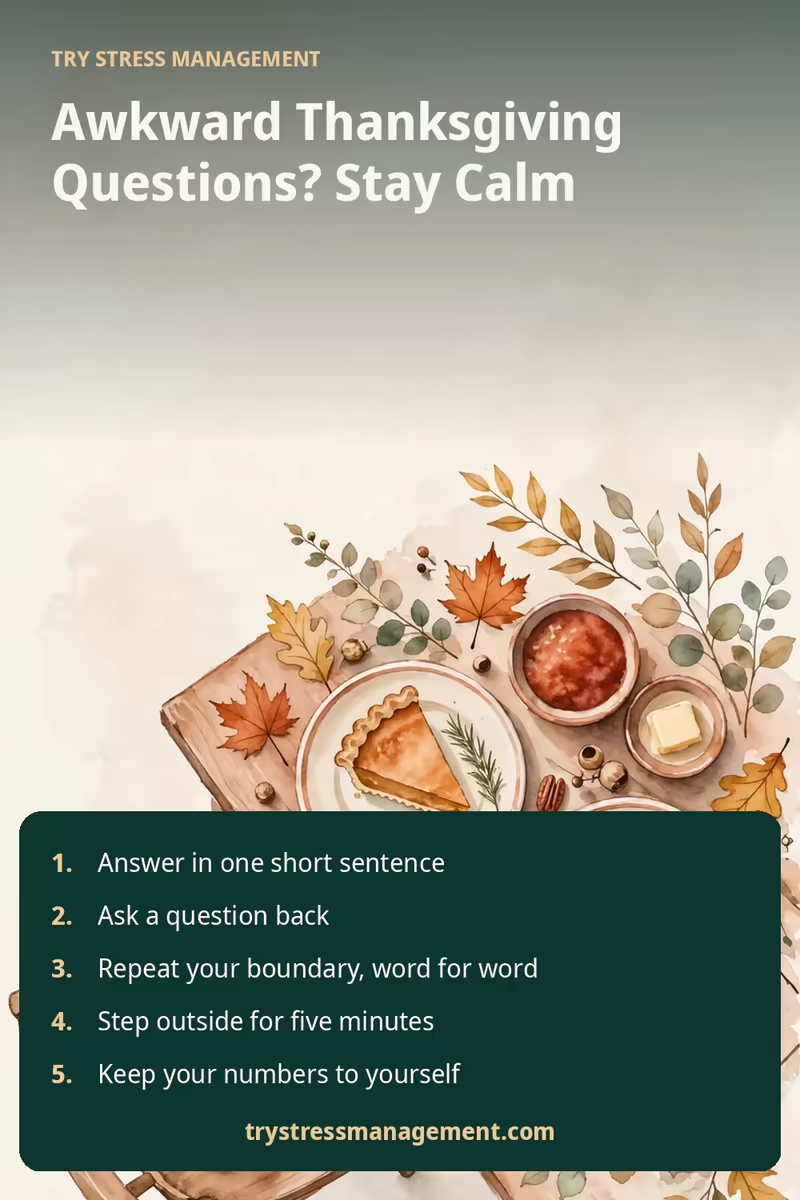
Decide your private subjects before you arrive, and pick one short script for each. Keep replies under two sentences, then turn things back with something of your own. Repeat a boundary word for word instead of building a new one under pressure. Step outside for five minutes whenever the room gets to be too much. And remember that a partial, honest reply is a complete one at a family meal: you owe your loved ones warmth, not a full report on your life.
Free printable: Sleep Better Tonight
A 10-minute evening wind-down on one page: dim lights, screens off, tomorrow’s worries onto paper, a gentle stretch, and slow breathing — the same wind-down that closes a long week. Join the free email list and the PDF arrives in your inbox. Print it and keep it by the bed.
Frequently asked questions
What gets asked most?
In the Dating.com survey reported in November 2026, 45% of respondents said the one they face most is when they are getting married or having children, ahead of work (28%) and earnings (26%).
Is it rude to refuse?
No. A short, warm refusal with a change of subject is polite by any normal standard: “That is not something I want to get into today. Tell me what you have been up to.” You control how much of your private life gets aired.
What do I say when someone keeps pushing?
Repeat your first reply in the same words, then change the subject or take a short break outside. Repeating a calm sentence is a clear boundary, and most people stop after the second hearing. If pushing continues, it is reasonable to move seats or leave earlier than planned.
How do I skip the day because of cost without hurting feelings?
Tell the host early, give the plain reason, and offer a substitute: a call on the day, a video toast, or hosting a small gathering yourself later. In the Barclays 2026 survey, 56% of US adults said they have skipped or would skip a gathering they could not afford, so a cost-based no is a common and understandable response.
Should I rehearse my lines beforehand?
A quick rehearsal helps many people. Say your two or three scripts out loud once, in the car or while you chop, so the words are familiar when you need them. Familiar words come out calmer, even when the moment itself is not calm.
This article offers general educational information about handling stressful family conversations. It is not medical advice and does not replace guidance from a qualified professional about your own situation. If holiday stress is sitting on top of persistent low mood or anxiety, talking with a qualified healthcare professional is a sound next step.

Hi, I’m Sophia! Welcome to my blog Try Stress Management (trystressmanagement.com), where I share simple, down-to-earth ways to handle stress and bring more calm into everyday life. Think of me as your friendly guide, offering practical tips, reflections, and little reminders that we’re all figuring this out together.
When I’m not blogging, you’ll usually find me with a good book, sipping tea, or exploring new walking trails. I believe small changes can make a big difference—and that a calmer, happier life is possible for everyone.